Headlines often compress the Saudi-US relationship into a single number. The White House framed a May 13, 2025 package as a Saudi commitment to invest in the United States across defense, energy, technology, infrastructure, and critical minerals. By November 18, 2025, the White House said Crown Prince Mohammed bin Salman had announced Saudi commitments in the United States would expand toward almost $1 trillion, language that signals intent rather than delivery. Global Finance Magazine also described a White House statement that the kingdom would increase an already pledged $600 billion in US investments to $1 trillion. In practice, this is not one check. It is a mix of instruments that can include commercial contracts, memoranda of understanding, future procurement pathways, and export-control authorization routes.
Execution hinges on what each instrument does. A Vision 2030 analysis frames US-Saudi investment and technology deals as a capital-and-technology bargain, with AI and chip access at the center because Saudi compute ambitions need US hardware, cloud partners, and security approvals. The same analysis warns that categories overlap but are not the same thing: deployed capital, defense procurement, AI infrastructure, export-controlled chips, commercial services, and political signaling can all appear in one announcement. That is why the practical question is which parts were announced, which are binding, and which help Vision 2030’s diversification logic. The IMF’s 2025 Article IV assessment is cited as expecting PIF and development funds to maintain Vision 2030-aligned project pipelines that support non-oil growth, reinforcing why technology transfer and service delivery matter as much as headline commitments.
From Pledge to Purchase Order: The 2026 Conversion Path
Several signposts show how Saudi-US tech and AI commitments start converting into 2026 deals. Access Partnership reported that a second U.S.-Saudi Investment Forum produced headline figures including USD 1 trillion in Saudi investment commitments to the U.S. and USD 575 billion in agreements announced overall, while noting some pledges are indicative or consolidate earlier commitments. It also highlighted HUMAIN, backed by the PIF, under a Strategic AI Partnership that signed agreements with Qualcomm and announced collaborations with NVIDIA, Microsoft, Amazon, Google, AMD, Cisco, and xAI. The same source pointed to a planned 500MW data center and U.S. approval of advanced chip exports to Saudi Arabia as a notable policy shift toward building allied AI and cloud ecosystems aligned with American standards and export-control frameworks. These are the kinds of steps that can move announcements toward deliverables.
Independent deal coverage also emphasizes AI infrastructure as the bridge between commitment and execution. SemiAnalysis wrote that the US announced a $600B deal with Saudi Arabia and, separately with the UAE, announced a 5GW data center campus led by G42 with an initial 1GW phase. SemiAnalysis also forecast north of 6 GW of operational data center capacity by 2030 and said its accelerator model shows the UAE’s G42 alone ordering hundreds of thousands of GPUs for 2026. Those figures are UAE-specific, but they illustrate the same mechanism Saudi Arabia is pursuing: turning capital and energy into compute capacity, then pairing that capacity with US hardware and security requirements. In this context, the Saudi US tech investment 2026 topic becomes less about one headline and more about approvals, campus build-outs, and supply-chain orders that can be tracked over time.
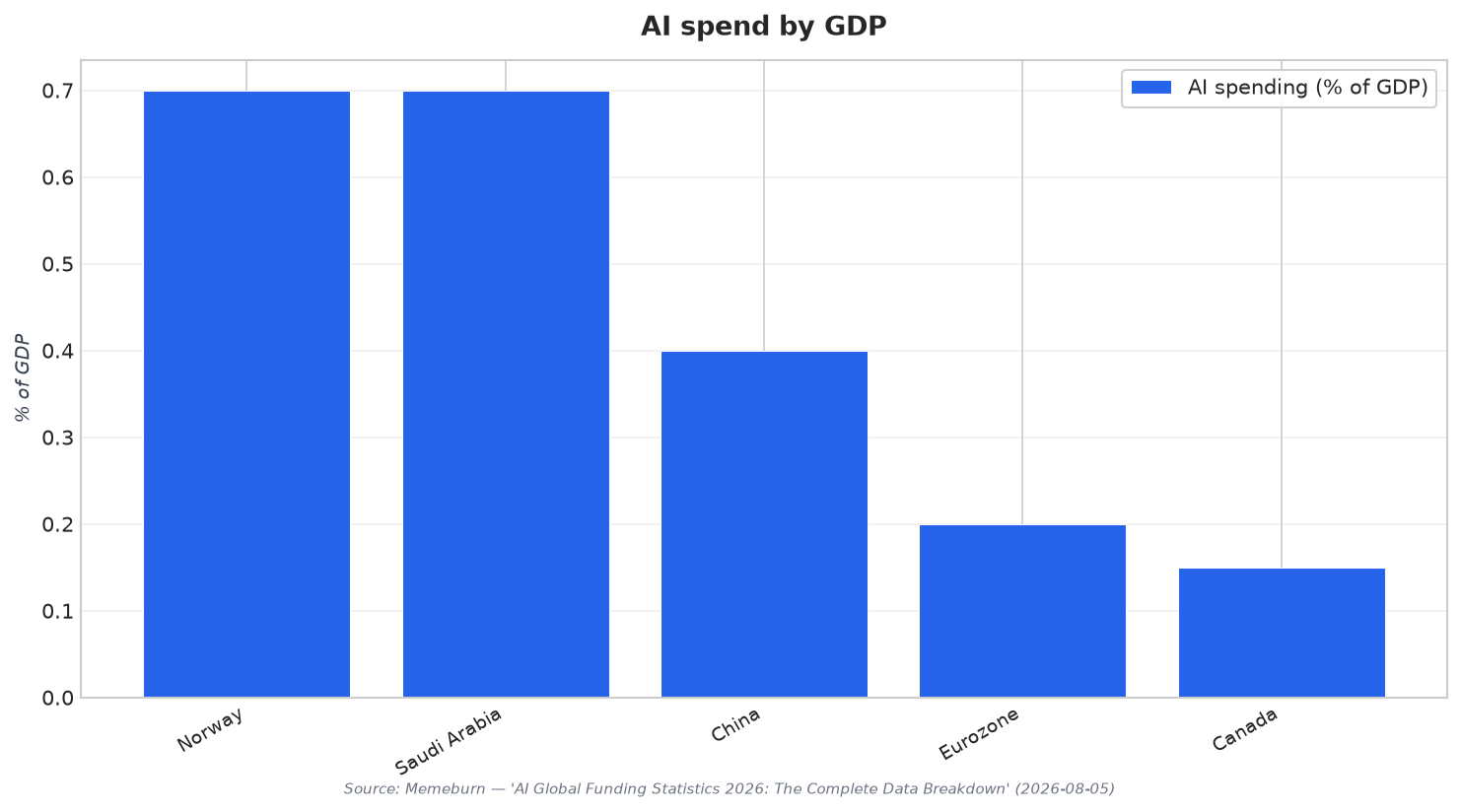
On the Saudi side, execution is visible when companies quantify value and contract scope. EnkiAI reported that Saudi Aramco had 34 US tech MoUs for AI production from 2021 to 2026, generating $5.3B in value, and it highlighted a Qualcomm edge AI industrial device deal. EnkiAI also cited a $37 million contract with Saudi Solutions in March 2026 to enhance computing capabilities as part of a wider digital transformation program, and described 2025 onward as a period when Aramco began publicly reporting financial returns from technology investments. Meanwhile, Memeburn’s 2026 data roundup placed Saudi Arabia in a global context, stating that Norway and Saudi Arabia follow at roughly 0.7% of GDP in the referenced comparison, and that Saudi Arabia launched the $100 billion Project Transcendence initiative. Those global and national figures frame why converting pledges into deliverables is the main credibility test in 2026.
What did the White House say about Saudi investment commitments in 2025?
How did the U.S.-Saudi Investment Forum describe the scale of announcements?
What deal elements show how Saudi-US AI commitments can turn into 2026 delivery?
What is a concrete 2026 contract example tied to Saudi digital and AI execution?
What should readers track in the Saudi-US tech investment 2026 story besides headline pledges?
Talk to us for your needs in:
-
Due Diligence and Valuation Services
-
M&A Strategy and Advisory
-
Post-Merger Integration Management
-
Regulatory and Compliance Advisory
-
Market Entry and Expansion Consulting
-
Investment and Financial Analysis
-
In-Depth Market Survey for M&A
-
Market Intelligence and Insights in M&A
-
Feasibility Study and Assessment in M&A
-
Saudi M&A Benchmarking