In Saudi Arabia, the logic behind consolidation and vertical deals is rooted in project execution. Multiple market sources describe steady demand visibility driven by long-term capital expenditure rather than short cycles. Structural steel alone is described as a large and growing pool: one report values Saudi Arabia’s structural steel market at USD 3.6 billion in 2025 and projects USD 6.1 billion by 2033 at a 6.8% CAGR. Another track of demand comes from fabrication, where the structural steel fabrication market is valued at USD 2.65 billion in 2025 and is estimated to grow from USD 2.81 billion in 2026 to USD 3.71 billion by 2031 at a 5.77% CAGR. In that backdrop, consolidation tends to reward players that can deliver reliably across engineering, procurement, fabrication, and site schedules.
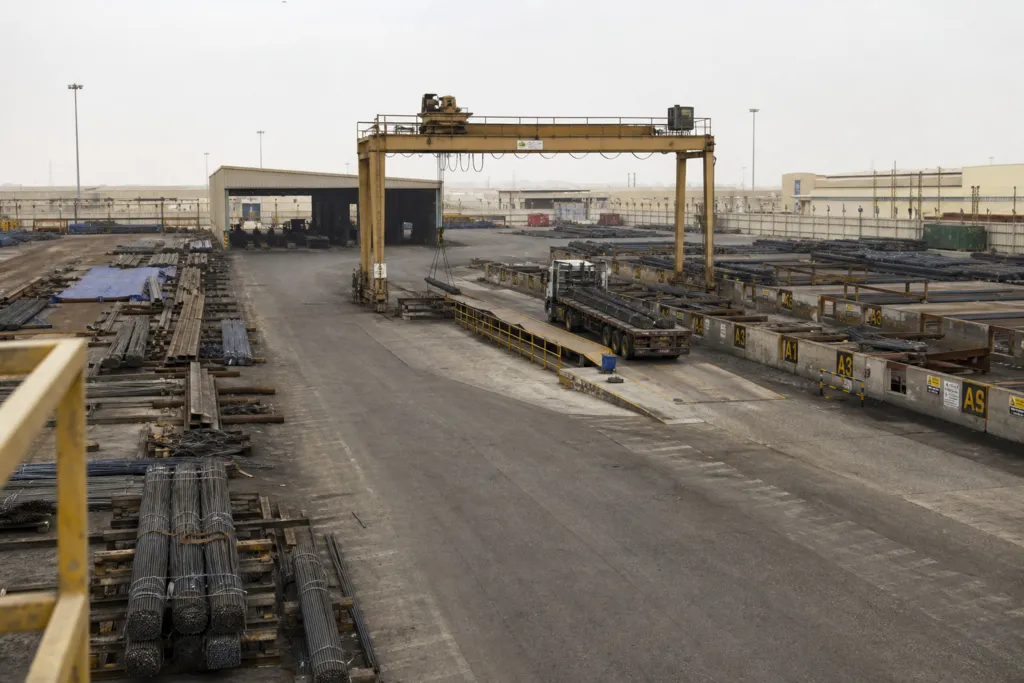
Different segments show different shapes of competition. In rebar, one report describes a semi-consolidated market, with large integrated producers alongside smaller rolling mills. It lists Saudi Iron & Steel Company (Hadeed), Rajhi Steel, Al Ittefaq Steel Products Company, Zamil Steel, and Al Yamamah Steel Industries as key players, and highlights that Hadeed is backed by SABIC and benefits from vertical integration and scale for cost efficiency and consistent supply. Rebar demand is framed as project-led and linked to government capital expenditure under Vision 2030. The same source states the government has committed over USD 1 trillion in project investments, with a significant portion allocated to transport, housing, tourism, and industrial infrastructure—conditions that can elevate the value of stable supply and downstream control.
Why Vertical Integration Keeps Winning Bids
Vertical integration also aligns with how fabrication shops are being pushed to deliver faster and prove local value. In structural steel fabrication, heavy sections led with 38% of market size in 2025, while oil & gas held 32.1% of end-user share. The same report says power & energy is projected to grow at an 8.4% CAGR through 2031, and custom-built modules & skids are projected to expand at a 7.11% CAGR through 2031. It adds that fabricators are shifting toward BIM-enabled modular construction and investing in robotic welding and precision laser-cutting to meet compressed delivery windows and stringent In-Kingdom Total Value Add (IKTVA) quotas. These requirements can make vertical deals attractive when they connect design, testing, fabrication, and procurement into one accountable chain.
Demand concentration also influences consolidation. The Eastern Province captured 36.88% of Saudi Arabia’s structural steel fabrication market size in 2025, while Riyadh Province is projected to expand at a 7.01% CAGR through 2031. The report attributes the Eastern Province’s strength to Jubail’s petrochemical corridor and notes Riyadh’s momentum in entertainment, cultural, and transport builds. It also cites a 15 gigawatt renewables pipeline as part of what keeps workshop utilization high. Procurement intensity can be huge on specific packages, too: the same source notes that metro extensions alone will need more than 100,000 tonnes of beams and plate-worked girders for viaducts and stations, and it references a USD 9.9 billion allocation to NEOM infrastructure through 2026. In this context, Saudi steel industry M&A can be less about “getting bigger” and more about controlling bottlenecks that can delay delivery.
There is also a standards and supplier-qualification angle that can shape who becomes an acquisition target. One prefabricated building and structural steel report values that market at $4.8 billion in 2026 and projects $9.52 billion by 2035, advancing at a 7.90% CAGR. It describes a consolidation phase that favors design-build specialists with BIM-to-fabrication integration, and notes that SASO quality conformity assessments help dictate pricing tiers. It adds that Ministry of Housing contractors are consolidating purchase volumes toward pre-qualified suppliers, which can amplify the payoff from vertical deals that bring in-house testing, compliance capabilities, and delivery capacity under one roof.
What signals that consolidation is underway in Saudi Arabia’s steel value chain?
How does vertical integration show up in Saudi rebar competition?
Which end-use sectors matter most for fabrication demand?
How do Vision 2030 project packages influence deal-making in the Saudi steel industry?
What should buyers look for when evaluating Saudi steel industry M&A opportunities?
Talk to us for your needs in:
-
Due Diligence and Valuation Services
-
M&A Strategy and Advisory
-
Post-Merger Integration Management
-
Regulatory and Compliance Advisory
-
Market Entry and Expansion Consulting
-
Investment and Financial Analysis
-
In-Depth Market Survey for M&A
-
Market Intelligence and Insights in M&A
-
Feasibility Study and Assessment in M&A
-
Saudi M&A Benchmarking