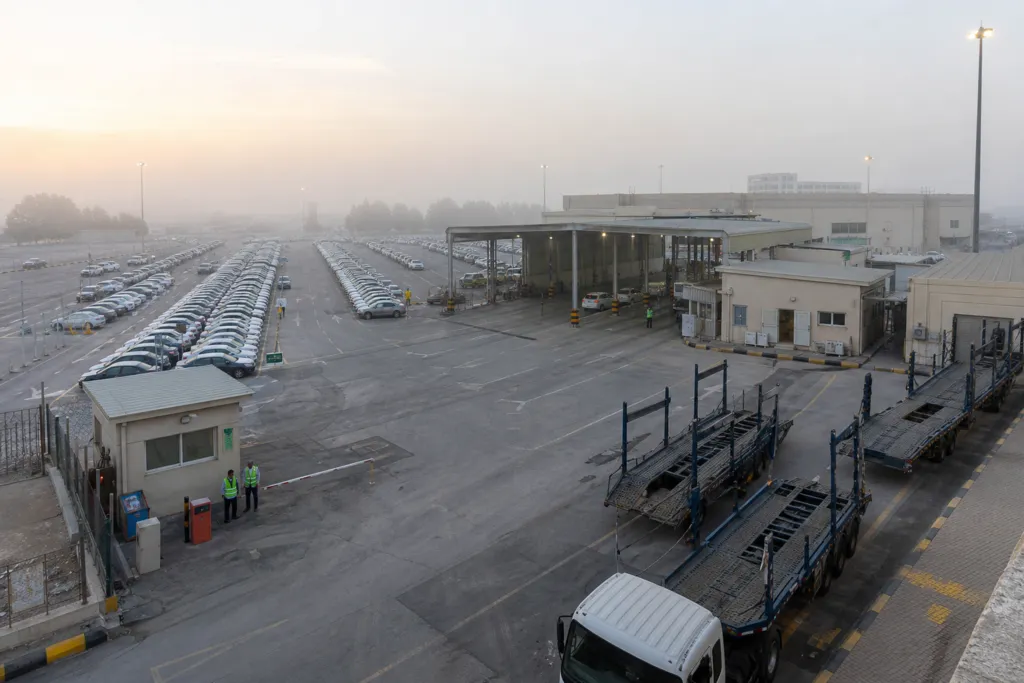
Saudi Arabia’s auto market is in a period of fast change, and the distribution layer is feeling it first. In 2026, Focus2move reported sales were down 20.3% year-to-date through July 2026, while Chinese brands were “increasingly gaining share” as traditional leaders declined. Another data point shows how choppy demand can be: ArabWheels reported Saudi car sales fell 21.9% in April 2026. At the same time, Autopunditz reported the market grew 6.2% in H1 2026 and said Toyota remained the leader while MG, Haval, Jetour, and Changan drove the rise of Chinese brands. In practice, distributors are having to plan for growth and contraction signals at once.
This is the context in which names like Chery and groups like Almajdouie become part of a broader story: the Chinese brand wave is forcing distribution strategies to evolve. Focus2move called out BYD as the “most disruptive development,” with an expansion of +368.6%. But the same source also described a mixed picture across Chinese brands, noting Jetour and Haval were growing strongly while Changan (-17.1%), MG (-21.9%), and Geely (-69.0%) were declining. That split matters for distributors because it changes how they prioritize showroom space, inventory, aftersales investment, and the balance between incumbents and challengers across their portfolios.
Why Distribution Strategy Is Shifting in 2026
The market’s structure is also changing in ways that reward scale and sharper channel execution. Mordor Intelligence valued the Saudi Arabia automobile market at USD 47.46 billion in 2025 and estimated USD 50.33 billion in 2026, with a forecast to reach USD 67.55 billion by 2031 at a CAGR of 6.05% (2026–2031). In that same report, OEM dealers held a 60.60% share of the sales channel in 2025, while online platforms were projected to grow at a 6.18% CAGR to 2031. Passenger cars held a 76.55% share in 2025, and internal combustion engines commanded 86.35% share, which helps explain why distributors must manage both legacy volume and emerging formats at the same time.
Electrification adds another planning layer, but the sources suggest it is still early in the Saudi sales mix. Focus2move said EV adoption remains at an early stage and accounted for 4.8% of total industry sales in 2026. Mordor Intelligence also framed a transition, projecting electric vehicles to record a 6.32% CAGR to 2031, and highlighted localized production commitments from Lucid and Ceer as part of a broader shift. For distributors, that can mean making near-term money on high-volume internal-combustion segments while preparing service networks, training, and product education for a gradually expanding EV customer base.
In the middle of these changes, attention to Saudi automotive distribution M&A is less about deal headlines and more about operational resilience. Statista described Saudi Arabia as the largest automotive market in the MENA region and said it accounts for almost half of the region’s car sales, with over 700,000 new vehicles registered annually. Statista also noted the Kingdom aims to produce 300,000 cars annually by 2030 and is working with OEMs, with initiatives such as tax incentives and infrastructure support. Combined with the brand polarization described by Focus2move and the channel and growth forecasts from Mordor Intelligence, distribution groups increasingly need stronger coverage, better economics, and the flexibility to manage winners and laggards across fast-shifting brand lineups.
What do the 2026 sources say about Saudi auto sales momentum?
Which Chinese brands were highlighted as rising or falling in Saudi Arabia?
How big is the EV share in Saudi Arabia according to the sources?
What does Mordor Intelligence say about Saudi sales channels and online growth?
How is Saudi automotive distribution M&A linked to the Chinese brand wave?
Talk to us for your needs in:
-
Due Diligence and Valuation Services
-
M&A Strategy and Advisory
-
Post-Merger Integration Management
-
Regulatory and Compliance Advisory
-
Market Entry and Expansion Consulting
-
Investment and Financial Analysis
-
In-Depth Market Survey for M&A
-
Market Intelligence and Insights in M&A
-
Feasibility Study and Assessment in M&A
-
Saudi M&A Benchmarking