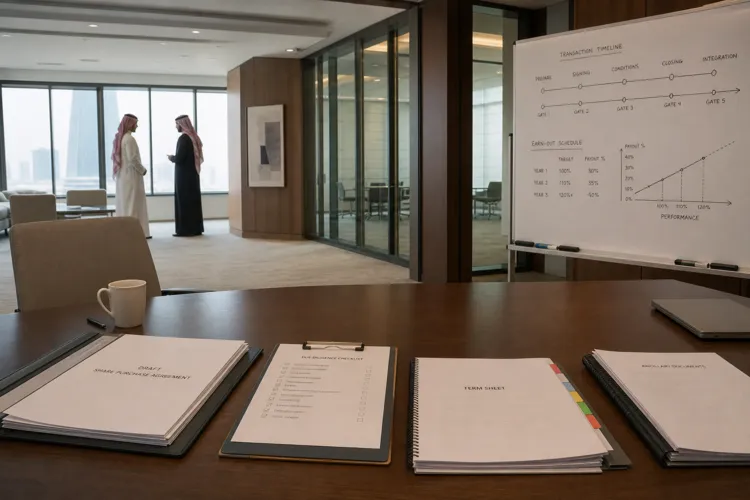
An extension “to 2027” changes how stakeholders read risk. In the Rimath Hospitality Thannah deal, the key signal is not a single metric, but the fact that time itself becomes part of the transaction’s operating reality. Across Saudi Arabia, multiple markets are showing why timelines matter: procurement sequencing, delivery capacity, and counterparties needing clarity before they commit. When deadlines shift, it can indicate that approvals, financing, or delivery dependencies are being re-ordered rather than cancelled. That distinction matters for execution planning because a delayed milestone can still preserve intent while increasing exposure to external shocks and internal bandwidth limits.
One way to ground that interpretation is to look at how Saudi deal activity is described in 2026. In Q1 2026, Saudi Arabia recorded 24 mergers and acquisitions worth $689 million, representing a 4% annual increase in deal volume, according to Ansarada’s Middle East M&A Market Analysis report coverage. In the wider Middle East, the same reporting cited 196 announced deals in Q1 2026 with a combined value of $23.3 billion, versus 207 pacts worth $31.3 billion a year earlier. The contrast suggests that even when the regional backdrop shows softer totals, Saudi deal count can rise, while timelines and conditions still remain sensitive to uncertainty.
Why 2027 Deadlines Keep Colliding With Planning Visibility
Execution risk often appears first as a visibility problem. In crude markets, Bloomberg-reported negotiations cited by IndexBox describe Saudi Arabia and Asian refiners clashing over fixed-volume term supplies for 2027, with only days remaining to settle volumes. The dispute centered on whether spot purchases should be counted toward term supply when sellers could not deliver contractual cargoes, and it reportedly slowed Asian purchases of November-loading crude. The same account explains why timing matters: Asian refiners typically order November 2026 spot cargoes that would load in January 2027, and without clarity on term supply, they have “very little visibility” on spot purchases. That is the same structural issue a 2027 extension can highlight in a corporate deal: counterparties hesitate when sequencing is unclear.
Capacity constraints and delivery risk are also being described directly in Saudi Arabia’s projects market. MEED’s Saudi Arabia Projects Market Report 2026 puts the total project pipeline at $2.14tn, including $1.72tn that is planned and unawarded. It also reports $75.5bn in project awards during the first eight months of 2026, while noting the number of projects awarded fell and there is more focus on larger-value awards. MEED adds that developers are responding to cost inflation, supply chain pressure, limited execution capacity, and growing project complexity. For a hospitality-linked transaction like the Rimath Hospitality Thannah deal, that context frames why an extended deadline can reflect delivery realities around procurement strategy, contractor availability, and the order in which projects reach market.
Construction reporting reinforces how execution risk is tracked through awards and pipelines rather than headline ambition alone. GlobalData cites the Saudi Contractors Authority (SCA) as stating there were 97 project awards between January and July 2026, with a combined value of SAR111.3 billion ($29.7 billion), compared with 84 awards worth SAR70.1 billion ($18.7 billion) in January to July 2025. GlobalData also states the construction industry is expected to grow by 1.8% in real terms in 2026 and to register annual average growth of 4.4% between 2027 and 2030. Read together, a 2027 extension can be interpreted as a response to an environment where activity exists, but sequencing, delivery capacity, and procurement timing increasingly determine whether a deal closes cleanly or needs more time.
What does extending the Rimath Hospitality Thannah deal deadline to 2027 suggest about execution risk?
What do Saudi Arabia’s 2026 M&A figures imply about deal timelines?
How do 2027 term-deal negotiations in crude markets relate to corporate deal execution?
What projects-market facts point to delivery risk in Saudi Arabia?
What do recent project award figures show about the operating environment for execution?
Talk to us for your needs in:
-
Due Diligence and Valuation Services
-
M&A Strategy and Advisory
-
Post-Merger Integration Management
-
Regulatory and Compliance Advisory
-
Market Entry and Expansion Consulting
-
Investment and Financial Analysis
-
In-Depth Market Survey for M&A
-
Market Intelligence and Insights in M&A
-
Feasibility Study and Assessment in M&A
-
Saudi M&A Benchmarking