The best market entry strategy Saudi Arabia offers depends on how much investment, control, speed and local knowledge a company needs. Exporting is the low-cost starting point, joint ventures provide local capabilities, M&A is the fastest route with high control, and greenfield investment gives full independence at the highest initial commitment.
As Saudi Arabia advances its Vision 2030 diversification agenda, international companies face growing opportunities alongside distinct regulatory and operational considerations. According to the guide, G20 nations contributed 32% of Saudi Arabia's FDI stock in 2022, with the United States leading at 10% and the United Kingdom following at 8%.
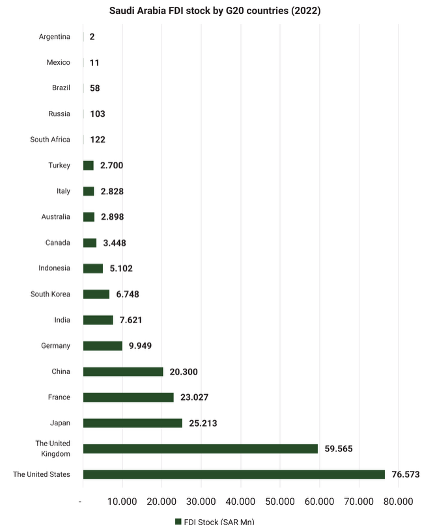
Figure 1: Saudi Arabia FDI Stock by G20 Countries, 2022 (SAR Mn). Source: The CEO Guide to KSA, Eurogroup Consulting (p. 27).
Eurogroup Consulting's The CEO Guide to KSA: Saudi Arabia Reimagined, Are You Ready? examines these entry routes through practical company examples, highlighting why successful expansion requires more than selecting an attractive sector.
What Are the Main Ways to Enter the Saudi Market?
Foreign companies entering Saudi Arabia can pursue four principal approaches: exporting, establishing a joint venture, acquiring an existing business, or developing their own operations. Each offers a different balance between financial exposure, operational control, and reliance on local expertise.
Exporting through distributors or agents generally requires less capital because businesses can serve Saudi customers without immediately establishing extensive local operations. However, commercial success depends heavily on the distributor's capabilities and market relationships.
Joint ventures allow international companies to combine their technical or commercial expertise with local knowledge. Mergers and acquisitions (M&A) may offer access to existing operations, customers, and organizational capabilities, although transaction costs and integration risks require careful assessment. Greenfield investments involve establishing operations from the ground up, offering substantial control but demanding greater capital, management resources, and preparation.
The CEO Guide to KSA provides the following qualitative comparison:
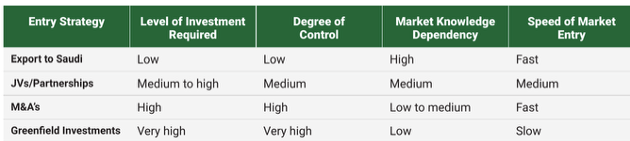
Figure 2: Understanding Entry Strategies. Source: The CEO Guide to KSA, Eurogroup Consulting (p. 83).
Actual investment requirements and implementation timelines depend on the industry, company structure, regulatory conditions, and strategic objectives.
When Does M&A Offer a Faster Path Into Saudi Arabia?
M&A can be attractive when international companies seek immediate access to an established operating platform rather than developing capabilities independently. However, faster entry does not necessarily mean lower risk. Acquirers must assess financial performance, contractual obligations, regulatory compliance, cultural compatibility, and the feasibility of integrating operations.
The CEO Guide examines AccorHotels' relationship with Saudi Arabia's Kingdom Holding Company (KHC). In 2015, KHC finalized a US$3.2 billion transaction involving AccorHotels and the Fairmont Raffles platform, resulting in KHC holding a 5.8% stake in AccorHotels.
Importantly, this was not Accor acquiring a Saudi company. The transaction illustrates how cross-border corporate consolidation and strategic shareholder relationships can strengthen a company's international development platform.
According to the guide, Accor operated 42 hotels in Saudi Arabia in 2023 and had announced plans to exceed 90 properties by 2027. These figures represent the company's historical portfolio and announced expansion ambitions, not verified 2026 operating totals.
For companies considering acquisitions, the strategic question is whether an established business can provide capabilities that would otherwise take considerable time to develop. This approach highlights how acquisitions can accelerate market entry by providing access to existing operations, customers, and local capabilities.
When Is a Joint Venture the Right Choice in Saudi Arabia?
A partnership can provide access to distribution networks, established commercial relationships, and local operational knowledge while allowing companies to share investment responsibilities.
Roche demonstrates how market-entry strategies can evolve as a company develops its understanding of Saudi Arabia. The Swiss pharmaceutical company initially entered the Kingdom through local distributors during the 1980s.
In April 2018, Roche signed a memorandum of understanding with Saudi Pharmaceutical Industries & Medical Appliances Corporation (SPIMACO) to support localized pharmaceutical production. The agreement covered products associated with approximately SAR 100 million in annual sales, according to the guide. Later in September 2018, Roche obtained a license through the Saudi Arabian General Investment Authority for a diagnostics joint venture with a local partner.
This example demonstrates how international companies can gradually develop their market presence through distribution agreements, local production, and strategic partnerships.
Julien Pescheux, former Executive Vice President of Saudi Airlines Catering Company, emphasizes the importance of partner value in the guide:
"Finding a local partner would be a privilege if they are providing you with a strategic value"
A local partner should contribute capabilities that strengthen competitiveness, rather than simply fulfilling a perceived market-entry requirement. Foreign ownership regulations have also evolved, with the guide describing opportunities for full foreign ownership in certain sectors. Companies should verify the applicable legal framework before determining whether a joint venture is necessary or commercially advantageous.
Is Greenfield Investment Worth the Higher Commitment?
For companies seeking complete control over operational standards, brand experience, and long-term development, greenfield investment offers a different proposition.
IKEA provides an example of this approach in Saudi Arabia. The Swedish home furnishings retailer opened its first store in Jeddah in 1983, establishing a physical presence through greenfield investment, and later developed retail operations adapted to Saudi customers while retaining control over its brand and operating model.
However, the guide also highlights the importance of cultural adaptation. IKEA faced criticism in 2012 over alterations to its Saudi catalogue, demonstrating how localization decisions can create tensions between international brand identity and local market expectations.
Given the higher initial commitment, market feasibility, demand assessment, and implementation planning are particularly important.
Building a Market Entry Strategy Saudi Arabia Can Support Long Term
Businesses seeking to test demand may initially favor exporting. Those requiring local expertise might consider partnerships, while companies prioritizing speed and operational control may evaluate acquisitions. Greenfield investment may be more appropriate where long-term independence and operational consistency outweigh the advantages of acquiring an established platform.
Before committing, executive teams should assess:
- Market attractiveness: Customer demand, competition, pricing, and sector development.
- Investment requirements: Initial capital, financing, operating expenditure, and expected returns.
- Regulatory exposure: Foreign ownership rules, approvals, employment requirements, and compliance obligations.
- Partner or acquisition suitability: Strategic fit, organizational capabilities, and potential integration challenges.
- Execution readiness: Management capacity, supply chains, talent availability, and realistic implementation timelines.
For businesses evaluating their options, Market Entry and Expansion Consulting can support market assessment, target identification, feasibility analysis, and strategic planning. To discuss your plans, contact our team.
Frequently Asked Questions
What is the fastest way to enter the Saudi Arabian market?
Exporting through an established local distributor and acquiring an existing business are both rated as relatively fast entry routes in Eurogroup Consulting's CEO Guide to KSA. Exporting requires less investment but offers limited control over sales and branding. M&A provides much greater control and immediate access to operations and customers, but it demands a significantly larger financial commitment.
Do foreign companies need a Saudi partner?
Not always. According to the CEO Guide, a local partner is often required depending on the sector, but recent reforms now allow 100% foreign ownership in certain sectors. Even where a partner is not mandatory, a joint venture can still add value through local market knowledge, distribution networks and relationships. Companies should verify the rules that apply to their activity.
What are the main risks of M&A in Saudi Arabia?
The main risks include inaccurate valuations, undisclosed liabilities, regulatory uncertainty, cultural differences and difficult post-merger integration. The CEO Guide stresses that thorough due diligence and a clear understanding of local regulations and market dynamics are essential. Buyers should assess financial, legal, commercial and operational aspects of the target before committing to a transaction.
What is a greenfield investment?
A greenfield investment means building a fully owned operation in Saudi Arabia from scratch, including facilities, staff, systems and supplier relationships. It offers the highest level of control over brand, quality and operating standards, but it is also the slowest and most capital-intensive entry route. IKEA's first store in Jeddah in 1983 is the guide's example.
Which companies have entered Saudi Arabia successfully?
The CEO Guide to KSA uses three case studies to illustrate different entry routes. Roche started by exporting through local agents before moving into local production and a diagnostics joint venture. IKEA entered through greenfield investment, opening in Jeddah in 1983. Accor's international platform was strengthened through its 2015 transaction with Kingdom Holding Company.
Planning Your Market Entry Into Saudi Arabia?
For executives weighing their options, Eurogroup Consulting's comprehensive CEO Guide provides detailed market-entry frameworks, regulatory considerations, sector opportunities, and company case studies to support informed strategic decisions.
Talk to us for your needs in:
-
Due Diligence and Valuation Services
-
M&A Strategy and Advisory
-
Post-Merger Integration Management
-
Regulatory and Compliance Advisory
-
Market Entry and Expansion Consulting
-
Investment and Financial Analysis
-
In-Depth Market Survey for M&A
-
Market Intelligence and Insights in M&A
-
Feasibility Study and Assessment in M&A
-
Saudi M&A Benchmarking