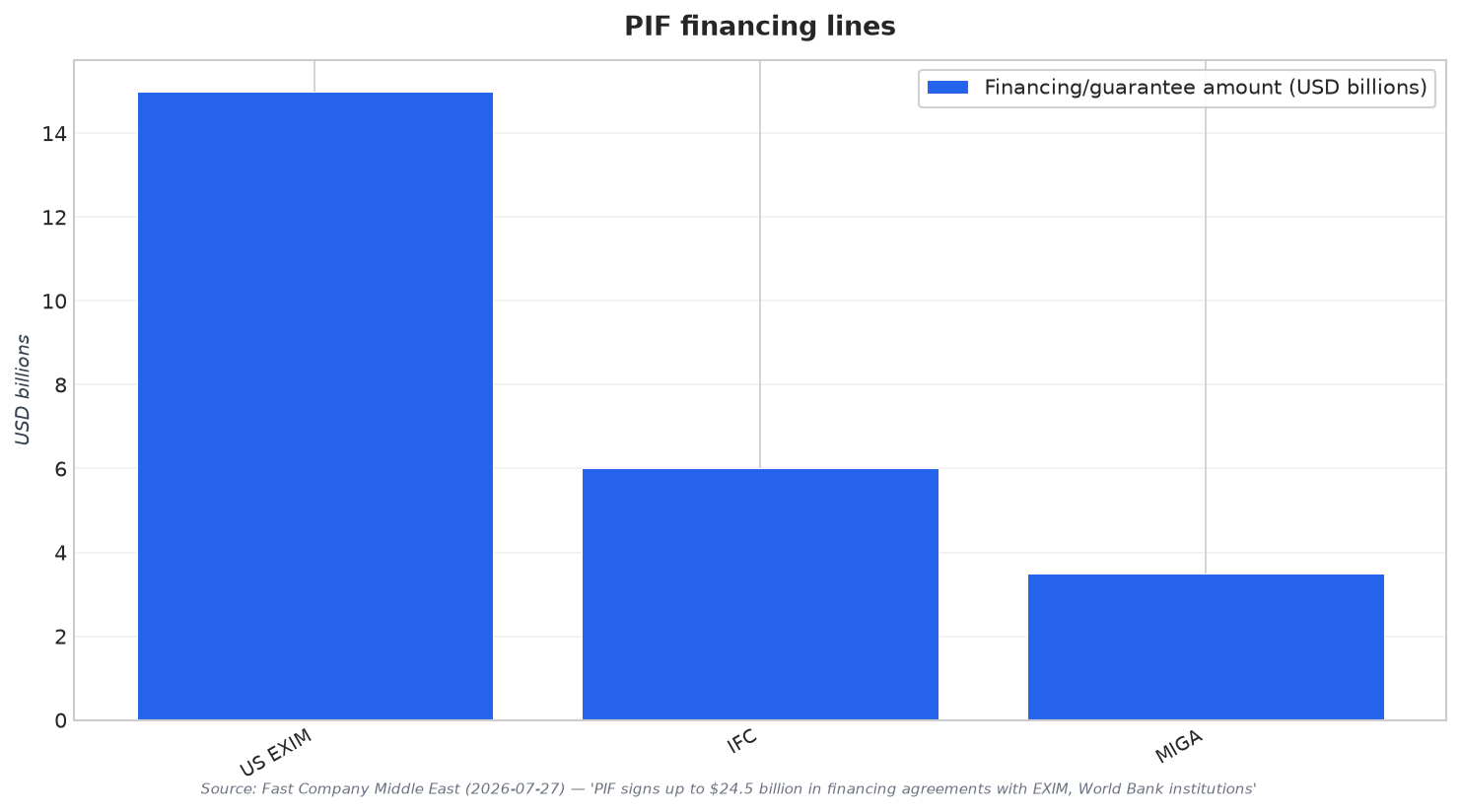
Saudi Arabia’s Public Investment Fund (PIF) signed three financing memorandums of understanding that together open up to $24.5 billion, according to multiple reports. The package includes a framework with the Export-Import Bank of the United States (EXIM) for up to $15 billion in long-term financing, plus separate memorandums with the International Finance Corporation (IFC) for up to $6 billion and the Multilateral Investment Guarantee Agency (MIGA) for up to $3.5 billion. The stated purpose is to expand investment opportunities and support economic development in Saudi Arabia and other emerging markets, while also diversifying PIF’s funding sources and strengthening partnerships with international financial institutions.
For portfolio-company acquisitions, the most direct link is how the EXIM framework is described. The EXIM memorandum establishes a route for eligible PIF portfolio companies to procure U.S.-origin goods and services. That matters when an acquisition thesis relies on importing equipment, technology, or services as part of integration, expansion, or modernization. The parties said they will explore opportunities across advanced technology, aerospace, infrastructure, future mobility, water security, and critical minerals. In practice, that turns deal execution into something financeable: the acquisition can be paired with financed procurement, aligning capex needs with the acquisition plan.
Where IFC and MIGA Fit Into Acquisition Execution
The IFC and MIGA memorandums broaden the toolkit beyond procurement. IFC’s agreement focuses on exploring potential co-financing opportunities across infrastructure, energy, transportation, tourism, and healthcare. It also supports knowledge sharing and encourages greater private-sector participation in projects developed by PIF portfolio companies. Meanwhile, MIGA’s memorandum explores credit enhancement guarantees to facilitate financing for PIF portfolio companies investing across the Middle East and North Africa, with priority areas including decarbonization, innovative industries, and high-value job creation. For acquisitions, co-financing and credit enhancement can support larger transaction scopes, especially when post-deal buildout requires multiple funding sources.
In parallel, PIF has positioned the United States as a major procurement market. PIF said the U.S. is its largest international market, with the fund and its portfolio companies procuring $65 billion in U.S. goods and services since 2017. PIF estimates this activity contributed $35 billion to U.S. gross domestic product. This context helps explain why PIF US EXIM financing is structured around U.S.-origin goods and services: it aligns with an established procurement footprint and a stated goal of strengthening supply chains, while supporting industrial and digital innovation across the targeted sectors.
These agreements also land in a broader Saudi operating backdrop where project activity is large and competitive, which can drive acquisition-led strategies. The Saudi Contractors Authority said 1,648 foreign contracting companies have entered the Saudi market, and around 140,000 local and foreign contracting firms are registered. It expects project values to exceed SR3 trillion ($800 billion) over the next three years, driven by Expo 2030 Riyadh and the 2034 FIFA World Cup. When a portfolio company acquires capabilities to win work in such a pipeline, procurement-backed financing and credit enhancement can become important tools for scaling delivery capacity and integrating assets efficiently.
What did PIF sign with EXIM, IFC, and MIGA, and for how much?
How can PIF’s US EXIM financing support portfolio-company acquisitions?
Which sectors are referenced under the EXIM framework?
What roles do IFC and MIGA play in these memorandums?
What did PIF say about its procurement ties to the United States?
Talk to us for your needs in:
-
Due Diligence and Valuation Services
-
M&A Strategy and Advisory
-
Post-Merger Integration Management
-
Regulatory and Compliance Advisory
-
Market Entry and Expansion Consulting
-
Investment and Financial Analysis
-
In-Depth Market Survey for M&A
-
Market Intelligence and Insights in M&A
-
Feasibility Study and Assessment in M&A
-
Saudi M&A Benchmarking