

Tax structuring for Saudi acquisitions starts with the Kingdom’s dual regime. Zakat applies to Saudi and GCC shareholders, and corporate income tax (CIT) applies to foreign shareholders or the foreign portion in mixed-ownership companies. Sources describe this split as fundamental, because mixed-ownership structures can be subject to both regimes at the same time, based on ownership percentages. The Zakat, Tax and Customs Authority (ZATCA) administers filings electronically through its portal. Compliance can matter beyond tax, because filings are tied to operational requirements such as renewals and eligibility for government processes.
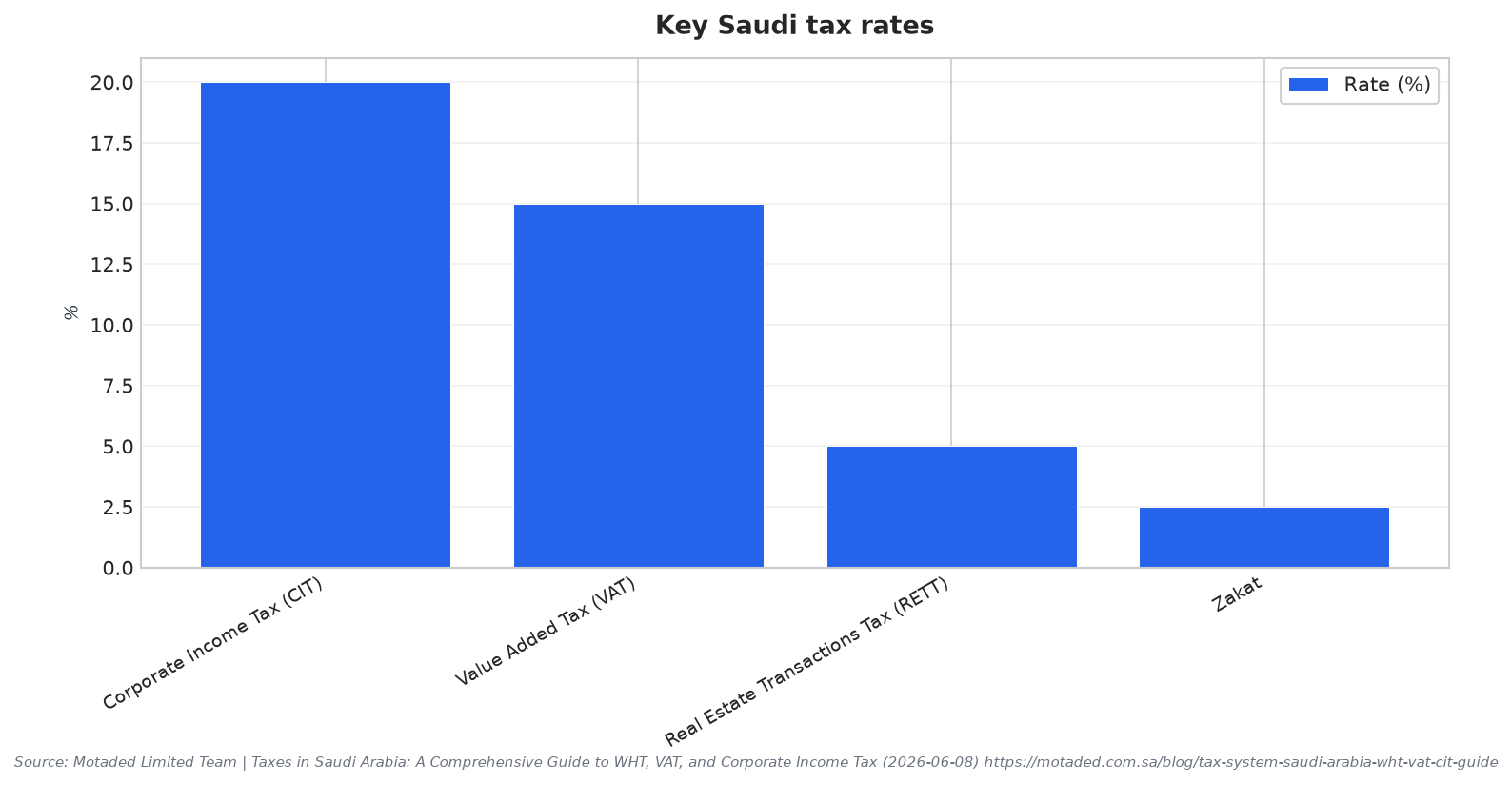
RETT is a frequent trigger in acquisition planning when the transaction includes Saudi real estate, or when the target holds real property that will be disposed of. Saudi Arabia has levied a 5% Real Estate Transaction Tax on property disposals since October 2020, and sources state RETT equals 5% of the property transfer value. The tax is calculated on the agreed sale price or the fair market value, whichever is higher. Sellers must register the transaction through ZATCA’s RETT portal and pay before the transfer can be recorded with the notary. Sources also note exemptions may apply, including inheritance, certain family gifts (up to the third degree), and contributions of property to a company in exchange for shares.
Withholding and Zakat/CIT: Align Payment Flows and Ownership
Withholding tax planning is central where the acquisition model includes payments to non-residents after closing. Sources state that payments made by Saudi-resident entities to non-residents are typically subject to WHT at source, and the Saudi payer is responsible for deduction and remittance. Rate examples in the sources include 5% on dividends, 5% on interest, 15% on royalties, 15% on technical and consulting fees, and 5% on rent and insurance premiums. Another source also highlights 15% for royalties and management fees as a “standard” benchmark. Operationally, WHT is due within the first 10 days of the following month, so transaction documents and treasury processes should support timely deductions and reporting.
Zakat and CIT shape post-deal effective tax outcomes and should be reflected in valuation and governance. Sources state Zakat is 2.5% and is applied to Saudi or GCC shareholders in commercial activities, while CIT is 20% of net profit for foreign companies operating in the Kingdom or the foreign shareholder’s portion in mixed-ownership companies. Annual Zakat/CIT returns are due within 120 days of fiscal year end. One source adds that Zakat is levied on the higher of two figures, designed so that profitable companies cannot reduce the obligation through balance-sheet structuring alone. In practical structuring, this means ownership mapping, shareholder classification, and audit-ready accounts become part of the deal plan, not only a year-end compliance task.
A 2026 Saudi acquisition checklist should connect RETT, WHT, and Zakat/CIT into one closing and integration workstream. If real estate is being disposed of, confirm whether RETT applies at 5% and who registers and pays through ZATCA’s portal before notarization. If cross-border payments will be made, confirm WHT treatment and build deduction-and-remittance steps into finance operations, mindful of the first-10-days deadline. For shareholder tax, document the Saudi/GCC versus foreign split so Zakat at 2.5% and CIT at 20% are applied to the right portions, and plan annual filings within 120 days. This approach supports Saudi M&A tax structuring for 2026 without relying on assumptions that can break at signing or during integration.
When does RETT apply in a Saudi acquisition, and what is the rate?
What withholding tax rates commonly affect post-closing payments to non-residents?
How do Zakat and CIT apply in mixed-ownership structures?
What key filing deadlines should deal teams build into integration plans?
How should teams approach Saudi M&A tax structuring for 2026 in practice?
Talk to us for your needs in:
-
Due Diligence and Valuation Services
-
M&A Strategy and Advisory
-
Post-Merger Integration Management
-
Regulatory and Compliance Advisory
-
Market Entry and Expansion Consulting
-
Investment and Financial Analysis
-
In-Depth Market Survey for M&A
-
Market Intelligence and Insights in M&A
-
Feasibility Study and Assessment in M&A
-
Saudi M&A Benchmarking