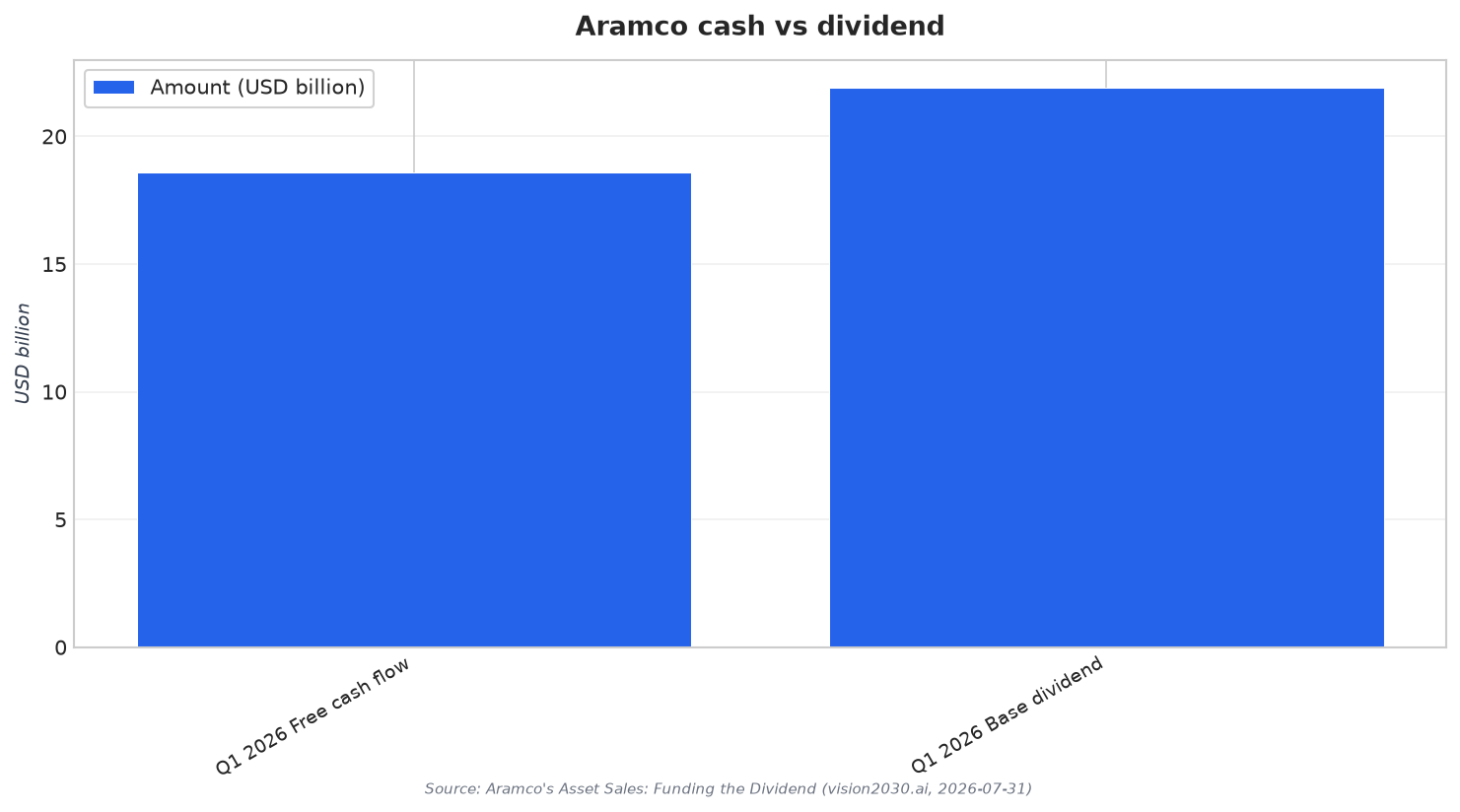
Saudi corporate carve-outs 2026 sit inside a broader shift in how capital is raised and recycled across the Kingdom’s most important balance sheets. Aramco’s dividend expectations and PIF’s evolving allocation priorities are pulling asset sales and portfolio actions into the center of dealmaking. In Q1 2026, Aramco’s free cash flow was $18.6 billion while it declared a $21.9 billion base dividend, and its FCF-to-dividend ratio was cited at 0.85x—context that frames why liquidity, borrowing, and monetisation matter. In parallel, PIF is also using capital markets: a $7 billion bond issuance in May 2026 was reported as evidence that borrowing is already part of the funding toolkit.
Aramco’s monetisation programme provides a concrete ledger of assets being turned into cash, and that behaviour can feed future deal flow. As of July 2026, three completed midstream transactions since 2021 total $38.9 billion banked, with up to $46.5 billion more reported to be in preparation. The same source sets that against Aramco’s guided 2026 dividends of $87.6 billion, underscoring the scale of distributions relative to asset-sale proceeds. The arithmetic is paired with another pressure point from full-year 2025: Aramco generated $85.4 billion of free cash flow against $85.5 billion of shareholder distributions. When operating cash does not fully cover distributions, the mechanisms described are borrowing and asset sales, and those mechanisms naturally resemble carve-outs and structured monetisations.
Why the 2026 Pipeline Looks More Transaction-Ready
Deal capacity is also being signaled by what Saudi’s trackers describe as an accelerating market shaped by giga-project spending, privatisation execution, PIF’s expanding mandate, and a deepening IPO pipeline. Invest Riyadh’s dashboard cites IPO and capital markets transactions at $12.5 billion (14.7%) and notes 22 companies listed in 2024, calling it the most active IPO year since Aramco’s 2019 listing. The same dashboard attributes $38.0 billion (45% of total) to PIF’s dominance of the deal landscape, and it frames a privatisation pipeline of $26–42 billion with Saudia Airlines described at $8–12 billion as a marquee transaction. It also notes energy and petrochemicals leading by value at $18.5B (21.8%) driven by the Aramco secondary offering, while technology and telecom showed 35% year-over-year growth.
PIF’s own strategy and portfolio architecture add another layer to why carve-outs and restructurings can become more common in a constrained funding environment. As of year-end 2024 disclosures, PIF reported roughly USD 925 billion of assets under management, up nineteen percent year-on-year, and it has publicly flagged a USD 1 trillion threshold for 2025 and a USD 2 trillion AUM target by 2030. The fund’s 2026–2030 strategy raised its domestic allocation target from 70% to 80%, a shift described as redirecting tens of billions of dollars back into the Saudi economy over five years if executed. The same source notes a post-2024 strategic rebalance after a USD 8 billion writedown on giga-project carrying values disclosed in 2024 financial statements, and that the Mukaab cube within New Murabba was paused beyond foundation work in January 2026 pending feasibility review. These facts point to a more selective capital allocation mindset, which can push managers toward carve-outs, sales, and reprioritisation to free capital.
Global private equity conditions also help explain why larger, higher-conviction transactions can dominate while carve-outs remain a practical route to market. PwC’s US midyear outlook says deal volume in H1 2026 declined 34%, while average deal size rose nearly 4 times compared to H1 2025, and it adds that aggregate deal value increased nearly 10% even as transactions fell. This is US data, but it offers a useful comparator for how uncertainty can concentrate capital into fewer, bigger deals—often including carve-outs. Separately, a lower middle market analysis notes that companies at billion-dollar scale come to market through sponsor exits, carve-outs, and take-privates, and it cites StepStone deal-level data in PitchBook’s Q1 2026 report showing realized and partially realized lower middle market deals since 2009 returning a pooled 39% gross IRR and 3.3x gross TVPI. For Saudi Arabia, the takeaway is directional: as Aramco monetises assets and PIF manages funding and portfolio priorities, more transaction structures that resemble carve-outs and monetisations can slot into a pipeline already primed by IPOs and privatisations.
How are PIF and Aramco actions shaping the Saudi carve-out landscape in 2026?
What numbers show pressure on Aramco’s dividend coverage in 2026?
How active is Saudi Arabia’s IPO pipeline according to the deal tracker?
What is the size of the privatisation pipeline mentioned for 2025–2027?
What do US private equity trends suggest about why carve-outs can matter in 2026?
Talk to us for your needs in:
-
Due Diligence and Valuation Services
-
M&A Strategy and Advisory
-
Post-Merger Integration Management
-
Regulatory and Compliance Advisory
-
Market Entry and Expansion Consulting
-
Investment and Financial Analysis
-
In-Depth Market Survey for M&A
-
Market Intelligence and Insights in M&A
-
Feasibility Study and Assessment in M&A
-
Saudi M&A Benchmarking