
Deal activity in Saudi Arabia is giving hotel investors a clear signal: consolidation is becoming a practical execution tool. A Saudi-focused report frames hotel mergers and acquisitions as a route to speed, scale, and certainty, tying momentum to Vision 2030 initiatives and Expo 2030 expectations. That thinking sits inside a wider M&A backdrop. Saudi Arabia recorded 24 M&A deals worth $689 million in Q1 2026, a 4% annual increase in deal volume, based on Ansarada figures reported by Arab News. In lodging, the discussion is moving beyond one-off properties toward platform logic, where a buyer can build a presence faster through a curated set of assets than by developing each site from scratch.
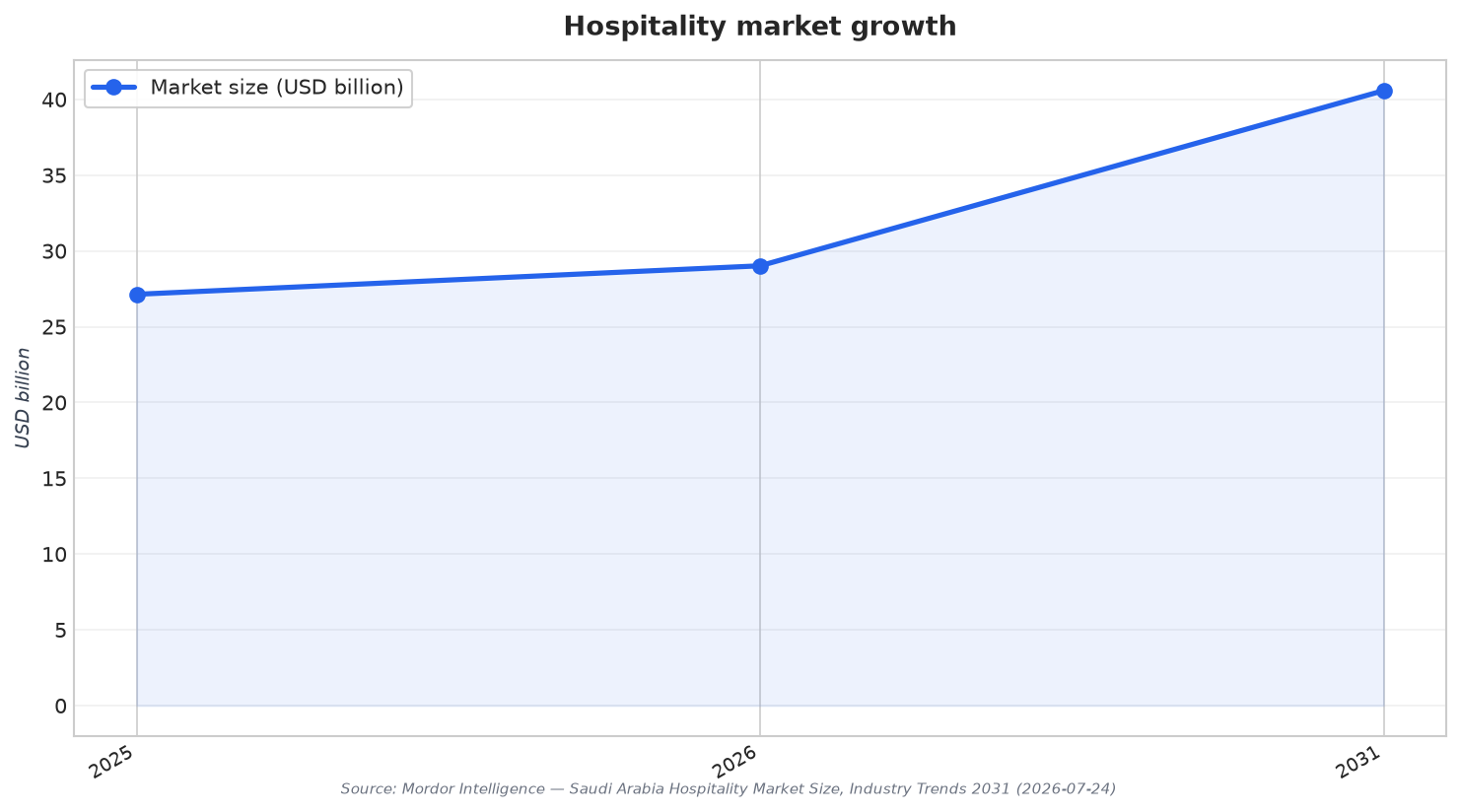
Underlying market growth helps explain why platform strategies are gaining traction. Mordor Intelligence estimates the Saudi Arabia hospitality market at USD 27.14 billion in 2025 and USD 29.02 billion in 2026, with a projection of USD 40.58 billion by 2031, reflecting a 6.93% CAGR over 2026–2031. The same source shows chain hotels holding 57.74% of market share in 2025, while independent hotels are forecast to trail as chains expand at an 11.62% CAGR through 2031. In parallel, the luxury segment led with 36.92% of market size in 2025, and serviced apartments are advancing at a 12.57% CAGR through 2031. For acquirers, that mix supports roll-up and conversion plays designed to capture demand without depending on a single format.
From Trophy Assets to Platforms: Where Buyers Are Focusing
Supply composition is shaping where consolidation looks most attractive. One perspective cited in the M&A report says about 61% of existing inventory is concentrated in luxury and upper-upscale, while nearly 78% of new rooms through 2030 are planned at the higher end; another viewpoint pegs 75% of upcoming rooms as luxury. That skew is pushing some buyers to look for midscale and economy exposure, especially in locations with durable demand where luxury ADR assumptions may be harder to underwrite. In practice, the same report describes deal teams screening for “asset transformation,” including conversions and adaptive reuse, to reposition under-managed hotels into scalable branded offerings that can generate repeat demand and portfolio-level efficiency.
Geography and demand clusters are also becoming central to how investors map targets. Mordor Intelligence estimates the Makkah–Jeddah corridor held 26.62% of Saudi hospitality market size in 2025, while the Red Sea and wider western coast are projected to expand at an 18.20% CAGR through 2031. Religious travel adds a distinct demand floor. Mordor reports Hajj attendance at approximately 2.1 million in 2025 and 1.71 million in 2026, with projections of around 2.3 million, while Umrah pilgrims totaled 18 million in 2025 and are expected to exceed 20 million in 2026. The same source notes average spending of USD 5,400 per pilgrim, and estimates religious tourism generated about USD 30 billion in 2025 and is projected at about USD 34 billion in 2026.
Technology is reinforcing the platform thesis, because scale is easier to monetize when distribution and data are unified. Mordor reports OTAs captured 41.65% of transactions in 2025, while direct digital channels are growing at a 14.78% CAGR as hoteliers invest in proprietary platforms. On the enterprise stack, Grand View Research estimates Saudi Arabia’s hotel and hospitality management software market generated USD 96.2 million in 2025 and is expected to reach USD 231.8 million by 2033, with a 12.1% CAGR. MarketsandMarkets adds that Saudi Arabia’s customer data platform market was valued at $271 million in 2025 and is projected to reach $1043.4 million by 2030, representing a 30.9% CAGR. Together, these figures show why Saudi hospitality M&A is increasingly paired with digital integration plans, not just real estate ownership.
Why are hotel deals in Saudi Arabia shifting toward platform strategies?
What market growth signals are influencing hotel investment in Saudi Arabia?
How does the supply mix affect acquisition targets and conversions?
Which Saudi regions are highlighted as clustering opportunities for hospitality investors?
What is driving the Saudi hospitality M&A story beyond real estate ownership?
Talk to us for your needs in:
-
Due Diligence and Valuation Services
-
M&A Strategy and Advisory
-
Post-Merger Integration Management
-
Regulatory and Compliance Advisory
-
Market Entry and Expansion Consulting
-
Investment and Financial Analysis
-
In-Depth Market Survey for M&A
-
Market Intelligence and Insights in M&A
-
Feasibility Study and Assessment in M&A
-
Saudi M&A Benchmarking