Buy-and-build is a simple idea with a hard execution path. A private equity sponsor backs a platform company, then acquires smaller operators to create scale, shared systems, and stronger pricing power. In Saudi Arabia, the logic is sharpened by the sheer volume of SMEs and the scale of end-market demand signals. Murtakaz cites 1.2M+ registered SMEs and Vision 2030’s target to increase SME contribution to GDP from 20% to 35%. That combination attracts roll-up thinking because it implies a large base of potential targets and a policy push that rewards formalization, investment readiness, and consolidation into more bankable operators.
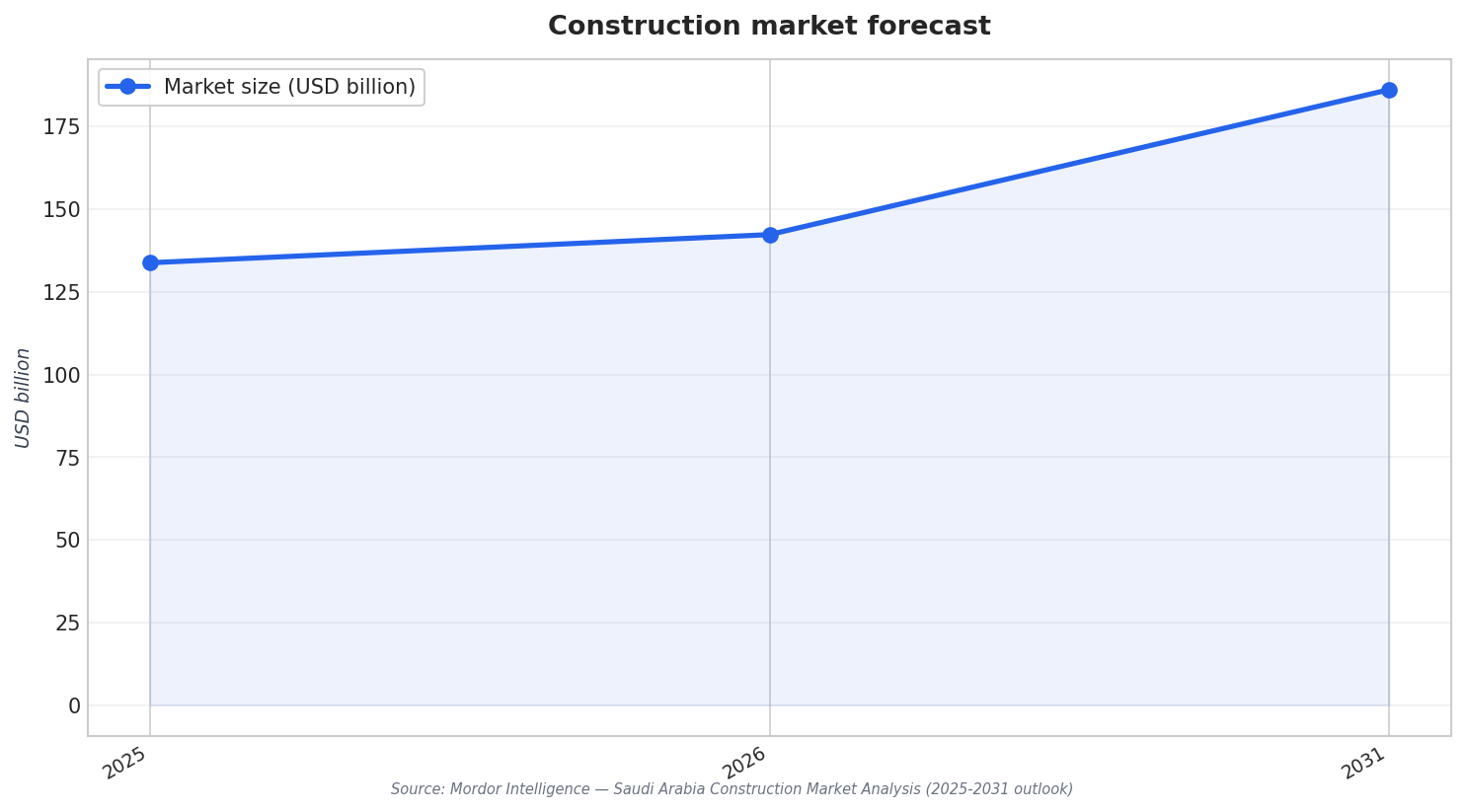
The second driver is the depth of project and procurement pipelines in sectors that are naturally fragmented at the subcontractor and specialist-supplier layer. Mordor Intelligence projects Saudi Arabia’s construction market at USD 142.30 billion in 2026, reaching USD 186.13 billion by 2031, at a 5.52% CAGR from 2026 to 2031. In 2025, infrastructure led with 36.6% of revenue, new construction held 81.2% share, and public spending represented 71.5% of activity, while private capital is expected to grow at a 7.10% CAGR during 2026–2031. For PE, this mix can translate into buy-and-build opportunities in the “picks-and-shovels” SME layer: compliance-heavy specialty trades, project controls, and suppliers that can standardize delivery to win larger, repeatable packages.
Where Roll-ups Work Best: Repeatable Demand, Fragmented Supply
Prefabrication is a clear case where scale and process discipline can separate winners from smaller yards. Mordor Intelligence expects the Saudi Arabia prefabricated buildings market to reach USD 2.30 billion in 2025 and grow at a 9% CAGR to USD 3.5 billion by 2030. The same source notes that the market is moderately fragmented, and it gives tangible productivity benchmarks: Red Sea International reports annual throughput of 770,000 m², while Spacemaker KSA completes up to 1,000 m² of pods per day. It also flags operational friction—regulatory fragmentation outside the capital elongates approval timelines—yet points to demand breadth, with the Future Projects Forum listing more than SAR 1 trillion in upcoming contracts beyond the three major metros. For a Saudi SME buy-and-build thesis, this is the roll-up setup: acquire regional fabricators and installers, integrate QA and compliance, and use shared capacity planning to compete for geographically distributed work.
Digital commerce creates a different kind of roll-up: software-enabled services and logistics capabilities layered onto SME adoption. Mordor Intelligence estimates Saudi Arabia’s e-commerce market at USD 31.29 billion in 2026, growing to USD 54.87 billion by 2031 at an 11.92% CAGR. It attributes momentum to structural enablers including 99% internet penetration and 78% 5G coverage, and shows behavior shifting toward mobile with smartphones delivering 77.98% of revenue share in 2025. B2C held 73.54% share in 2025, while B2B is advancing at a 13.45% CAGR through 2031. PE can map these signals into a consolidation plan across SME-focused enablers—onboarding, payments, last-mile operations, and performance marketing—where scale lowers unit costs and improves conversion through shared data and standardized playbooks.
Real estate also hints at where SME customers are accelerating, which matters for roll-ups that sell into business demand. Mordor Intelligence values the Saudi Arabia real estate market at USD 72.84 billion in 2026, projecting growth at a 7.17% CAGR to USD 102.96 billion by 2031. In 2025, individuals and households held 69.4% share, while corporates and SMEs are expected to advance at an 8.02% CAGR through 2031, the fastest among end-users. For PE, that can justify buy-and-build across SME-facing facility services, fit-out supply chains, and specialist commercial property solutions that benefit from standardized delivery. The strategic throughline is consistent: consolidate fragmented operators, professionalize compliance and reporting, and build a platform sized to win larger contracts in markets where demand is expanding and procurement expectations are rising.
What makes buy-and-build attractive for Saudi Arabia’s SME market?
Which sectors show the clearest roll-up signals for private equity in Saudi Arabia?
How does prefabrication support a Saudi SME buy-and-build thesis?
What e-commerce metrics matter most for consolidation strategies?
Why does corporate and SME demand matter in Saudi real estate for PE platforms?
Talk to us for your needs in:
-
Due Diligence and Valuation Services
-
M&A Strategy and Advisory
-
Post-Merger Integration Management
-
Regulatory and Compliance Advisory
-
Market Entry and Expansion Consulting
-
Investment and Financial Analysis
-
In-Depth Market Survey for M&A
-
Market Intelligence and Insights in M&A
-
Feasibility Study and Assessment in M&A
-
Saudi M&A Benchmarking