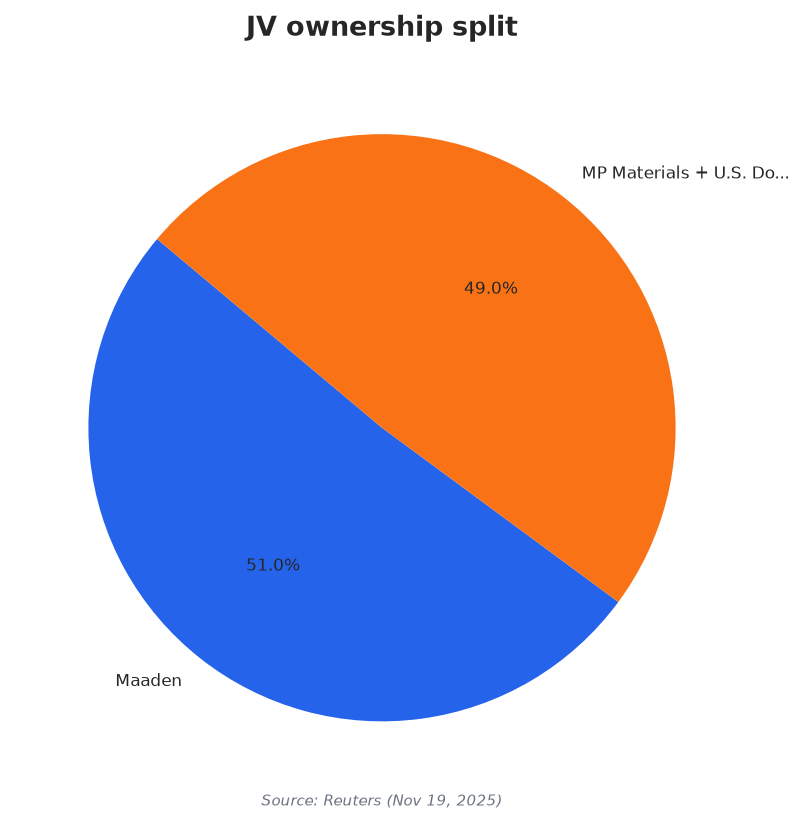
MP Materials said it would build a rare earths refinery in Saudi Arabia with the U.S. Department of Defense and state-owned Saudi Arabian mining company Maaden, expanding Middle Eastern processing of critical minerals. Reuters, CNBC, and Investing News describe a binding agreement in which Maaden will hold no less than 51%, while MP and the Pentagon will hold a combined 49%. The Defense Department will finance the U.S. portion on a non-recourse basis, while MP contributes technical expertise in separation and refining plus marketing capabilities. For dealmakers, this governance and financing mix matters because it signals a project designed for strategic resilience, not only commercial return.
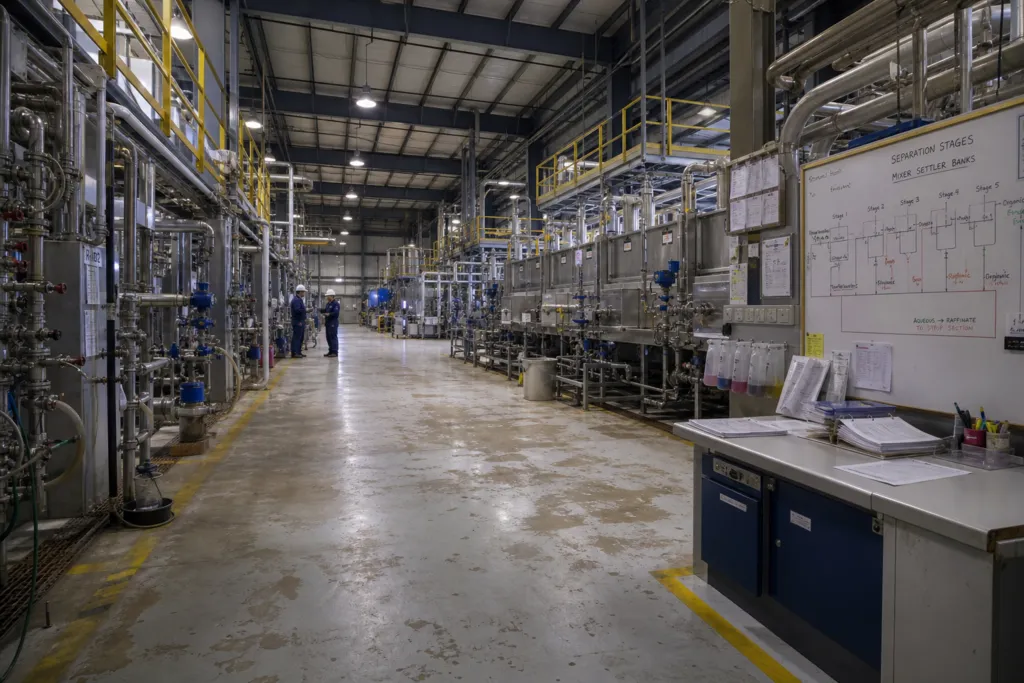
The proposed refinery is designed to process rare earth feedstock sourced from Saudi Arabia and other global regions and to produce separated light and heavy rare earth oxides. Reuters notes that rare earths must be teased out in a specific order, creating a logistical challenge that prevents “cherry-picking” only the most desired elements while processing inside the kingdom. That technical constraint is also an M&A constraint: buyers cannot assume a single-element strategy will work without securing the right feedstock mix and separation capabilities. The same sources say the refined products are intended to support U.S. and Saudi manufacturing and defense sectors and be marketed to allied nations, widening the potential customer set.
Why the “Middle” of the Value Chain Drives Deals
Multiple sources frame separation and processing as the true bottleneck. MP Materials’ CFO Ryan Corbett told Investing News that headlines often over-focus on mining or magnets, while the hardest parts sit in between. He described multiple steps from oxide to finished magnets: converting oxide to metal, then alloy flake, then powder, followed by pressing, sintering, slicing, and grinding. He also warned about ambitious magnet-plant announcements from groups that “have never made metal before,” emphasizing time, investment, R&D, and experience. That logic points M&A toward acquiring real process know-how and operational track records, not just announcing downstream intent.
Heavy rare earth exposure sharpens the strategic value of this Saudi rare earths refinery JV. Reuters reports that in the United States, MP has struggled to find supplies of dysprosium and terbium, two heavy rare earths used to make magnets for electric vehicles, fighter jets, and other products. Separately, CSIS is cited as stating that as of 2023, China accounted for 99% of global heavy rare earth element processing, and it highlights risks created by export restrictions and a 2023 global ban on exporting rare earth processing and separation technologies. In practical M&A terms, the scarcest inputs and the most constrained processing steps become the highest-leverage targets for partnership, consolidation, or offtake-backed investment.
The ownership split and U.S. financing approach also shape how supply-chain deals may be structured around the refinery. Reuters and CNBC say Maaden retains majority control at 51% or more, while MP and the Pentagon hold 49%. Shanghai Metals Market adds that the Pentagon will provide non-recourse funding and that MP contributes separation and refining technology, describing a “resource-for-technology model.” Aviation Week and Shanghai Metals Market also note a $400 million Pentagon stake in MP Materials, and SMM says the Saudi project extends a DoD approach aimed at building alternatives to China through allied systems. Reuters adds that MP already has magnet supply deals with Apple and General Motors, and MP said it was in discussions to support or collaborate on magnet manufacturing in Saudi Arabia, which could pull M&A interest toward adjacent steps that turn separated oxides into magnet-ready materials.
What is the ownership split in the Saudi Arabia refinery partnership?
How is the U.S. portion of the joint venture financed?
Why does heavy rare earth processing drive supply-chain M&A interest?
How does the Saudi rare earths refinery JV relate to magnets and defense supply chains?
Talk to us for your needs in:
-
Due Diligence and Valuation Services
-
M&A Strategy and Advisory
-
Post-Merger Integration Management
-
Regulatory and Compliance Advisory
-
Market Entry and Expansion Consulting
-
Investment and Financial Analysis
-
In-Depth Market Survey for M&A
-
Market Intelligence and Insights in M&A
-
Feasibility Study and Assessment in M&A
-
Saudi M&A Benchmarking