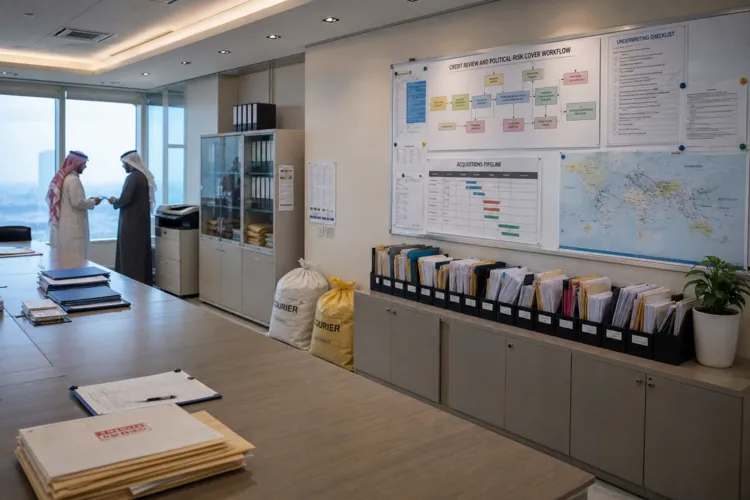
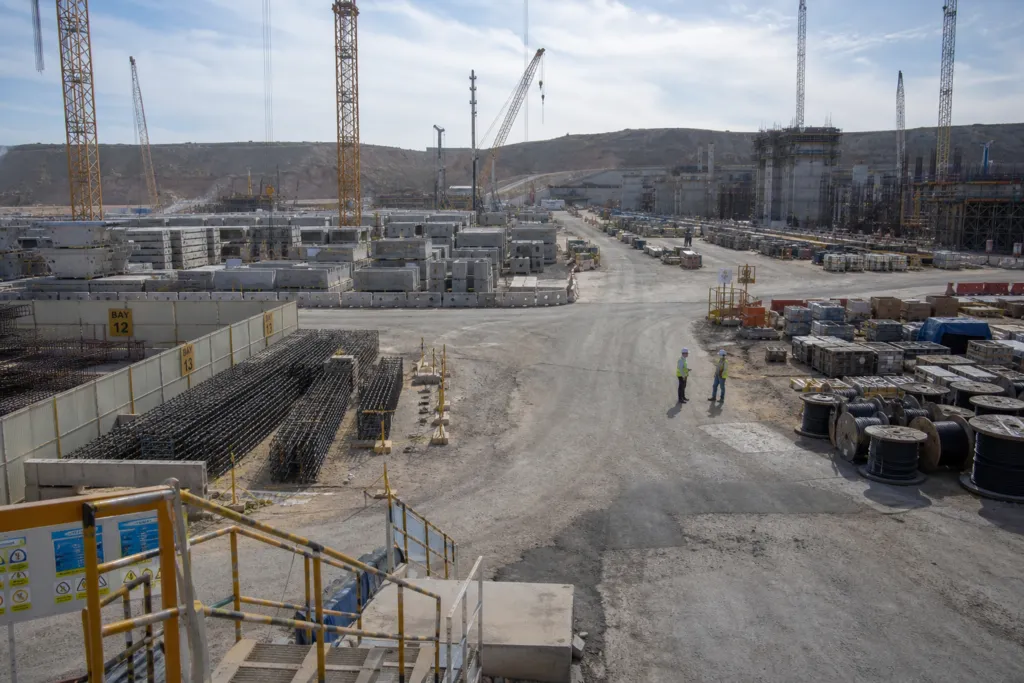
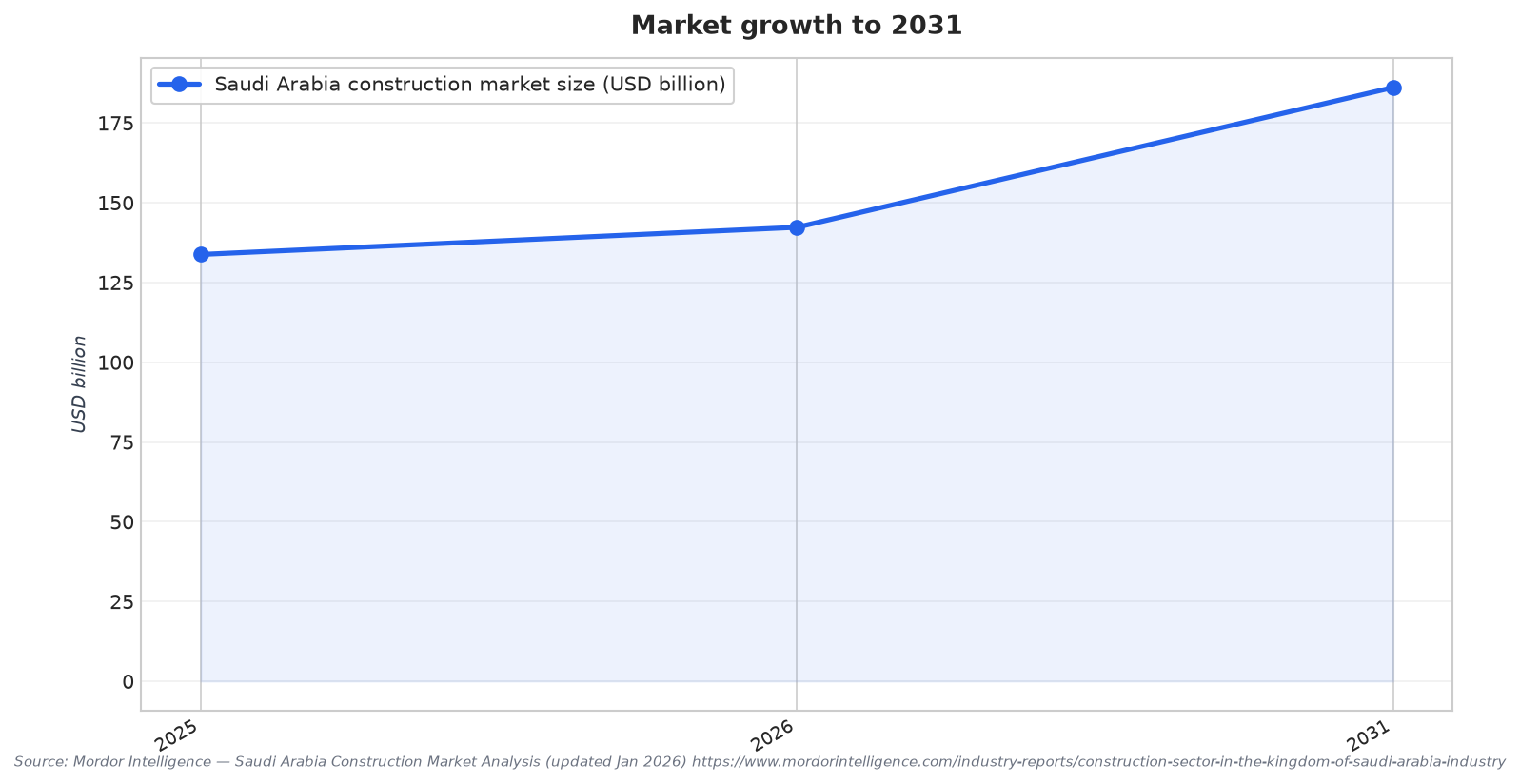
Saudi Arabia’s construction market is projected at USD 133.79 billion in 2025 and USD 142.30 billion in 2026, reaching USD 186.13 billion by 2031, with a 5.52% CAGR from 2026 to 2031, according to Mordor Intelligence. In that context, Saudi giga-project contractor M&A becomes less about financial engineering and more about building execution depth. Giga- and mega-project demand is tied to Vision 2030 pipelines such as NEOM, Red Sea, Diriyah, and Qiddiya, which Mordor describes as multi-billion-dollar scopes spanning housing, utilities, and leisure assets. The same report highlights intensifying rivalry as local champions form joint ventures with global majors to secure technology and balance-sheet strength for large awards.
The structure of demand helps explain why consolidation pressure is rising. Mordor notes that public spending accounted for 71.5% of 2025 activity in Saudi Arabia, while private capital is expected to grow at a 7.10% CAGR during 2026–2031. Infrastructure led with 36.6% of 2025 revenue, and new construction dominated with an 81.2% share in 2025. Those figures matter because large public-led infrastructure packages tend to reward contractors with stronger working-capital lines, delivery systems, and compliance capabilities. MarkWide adds that government infrastructure agencies are displacing private residential developers as the dominant procurement channel as Vision 2030 megaprojects reshape priorities, while also pointing to differentiation among major local firms such as Saudi Binladin Group, Nesma & Partners Contracting, and El Seif Engineering Contracting.
Why Contractor Consolidation Is Accelerating Across Giga-Projects
Regional context reinforces the consolidation thesis, but it must be read carefully as “Middle East” and “GCC” dynamics, not only Saudi-specific outcomes. Market Data Forecast states that the Middle East construction sector is witnessing consolidation, with financially stable contractors acquiring distressed competitors to expand capacity. Separately, Mordor’s GCC construction report explains that firms with strong balance sheets, diversified order books, and robust working-capital lines weather delays better than narrowly focused peers, resulting in gradual industry consolidation within the GCC construction market. That same GCC source adds a cost driver: Wage Protection Systems across GCC states raise total labor costs by an estimated 15–20% for expatriate-heavy work, while Saudi policy ties contractor classification to national worker ratios, pushing investment in upskilling or automation.
Giga-project delivery also increases the value of specialist capacity and modern methods, which can be acquired, partnered for, or built through integration. Mordor notes that conventional on-site work accounted for 89.6% of Saudi Arabia’s 2025 value, while modern methods of construction are expanding at a 7.55% CAGR. It also cites modular hotel blocks used on Red Sea resort development, where Red Sea Global awarded USD 3.9 billion in early 2026 for 16 island resorts. In parallel, NEOM’s green-hydrogen plant reached 80% completion in 2025 and requires four gigawatts of dedicated renewables, creating follow-on packages for substations and transmission. These project realities encourage contractors to scale capability, not just headcount, and they make partnerships and consolidation tactics more relevant to winning and delivering packages.
For dealmakers and strategists, the playbook is not only about acquisitions; it also includes joint ventures and targeted international entries aligned to developer requirements. Mordor’s GCC report states that joint ventures proliferate on gigaproject lots because local content rules and global know-how must converge. Market Data Forecast notes that in January 2024, Vinci Construction Grands Projets was awarded a contract to build the central spine of The Line in NEOM, describing it as a major entry into Saudi Arabia’s flagship giga-project. Meanwhile, Mordor’s Saudi report points to escalation clauses partly offsetting cost-inflation risk by protecting contractor margins. In practical terms, contractor consolidation and selective M&A become a way to secure balance-sheet strength, expand capacity, and standardize delivery systems across multiple workstreams without losing qualification standing under evolving procurement rules.
What is driving consolidation and contractor acquisitions tied to Saudi giga-projects?
Which construction segments are most associated with large, public-led awards in Saudi Arabia?
How do modern construction methods influence consolidation strategies?
What giga-project awards and milestones show the scale of work driving contractor demand?
How should companies think about Saudi giga-project contractor M&A versus joint ventures?
Talk to us for your needs in:
-
Due Diligence and Valuation Services
-
M&A Strategy and Advisory
-
Post-Merger Integration Management
-
Regulatory and Compliance Advisory
-
Market Entry and Expansion Consulting
-
Investment and Financial Analysis
-
In-Depth Market Survey for M&A
-
Market Intelligence and Insights in M&A
-
Feasibility Study and Assessment in M&A
-
Saudi M&A Benchmarking