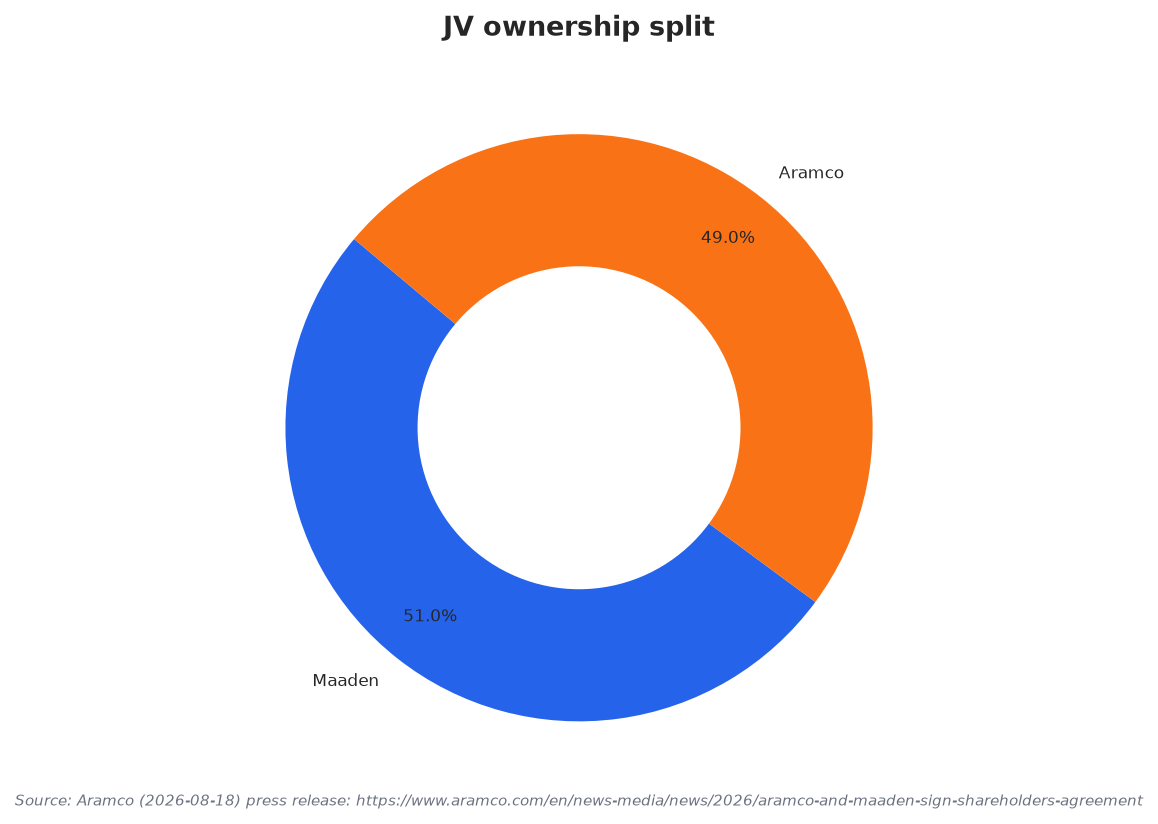
Saudi Aramco and Saudi Arabian Mining Company (Maaden) have signed a shareholders’ agreement to form a joint venture aimed at unlocking new opportunities in mineral exploration and hard-rock mining in the Kingdom of Saudi Arabia. Plans for the venture were first disclosed in January 2025, and the agreement is subject to regulatory approvals and other customary conditions, including required corporate approvals and antitrust clearance. Under the expected ownership structure, Maaden would hold 51% and Aramco 49%. The partners frame the deal as a way to accelerate discovery by combining two different advantage sets: subsurface data and advanced computing from Aramco, and mining and mineral exploration capability from Maaden.
The JV’s operating focus is Zone-4, also known as the Transition Zone, within the Arabian Platform. The expected exploration area spans approximately 182,000 square kilometers, described as nearly 10% of Saudi Arabia’s total land area. It stretches along a 100-kilometer-wide zone running parallel to the Arabian Shield. In practice, that geographic definition is central to why this dealmaking model stands out: it sets a single, clearly bounded target area and aligns both parties around a long-run, large-scale exploration program rather than a narrow, one-asset partnership. The exploration activities are expected to mainly focus on copper, alongside other minerals critical to the energy transition.
Why Zone-4 Is a Different Kind of Exploration Bet
Aramco and Maaden position the Zone-4 approach as a data-led exploration play. Aramco says it has accumulated and analyzed the largest amount of geological and geophysical data ever acquired in a single basin for the Kingdom over more than 90 years. The partnership intends to leverage that legacy information to identify mineral deposits inside the JV area. Aramco also highlights high-performance computing and AI as tools expected to accelerate discovery at low cost, while Maaden brings mineral exploration expertise and operating experience in resource development and mining. Together, the intent is to move faster from regional screening to prioritized targets and potential drilling decisions.
On the minerals side, both companies emphasize copper as the primary target, with additional attention on base metals such as zinc and lead, plus rare earth elements. Public reporting also describes the Transition Zone as believed to contain deposits of gold, silver, copper, zinc, lead, chromium, nickel, tantalum, niobium and rare earths, presenting a wide menu for follow-on work as the program matures. The Aramco Maaden mining JV structure is designed to match that breadth: a large land position, paired capabilities, and an exploration thesis that uses advanced analytics to narrow the search efficiently over time.
The deal also lands inside a national push to grow mining’s role in the economy. Saudi Arabia has estimated its mineral wealth at $2.5 trillion, and the country aims to increase the mining sector’s economic contribution to 240 billion Saudi riyals ($64 billion) by 2030 under Vision 2030. Industry activity has been scaling, too: the number of active exploration companies rose from six in 2020 to 226 in 2024, according to the Ministry of Industry and Mineral Resources. Against that backdrop, the Aramco–Maaden partnership signals a template that blends national-scale acreage, incumbents’ strengths, and a formal ownership split to drive exploration decisions through data, computing, and on-the-ground execution.
What is the ownership split in the Aramco–Maaden joint venture?
Where will the JV explore, and how large is the target area?
Which minerals are central to the program?
How does the Aramco Maaden mining JV model aim to speed up discovery?
Talk to us for your needs in:
-
Due Diligence and Valuation Services
-
M&A Strategy and Advisory
-
Post-Merger Integration Management
-
Regulatory and Compliance Advisory
-
Market Entry and Expansion Consulting
-
Investment and Financial Analysis
-
In-Depth Market Survey for M&A
-
Market Intelligence and Insights in M&A
-
Feasibility Study and Assessment in M&A
-
Saudi M&A Benchmarking