
Saudi dealmaking momentum in 2026 is visible in the mid-market numbers. Saudi Arabia opened 2026 with 24 mergers and acquisitions in Q1 worth $689 million, a 4% annual increase in deal volume, according to Ansarada’s Middle East M&A Market Analysis coverage cited in a Saudi mid-market report. In the same reporting set, the wider Middle East recorded 196 announced deals in Q1 2026 worth $23.3 billion, down from 207 pacts worth $31.3 billion a year earlier. Against that backdrop, it is easier to see why some buyers may seek influence without taking on full operational control. Minority positions can still provide board-level visibility, commercial access, and a seat in fast-moving sectors while leaving day-to-day execution with operators who already understand local procurement, compliance, and delivery.
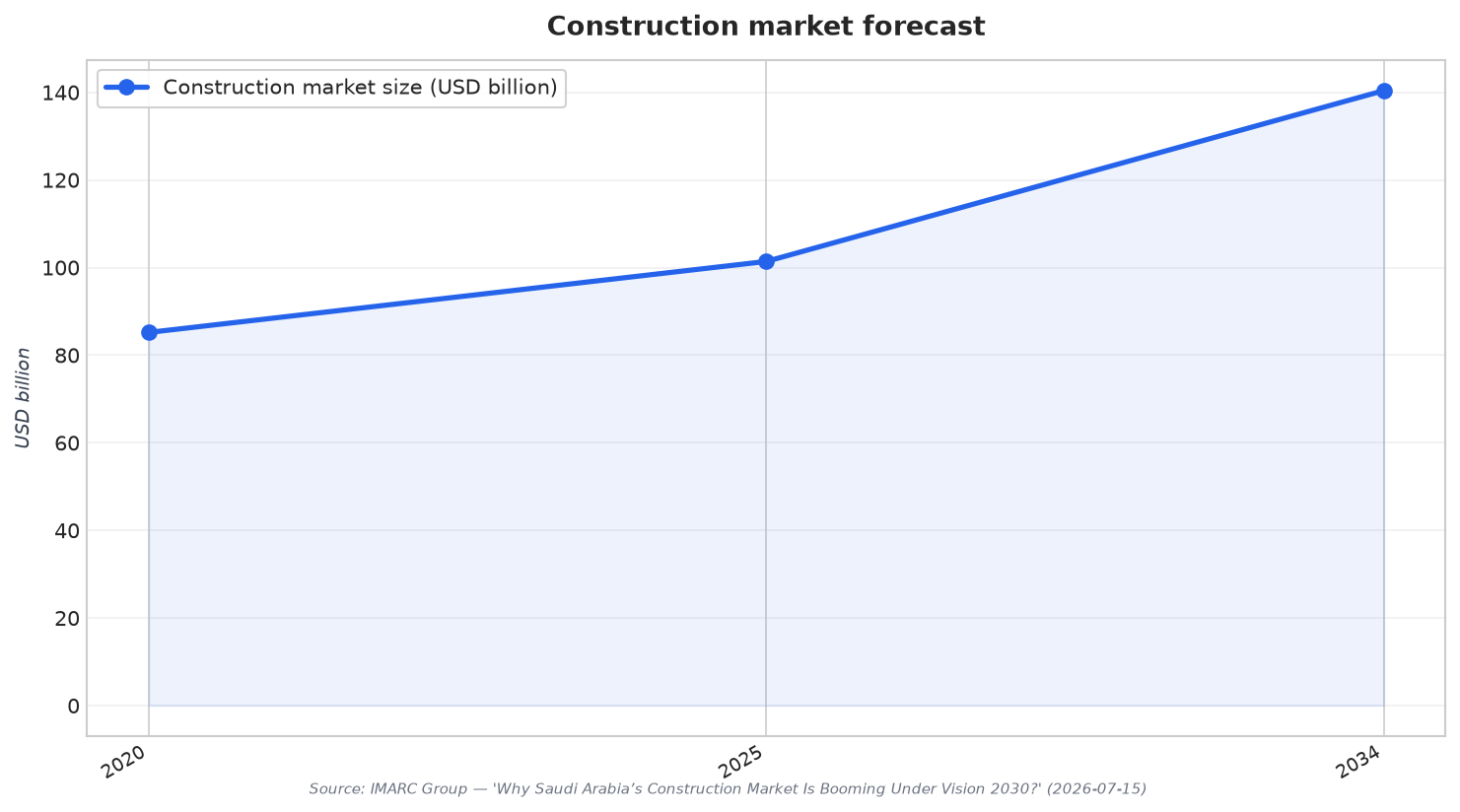
Scale is the defining reality in Saudi Arabia’s buildout cycle, and scale changes how risk is priced. IMARC Group estimates the Saudi Arabia construction market reached USD 101.4 billion in 2025 and is projected to reach USD 140.4 billion by 2034, expanding at a CAGR of 3.6% from 2026 to 2034. The same source says the Saudi government has committed USD 1 trillion in strategic project investments through 2030, including NEOM (USD 500 billion), the Red Sea Project (USD 15–16 billion), and Diriyah Gate (USD 20 billion). On the housing side, the National Housing Company launched more than 134,000 housing units with a total value exceeding SAR 100 billion, as part of a plan to make 300,000 units available by end of 2025. In this context, minority-stake structures can be a way to participate in multi-year execution without assuming total delivery and cost exposure.
Why 2026 Favors Influence-First Capital
Two large, regulated growth markets help explain why Saudi minority stake deals 2026 have a clear logic for many investors: digital infrastructure and real estate. Mordor Intelligence values the Saudi Arabia ICT market at USD 59.97 billion in 2025 and estimates growth from USD 65.45 billion in 2026 to USD 101.3 billion by 2031, at a 9.13% CAGR for 2026–2031. Cloud captured 43.43% share in 2025 and is forecast to grow at a 14.16% CAGR through 2031, while data-residency rules carry fines up to SAR 25 million for non-compliance. In real estate, Mordor projects the market expanding from USD 74.11 billion in 2025 and USD 79.09 billion in 2026 to USD 113.96 billion by 2031, a 7.58% CAGR from 2026 to 2031. These conditions can reward investors who bring capital and governance support while relying on specialized operators to manage regulatory and delivery complexity.
Consumer-facing assets add a further incentive to buy influence rather than control, because local knowledge and trust dynamics matter. Technavio forecasts Saudi Arabia retail market growth will increase by USD 77.5 billion during 2026–2030. Meanwhile, a Saudi market research overview notes that purchasing decisions often involve strong household influence, and that trust, community perception, and social acceptance can shape buying behavior. For investors, that can translate into a preference for partnering with incumbents that already understand local segmentation and reputation management, rather than attempting a full takeover and rebrand. Even when control transactions happen, they illustrate how targeted ownership can be used to secure operating leverage: BinDawood Holding completed acquiring a 51% stake in Vaza Food Co. for SAR 217.9 million, according to the same Saudi deal reporting.
Policy signals also point toward a more selective, durability-focused investment posture that naturally aligns with minority ownership in some cases. Deloitte’s April 2026 Middle East Economic Monitor says the Public Investment Fund’s 2026–2030 strategy signals a shift away from rapid expansion and toward long-term value creation, spending discipline, and resilience to external economic shocks. In parallel, Fitch Solutions only slightly lowered its 2026 GDP growth forecast for Saudi Arabia from 4.8% to 4.6% in response to the ongoing US–Iran conflict, with impacts concentrated in tourism and logistics, as cited in the mid-market report. Put together, these signals describe a market where investors still want exposure, but may structure it to manage uncertainty, align incentives, and scale positions over time rather than taking full control on day one.
What is the key M&A signal from Saudi Arabia’s Q1 2026 mid-market data?
How do construction and mega-project commitments shape influence-first investing?
Why do ICT regulations make minority stakes attractive in 2026?
How does Saudi consumer behavior affect deal structures in retail and services?
What’s a practical way to think about Saudi minority stake deals in 2026?
Talk to us for your needs in:
-
Due Diligence and Valuation Services
-
M&A Strategy and Advisory
-
Post-Merger Integration Management
-
Regulatory and Compliance Advisory
-
Market Entry and Expansion Consulting
-
Investment and Financial Analysis
-
In-Depth Market Survey for M&A
-
Market Intelligence and Insights in M&A
-
Feasibility Study and Assessment in M&A
-
Saudi M&A Benchmarking