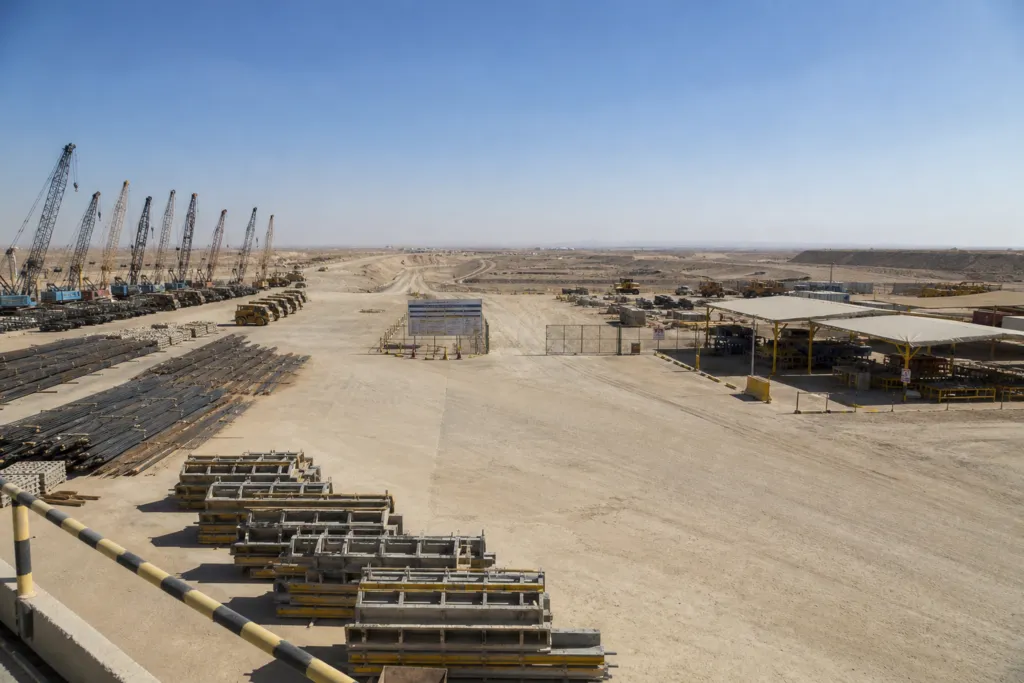
NEOM has delayed further work on The Line until at least after 2030, according to reporting that links the decision to a shift in Public Investment Fund (PIF) spending priorities. The Line was planned as a 170-kilometer long dual-skyscraper development, but it is now in a paused state rather than officially canceled. Multiple sources describe the move as a strategic reassessment that prioritizes projects expected to generate more immediate economic value, including ports, logistics networks, industrial facilities, and AI-focused data centers. That change reframes the project from a single megastructure timeline into a staged portfolio approach, where near-term deliverability and investable assets matter more than original headline ambition.
The scale-down is measurable inside the project’s own planning targets and construction progress. One analysis says the first phase of The Line has been reduced from 170 kilometers to approximately 2.4 kilometers, and that the 2030 population target has been cut from 1.5 million to 300,000. Another report puts the revised 2030 target at up to 100,000 people. The execution gap also shows up in the work delivered: sources describe 2.4 kilometres of foundation work for The Line, with no above-ground superstructure. In parallel, PIF’s 2024 annual results included an $8 billion write-down across the giga-project portfolio, while a separate brief estimates $8 billion in write-downs and contract restructurings tied to NEOM’s reduced scope.
Contractor Distress, Terminations, and Reallocation Deals
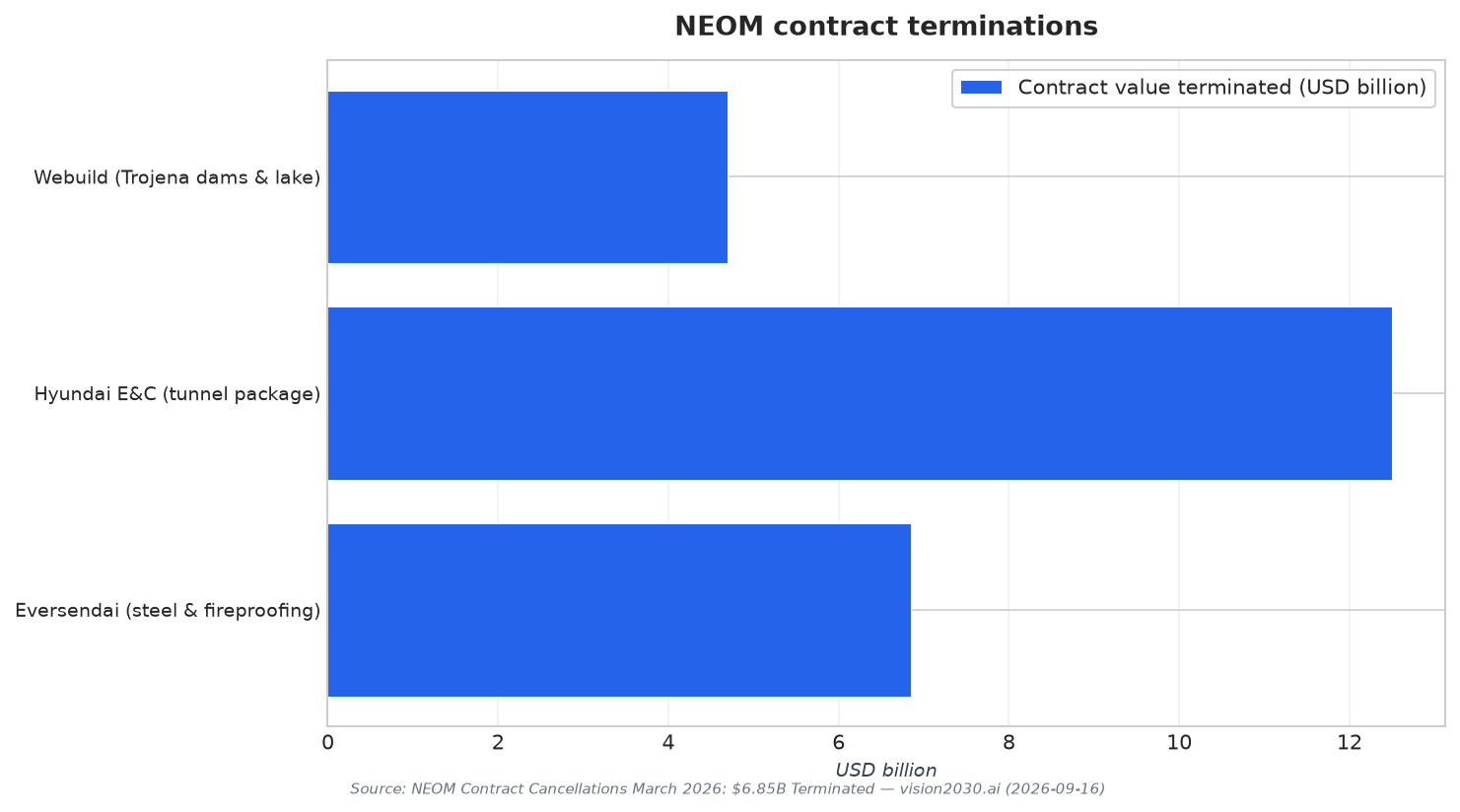
The NEOM The Line pause contractors are watching is not only a schedule issue; it is flowing through balance sheets and contract filings. One report says The Line construction was initially suspended on September 16, 2025, when only 2.4 kilometres of foundation work had been completed, and that the pause later became a formal halt until after 2030. In March 2026, three major NEOM packages were terminated with a combined value of approximately $6.85 billion, including a $4.7 billion Webuild contract for three dams and a 2.8-kilometre freshwater lake at Trojena that had reached 30 per cent completion. The same source says Hyundai Engineering and Construction confirmed termination of a tunnel construction package for a 12.5-kilometre section, and Malaysia’s Eversendai reported cancellation of structural steel and fireproofing works for Trojena’s Ski Village.
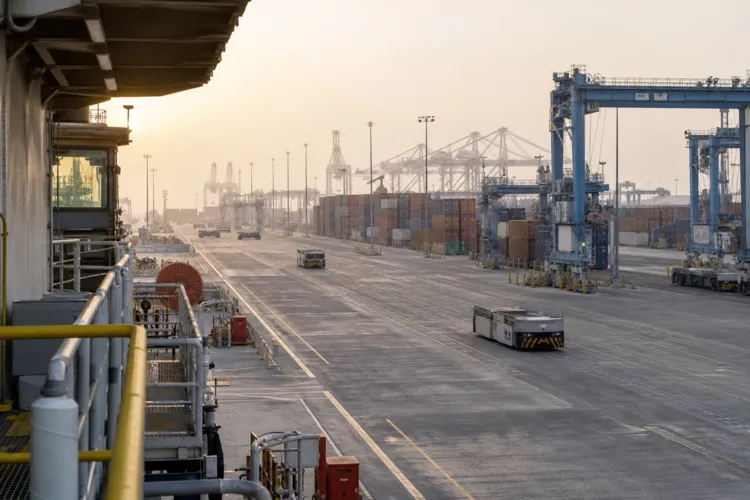
At the same time, the project is reallocating attention and capital toward assets that can operate sooner. NEOM plans to spend about $3 billion further developing Oxagon, the industrial city hosting a port on the Red Sea, and another report describes Oxagon being redesignated as a priority node alongside a pivot toward AI data centres. An audit-style account adds context on what has been built with prior spending: NEOM’s deputy CEO, Rayan Fayez, said at the World Economic Forum in Davos in February 2025 that the project had spent over $50 billion since 2017. That same account lists an operational airport capable of handling commercial flights, road networks, worker housing, port facilities, and the near-complete NEOM Green Hydrogen plant—an $8.4 billion joint venture between NEOM, Air Products, and ACWA Power that is described as 80 per cent finished and on track to produce 600 tonnes of green hydrogen daily from 2027.
Tourism-linked subprojects are also being pushed out on the calendar, reinforcing the “after 2030” horizon. Reporting says NEOM has postponed plans to develop tourism destinations along the Red Sea coast until after 2030, and that Trojena will not receive new investments until after 2030 either, even though it had earlier been due to host the 2029 Asian Winter Games. While some components remain in development, the overall narrative is a recalibration rather than a clean stop. One brief calls the change a “phased approach” that prioritizes quality and deliverability, arguing the original timeline was not feasible with available labor, materials supply chain, and engineering solutions. For contractors and suppliers, that means more renegotiations, selective terminations, and asset reallocation deals that favor projects with nearer-term operating cash flows.
Is NEOM canceling The Line or just delaying it?
What changed in the first phase scope of The Line?
What does the NEOM The Line pause mean for contractors?
Which parts of NEOM are being prioritized as spending shifts?
How have NEOM’s 2030 population targets been revised?
Talk to us for your needs in:
-
Due Diligence and Valuation Services
-
M&A Strategy and Advisory
-
Post-Merger Integration Management
-
Regulatory and Compliance Advisory
-
Market Entry and Expansion Consulting
-
Investment and Financial Analysis
-
In-Depth Market Survey for M&A
-
Market Intelligence and Insights in M&A
-
Feasibility Study and Assessment in M&A
-
Saudi M&A Benchmarking