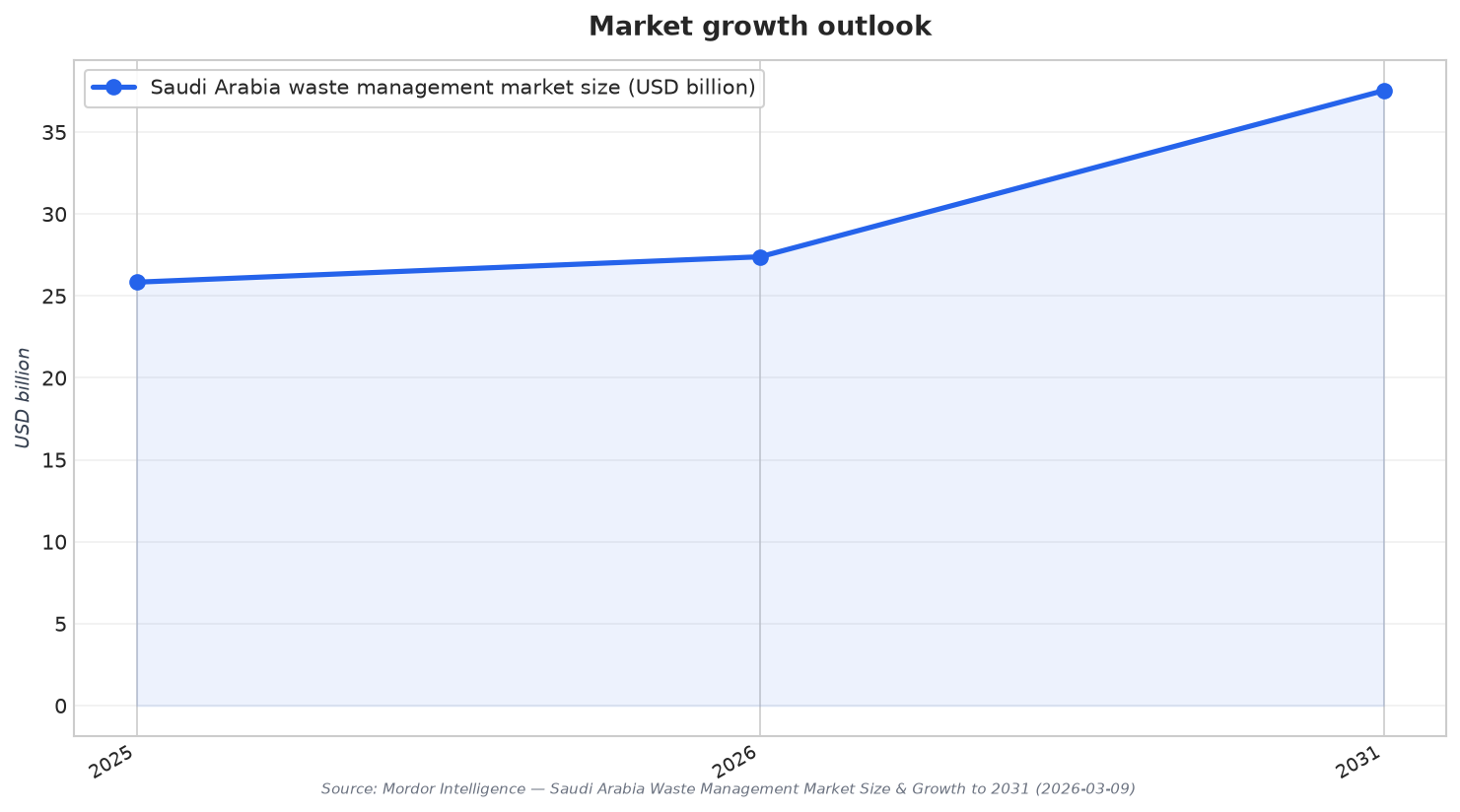
Saudi Arabia is moving waste management from a landfill-led model toward integrated recovery. Multiple sources describe policy pressure from Vision 2030 and a growing public-private-partnership (PPP) pipeline that is changing how assets are built and operated. Mordor Intelligence values the Saudi Arabia waste management market at USD 25.84 billion in 2025 and estimates growth to USD 27.39 billion in 2026 and USD 37.53 billion by 2031, at a 6.5% CAGR over 2026–2031. In parallel, the U.S. International Trade Administration notes a national aim to divert 90% of waste from landfills by 2040, setting a clear direction for investment and deal-making.
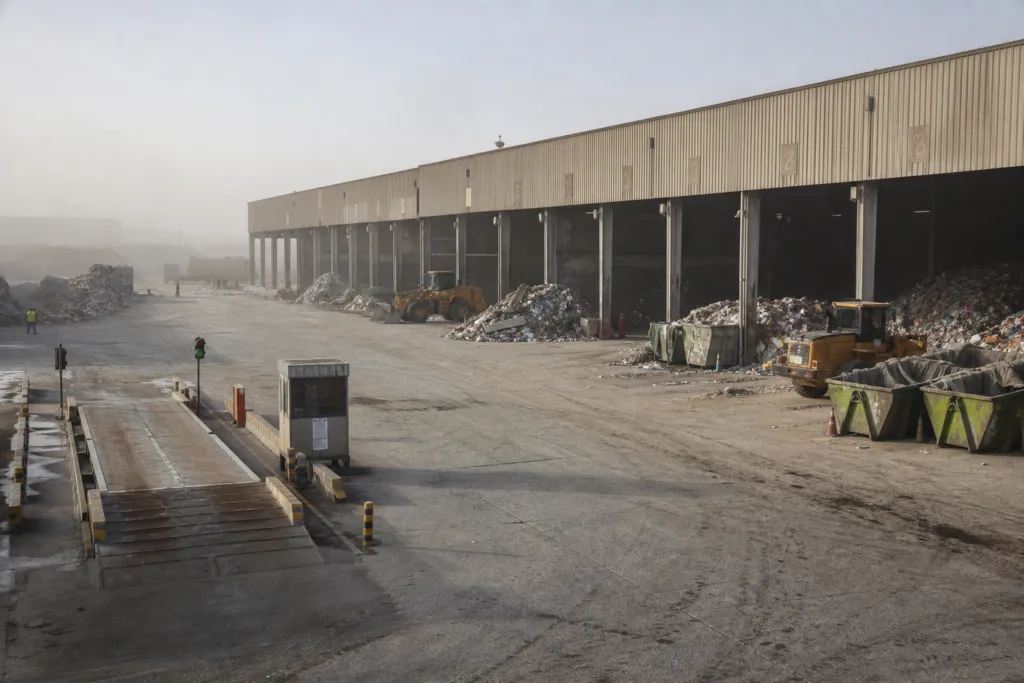
That direction is reinforced by enforcement and the sheer cost of poor outcomes. Mordor Intelligence cites stricter penalties under Royal Decree M/3, including fines up to USD 8 million and prison terms for non-compliance. The Trade.gov briefing, citing MWAN, estimates environmental degradation caused by solid waste in 2021 at USD 1.3 billion, while GMI Research cites USD 1.3 billion in damages in 2022. At the same time, Trade.gov reports total municipal solid waste (MSW) produced in Saudi Arabia at 110 million tons annually, and notes that municipalities manage it through contractors collecting, transporting, and disposing at landfills and dump sites. This contracting model creates natural entry points for privatisation frameworks and consolidation of service portfolios.
Privatisation, Scale, and Consolidation: Why Deals Cluster Around Volumes
In Saudi waste management M&A, scale matters because volumes concentrate in specific geographies and streams. Trade.gov states that nearly half of total waste comes from three major cities, with 21% from Riyadh, 14% from Jeddah, and 8% from Dammam. Mordor Intelligence similarly finds Riyadh accounted for 38.5% of the Saudi Arabia waste management market size in 2025, while residential waste held 55.35% share that year. It also reports that disposal and treatment services made up 53.45% of the market in 2025, while recycling is projected to grow at a 9.7% CAGR through 2031. These dynamics incentivize operators to consolidate routes, treatment capacity, and city-level contracts, then add recycling and recovery assets that match policy targets.
Operator concentration is already visible. Mordor Intelligence reports SIRC, Veolia, SUEZ, Averda, and BEEAH collectively managed more than 50% of treated volumes in 2025, and that SIRC alone recycled 16 million tons of construction-and-demolition (C&D) waste that year. The same report links large construction programs such as NEOM and the Red Sea Project to rising C&D waste and demand for mobile crushers, material recovery facilities (MRFs), and refuse-derived-fuel (RDF) plants. This is where “circular-economy deals” tend to land: acquiring or partnering for the infrastructure that turns mixed waste into secondary materials or fuels, rather than relying on landfills that Trade.gov says are often near capacity.
Privatisation and PPP readiness also shape how fast the market can reorganize. Trade.gov lists the National Center for Privatization and PPP (NCP) as an entity that helps develop regulations, create privatisation frameworks, and prepare government assets and services for privatisation. Regionally, Mordor’s GCC view adds context: it cites MWAN targets for 840 new facilities backed by USD 14.7 billion in funding, and notes SIRC pursuing an 81% recycling rate by 2035. At the same time, academic review work on circular economy transition in Saudi Arabia stresses that constraints are institutional, technological, market, and social, and highlights that metals, glass, batteries, and electronic waste are rarely recycled at scale and often end up in landfills or informal markets. These gaps help explain why consolidation and privatisation efforts focus on integrated platforms and traceability, including Mordor’s reference to blockchain-enabled traceability for extended producer responsibility (EPR) credits already in operation.
How large is Saudi Arabia’s waste management market, and what is the forecast?
What targets are pushing Saudi Arabia toward circular-economy infrastructure?
What evidence suggests consolidation is already happening among major operators?
Where do waste volumes concentrate in Saudi Arabia’s major cities?
What is driving Saudi waste management M&A toward integrated platforms rather than single services?
Talk to us for your needs in:
-
Due Diligence and Valuation Services
-
M&A Strategy and Advisory
-
Post-Merger Integration Management
-
Regulatory and Compliance Advisory
-
Market Entry and Expansion Consulting
-
Investment and Financial Analysis
-
In-Depth Market Survey for M&A
-
Market Intelligence and Insights in M&A
-
Feasibility Study and Assessment in M&A
-
Saudi M&A Benchmarking