Saudi Arabia is becoming a proving ground for venture-building models that try to create multiple companies with shared infrastructure, partners, and repeatable execution. A key example is the Sanabil Venture Studio by Redesign Health, formed through a partnership between Redesign Health and Sanabil Investments. Early in 2025, the partnership was described as aiming to jointly develop and launch at least 20 healthcare companies in the Kingdom. This is a distinct posture versus investing only in later-stage rounds. It focuses on building from the idea and pre-seed stage, then pushing toward scalable rollout and institutional adoption.
Redesign Health brings a venture-and-applied-technology platform it has been running since 2018. Across that period, Redesign Health has launched more than 60 companies, touched the lives of more than 15 million patients, and raised more than $1.5 billion from institutional, sovereign, and strategic investors. The firm’s operating cadence has been described as launching five or six companies a year. It also expanded its global footprint by launching hubs in Saudi Arabia and India last year, with more hubs expected. Redesign describes eight recurring themes it supports, including interoperability, expanding sites of care, and preparing for an aging population.
Why “Scale” Looks Different in Saudi Healthcare
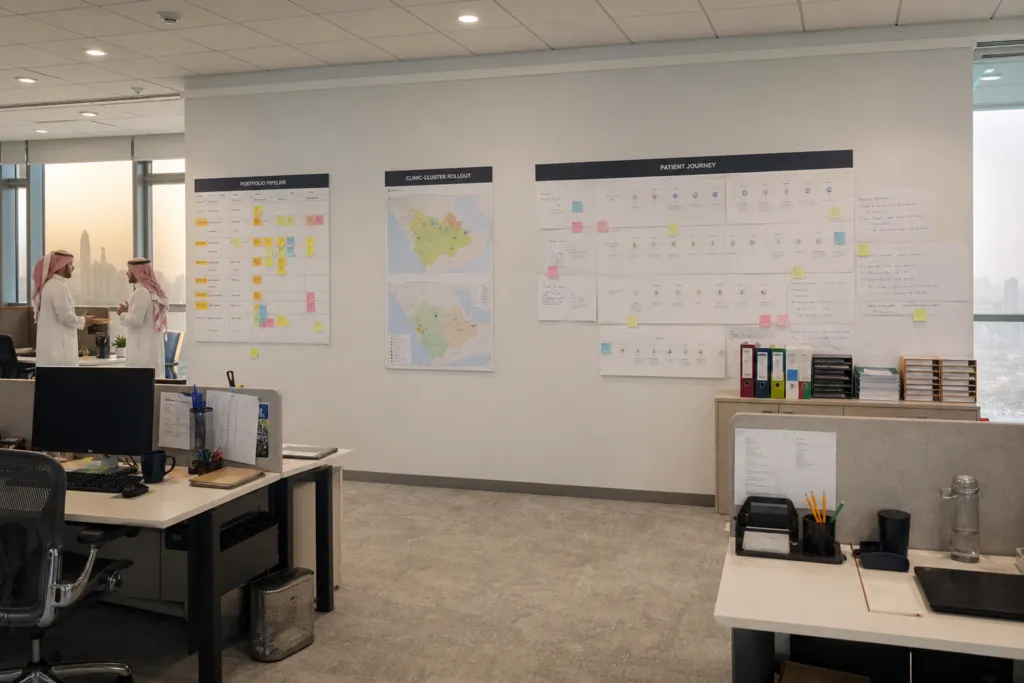
Saudi healthcare innovation is also being shaped by the system it needs to plug into. A Saudi healthtech acquisitions report links investor buying logic to integrated delivery across the Kingdom’s 20 health clusters under a national, prevention-focused Saudi Model of Care. Saudi Health Holding Company (HHC) is described as sitting at the center of this shift, with a network spanning 20 health clusters across all regions of Saudi Arabia. In one example of system-wide deployment, HHC named RapidAI as its enterprise provider of deep clinical AI across the 20 clusters, integrating imaging, reports, and structured clinical data from real-world patient cases to support faster decisions and scalable innovation.
These cluster dynamics matter for venture building because they reward solutions that can be implemented across multiple pathways and multiple regions, not just piloted inside one hospital group. The same report notes the RapidAI deployment explicitly targets neurology, cardiology, vascular, oncology, and orthopedic services, and highlights implementation capacity via Ascend Solutions, described as a local digital solutions provider delivering operational services, training, and optimization. For founders and venture studios, this makes local delivery teams and clinical accountability part of the product, not an afterthought. It also creates a clearer “why now” for studios assembling companies around interoperability and scaled operations.
Capital structure is another tailwind. A Saudi healthtech M&A analysis notes that, effective Feb. 1, Saudi Arabia’s Capital Market Authority removed the Qualified Foreign Investor regime that had been in place since 2015. Under that change, foreign institutional investors no longer need a minimum AUM of $500 million to invest in the Saudi stock market. PitchBook also cited Sahm Capital estimating this can unlock as much as $10 billion in new inflows in public markets, building on 519 billion Saudi riyals already held by foreign investors as of Q3 2025. In parallel, one Saudi VC overview says PIF, through its venture arm Sanabil Investments, has committed over $10 billion to startup investment, while another Vision 2030 funding brief says Sanabil commits approximately $3 billion per year to private investments including venture, growth capital, and small buyouts.
Against that backdrop, the Sanabil-Redesign Health partnership becomes easier to interpret as an operating system for company creation, rather than a single bet. The studio’s stated pipeline includes AI-powered platforms for older adults, surgical referral optimization tools, and chronic pain management businesses. Redesign’s venture-building playbook is reinforced by its own recent capital plans: it banked $175 million in December 2024 to cultivate 20 additional companies focused on healthy aging, expanding sites of service, and interoperability. For Saudi healthcare venture building, the strategic point is repeatability—designing businesses that can align with clusters, partner with institutions, and still fit investor expectations for scalable deployment and credible exit routes.
What is the Sanabil Venture Studio by Redesign Health aiming to do in Saudi Arabia?
What has Redesign Health achieved since it launched in 2018?
How do Saudi Arabia’s 20 health clusters affect scaling healthtech?
What capital-market change could influence exits for Saudi healthtech?
What does Saudi healthcare venture building look like in the Sanabil-Redesign model?
Talk to us for your needs in:
-
Due Diligence and Valuation Services
-
M&A Strategy and Advisory
-
Post-Merger Integration Management
-
Regulatory and Compliance Advisory
-
Market Entry and Expansion Consulting
-
Investment and Financial Analysis
-
In-Depth Market Survey for M&A
-
Market Intelligence and Insights in M&A
-
Feasibility Study and Assessment in M&A
-
Saudi M&A Benchmarking