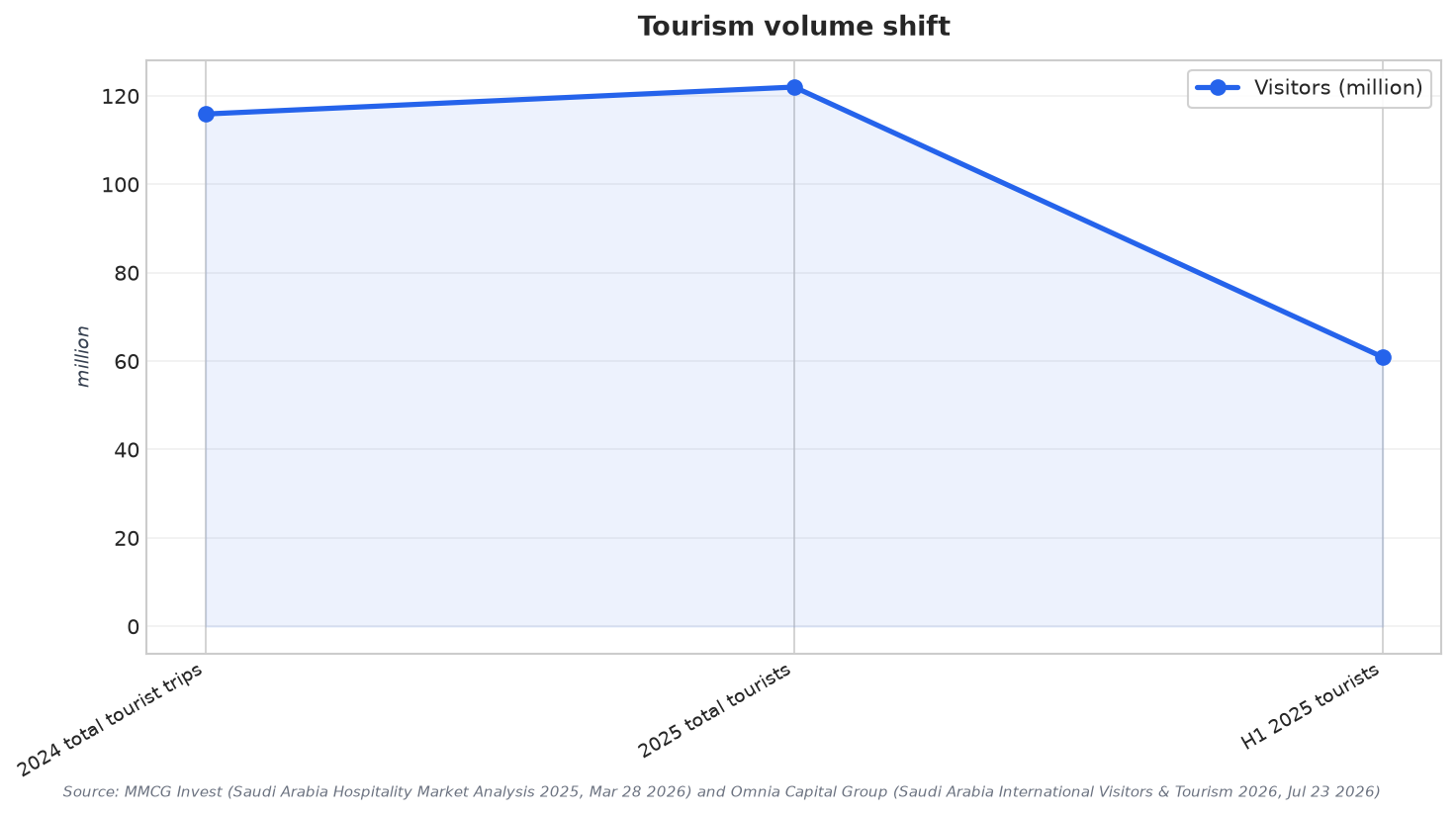
Saudi Arabia is still putting up large tourism volumes, yet parts of the ultra-luxury narrative are meeting market friction. Ministry of Tourism figures cited in multiple reports place 2024 at about 115.9 million total tourist trips, split roughly between 29.7 million international visitors and 86.2 million domestic trips. For 2025, totals are described at about 122 million, with 29.3 million international and 93.3 million domestic, alongside a first half that logged 60.9 million tourists and about SR161 billion of spend. At the same time, a reassessment of execution pace is showing up in how assets are sequenced, financed, and priced, especially where timelines are being pushed out.
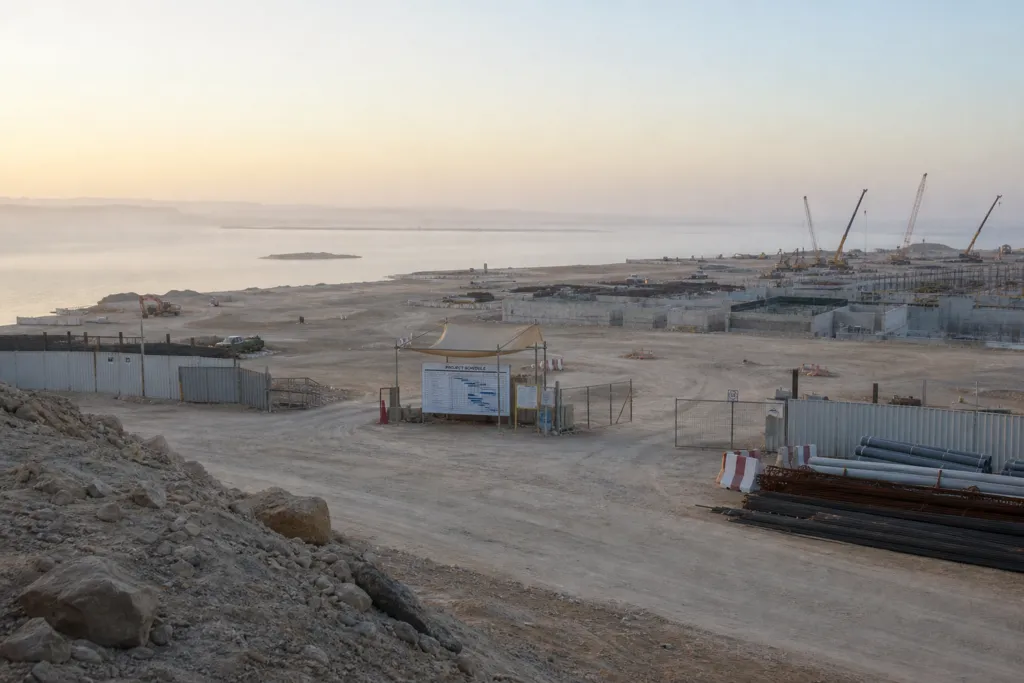
The most investable signal is not a single metric. It is the combination of ongoing demand and a changing project calendar. Mid-February reporting cited in a sovereign capital note said Red Sea Global decided to halt Phase Two construction after 2026 completions, while Trojena’s hosting of the 2029 Asian Winter Games was described as indefinitely postponed after late January reporting. Separately, analysis of Vision 2030’s flagship portfolio notes market “pushback” entering the 2025–2026 fiscal cycle, alongside an IMF warning (in its 2025 Article IV consultation) that non-oil real GDP growth has been decelerating and fiscal exposure to oil price volatility has risen further. For buyers, these dynamics can translate into repricing and a heavier focus on achievable near-term cash flows.
Where Repricing Meets Real Underwriting on the Red Sea
Opportunistic buyers tend to look for asset classes with structural tailwinds, and the Red Sea is being framed as one. ZAWYA describes the Red Sea coastline as roughly 1,846 km long, containing about 1,150 of the Kingdom’s 1,285 islands, with a regulatory layer led by the Saudi Red Sea Authority (SRSA) issuing licenses and setting rules and standards. It also cautions that the headline demand pool is Kingdom-wide: SAR304 billion (about USD81 billion) in combined domestic and inbound spending in 2025, with roughly 123 million visitors and 29.3 million international arrivals. It adds that leisure travel is about 52% of inbound overnight visits, up from 44% in 2019, which matters for underwriting resorts beyond pure pilgrimage seasonality.
But repricing only works if supply and performance assumptions are disciplined. A 2025 hotel market analysis puts national occupancy at about 61.5%, with ADR of $188 and RevPAR of $116, described as flat year-on-year. Under that national average, it reports Riyadh RevPAR fell 5.5% and Jeddah fell 9.6%, while Makkah rose 3.2%. On the supply side, it cites about 45,000 rooms under construction, equal to about 26% of existing stock, and over 92,000 rooms in the total pipeline. For buyers, that pipeline can cap near-term pricing power, which is why paused phases and stretched timelines can be a double-edged catalyst: less immediate competitive supply in some nodes, but longer ramps and more conservative exit assumptions.
Deal selection then becomes about matching the asset to the demand corridor, and stress-testing the narrative. A due diligence checklist citing Mordor Intelligence says the Makkah–Jeddah corridor held 26.62% of market size in 2025, while the Red Sea and wider western coast are expected to expand at an 18.20% CAGR to 2031. The same source cites a USD 29.02 billion market size estimate for 2026 and a projection to USD 40.58 billion by 2031 at a 6.93% CAGR, and notes that chain hotels held 57.74% share in 2025 while OTAs captured 41.65% of transactions. In that context, a pause at Trojena or a staged approach on the coast is not automatically negative; it can be the moment when pricing resets, leverage terms tighten, and buyers win by underwriting what can open, operate, and license cleanly.
What changed at Trojena and Red Sea Global that investors should track?
How big is the current demand base for Saudi tourism, based on reported figures?
How should buyers think about Saudi tourism project delays when pricing assets?
What market signals matter most for hotel underwriting right now?
Why is the Red Sea coast being described as an investable asset class?
Talk to us for your needs in:
-
Due Diligence and Valuation Services
-
M&A Strategy and Advisory
-
Post-Merger Integration Management
-
Regulatory and Compliance Advisory
-
Market Entry and Expansion Consulting
-
Investment and Financial Analysis
-
In-Depth Market Survey for M&A
-
Market Intelligence and Insights in M&A
-
Feasibility Study and Assessment in M&A
-
Saudi M&A Benchmarking