Saudi Arabia’s food and beverage space is moving fast. One source says the market is projected to nearly double, from USD 31.69 billion in 2024 to USD 61.77 billion by 2032. Another source values the Saudi F&B market at USD 24.29 billion in 2024 and expects it to reach USD 28.76 billion by 2030. In that kind of growth story, strategic acquirers often look for quicker scale than organic expansion can deliver.
For a quick snapshot of why scale matters, consider three operational signals in the Kingdom: the QSR segment holds a 40% market share of the total foodservice sector, there are over 55,000 registered food and beverage outlets, and cashless transactions accounted for 70% of total sales in 2023. These numbers help explain why buyers want bigger platforms with consistent execution.
A roll-up is a series of one-at-a-time acquisitions in a specific industry. A legal guide explains why buyers pursue roll-ups: rapid expansion that organic growth generally can’t match, stronger market power, and higher efficiency. It also notes benefits to acquired businesses, such as greater name recognition, economies of scale, geographic expansion of the brand name, and improved employee and management benefits.
What Strategic Acquirers Want From a Saudi Restaurant Platform
In Saudi food and beverage M&A, a strategic acquirer is often buying a repeatable operating system, not just a logo. The market has many locations to integrate, with over 55,000 registered outlets. The QSR segment’s 40% share highlights how much of the market depends on speed, standardization, and unit-level discipline. And average spend per transaction at QSR is $12, which pushes buyers to focus on volume, convenience, and tight execution.
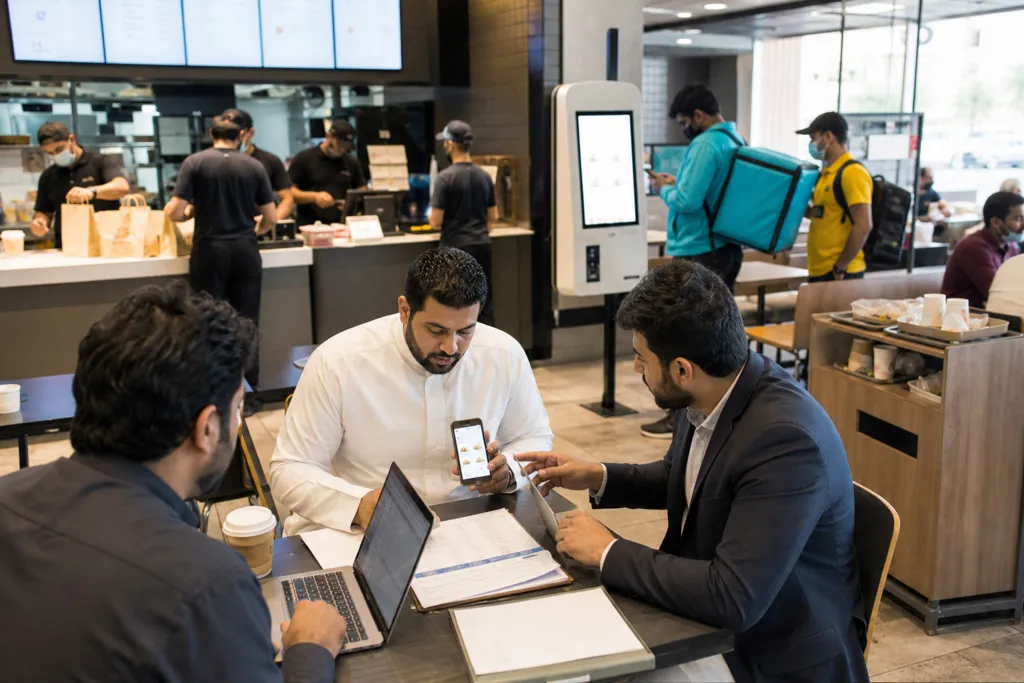
Digital behavior is another reason chains get rolled up. One data set says 60% of Saudi consumers prefer ordering food via mobile apps rather than phone calls. Cashless transactions also accounted for 70% of total sales in 2023. For acquirers, this supports investment in common ordering flows, loyalty, and shared systems across brands, instead of each chain building its own stack.
Buyers also need a plan that fits Saudi’s compliance reality. One investor guide highlights licensing through the Ministry of Investment Saudi Arabia (MISA) for 100% foreign ownership. It also notes a joint venture structure where a Saudi partner holds at least 25%. On taxes, it states Zakat is 2.5% on net assets for Saudi or GCC majority-owned companies, while foreign-owned entities are subject to corporate income tax. It also notes a 15% withholding tax may apply to profit repatriation and that VAT grouping under a holding company can simplify filing across branches.
Finally, scale helps beyond the front of house. A distribution overview says Saudi Arabia has strict import regulations and food safety standards, and distributors help navigate licensing, customs clearance, and SFDA regulations. It adds that distributors facilitate product registration and ensure imported goods meet halal certification and labeling requirements. For a roll-up buyer, aligning procurement and distribution can reduce friction as the platform grows.
What is a roll-up acquisition, and why does it fit restaurant chains?
What data signals are pushing Saudi food and beverage M&A activity?
Why do strategic buyers care about digital ordering in Saudi Arabia?
What ownership and tax points can shape deal structure in Saudi Arabia?
Talk to us for your needs in:
-
Due Diligence and Valuation Services
-
M&A Strategy and Advisory
-
Post-Merger Integration Management
-
Regulatory and Compliance Advisory
-
Market Entry and Expansion Consulting
-
Investment and Financial Analysis
-
In-Depth Market Survey for M&A
-
Market Intelligence and Insights in M&A
-
Feasibility Study and Assessment in M&A
-
Saudi M&A Benchmarking