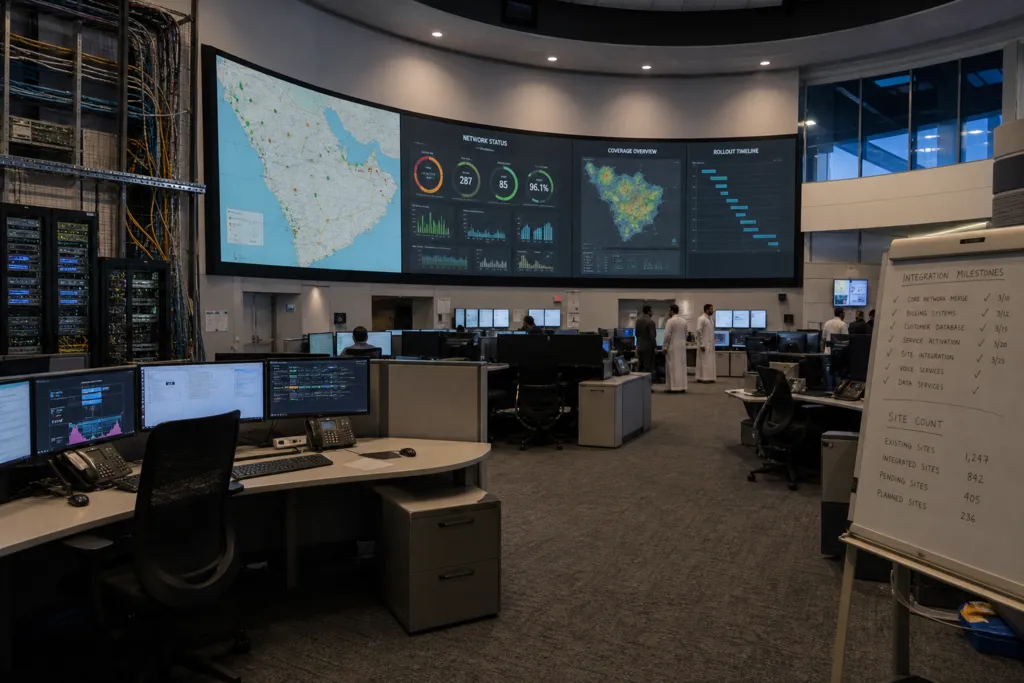
Saudi Arabia’s telecom tower story is increasingly about consolidation, scale, and monetization. A key milestone is the TAWAL GLIC merger outcome described as a combination completed by the Public Investment Fund (PIF) that creates a tower player with a 30,000-mast portfolio. This matters because it aligns with a wider push that sources connect to Vision 2030 and to PIF’s approach to asset consolidation. At the same time, the operating thesis is shifting away from “more towers at any cost” and toward extracting value from passive infrastructure through co-location, long-term lease structures, and targeted upgrades.
Scale is also being reinforced by deal talk. Reporting in July 2026 said PIF-backed TAWAL was in talks to acquire more than 10,000 sites from Mobily, Saudi Arabia’s second-largest mobile operator, according to people familiar with the matter. The same reporting said that, if completed, the transaction would make TAWAL one of the region’s biggest telecom tower owners and give it monopoly power over the kingdom’s mobile tower infrastructure. It also said TAWAL would then be expected to start preparing for an IPO that could occur in 2027 or 2028, positioning the enlarged platform as a potential public-market story.
Why A 30,000-Site Base Changes the IPO Narrative
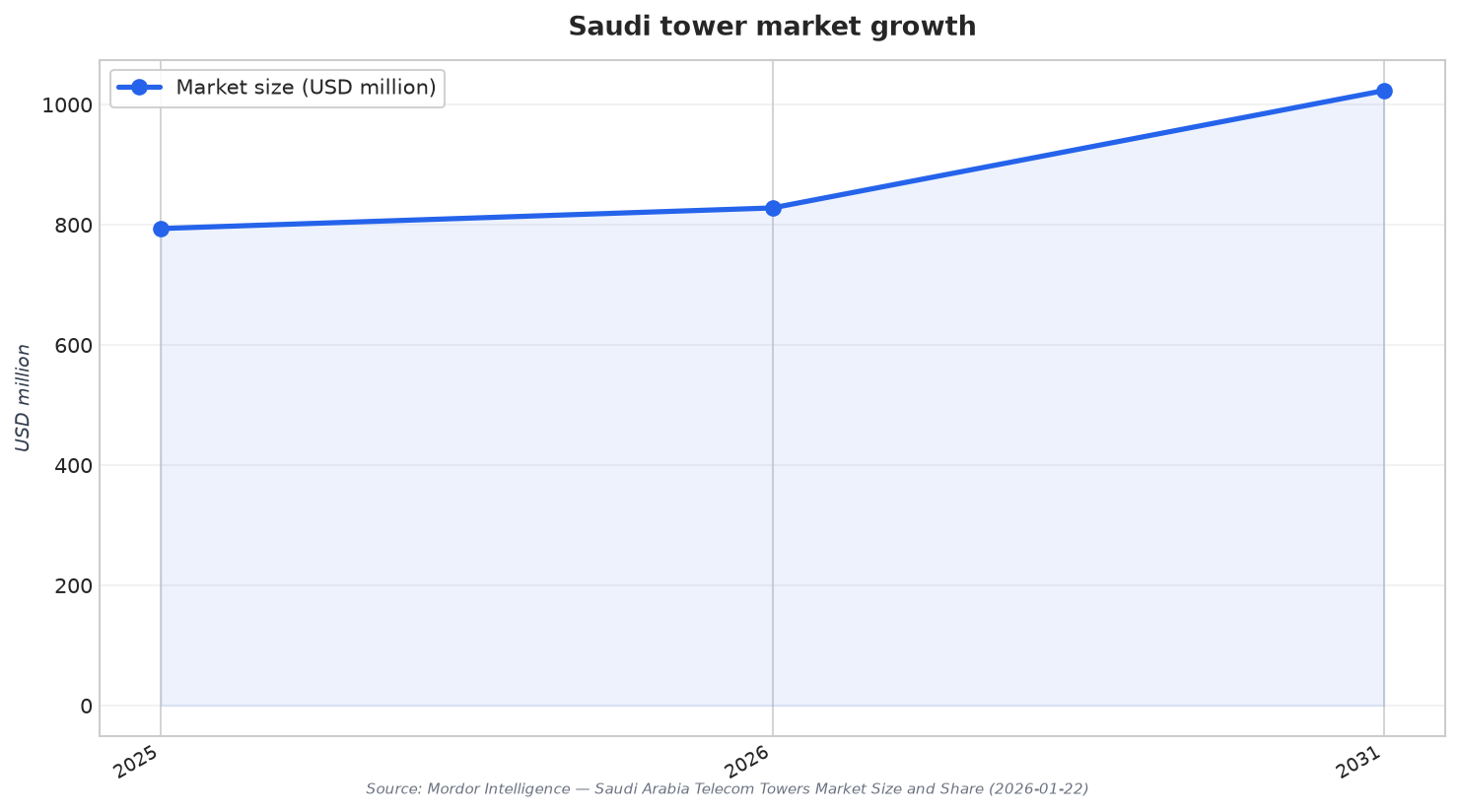
Market structure trends help explain why a larger, consolidated TowerCo could be marketed as more “IPO-ready.” Mordor Intelligence estimated the Saudi Arabia telecom towers market at USD 793.80 million in 2025 and USD 828.09 million in 2026, with projections reaching USD 1023.28 million by 2031, implying 4.32% CAGR over 2026–2031. In that same view, independent TowerCos held 59.02% of market share in 2025, and operator divestitures were forecast to lift that segment at a 6.28% CAGR through 2031. Those figures frame a sector where ownership is already tilting toward specialist infrastructure vehicles rather than mobile operators.
The operating playbook is also evolving in ways that reward portfolio scale. Mordor Intelligence described densification pressures from 5G spectrum releases, noting that equal 3.4–3.8 GHz assignments to all three mobile operators redirected competition toward network-quality metrics and an aggressive build program that may lift site densities three to five times above LTE norms. Within the same report, rooftop deployments were projected to expand at a 5.87% CAGR from 2026–2031, and stealth and concealed structures were cited as the fastest-growing design at an 8.61% CAGR through 2031. Power modernization is part of the picture too, with renewable-only towers progressing at a 16.41% CAGR to 2031, even as grid-and-diesel hybrids accounted for 78.35% of market size in 2025.
Finally, the broader “digital infrastructure” backdrop can support the investor narrative, but it must be read as global context rather than Saudi-specific performance. One report estimated the global digital infrastructure market at USD 365 billion in 2025 and expected it to reach between USD 438 billion in 2026 and about USD 2297 billion by 2035, with a 20.2% CAGR from 2026 to 2035. Another report projected the digital infrastructure market to reach USD 1.08 trillion by 2031, growing at a 20.05% CAGR from 2026 to 2031, while also stating that the colocation segment represented the highest revenue share in 2025 at 36% and that IT and telecom held a 24% share in 2025. For an enlarged tower platform emerging after the TAWAL–GLIC combination, those global signals can strengthen the “infrastructure-as-an-asset-class” framing around an IPO path that sources say could be targeted for 2027 or 2028.
What did the TAWAL and GLIC transaction create?
How many towers does TAWAL own across its footprint?
What additional deal is TAWAL reported to be discussing with Mobily?
How does the Saudi telecom towers market outlook look in the sources?
When do sources suggest an IPO could happen after the TAWAL GLIC merger consolidation phase?
Talk to us for your needs in:
-
Due Diligence and Valuation Services
-
M&A Strategy and Advisory
-
Post-Merger Integration Management
-
Regulatory and Compliance Advisory
-
Market Entry and Expansion Consulting
-
Investment and Financial Analysis
-
In-Depth Market Survey for M&A
-
Market Intelligence and Insights in M&A
-
Feasibility Study and Assessment in M&A
-
Saudi M&A Benchmarking