
Nomu is Tadawul’s parallel equity market for growth-stage Saudi SMEs, launched on 26 February 2017 with lighter listing requirements than the main market. Participation is limited to qualified investors under Capital Market Authority rules, while disclosure and governance expectations still apply. The practical effect is a public-market “on-ramp” for smaller firms that would struggle to meet main-market thresholds. Arab News described it as a “training ground” where companies strengthen governance, adapt to public-market discipline, and build investor credibility before transitioning. In that context, the Saudi Nomu parallel market M&A story is less about sudden exits and more about how listed SMEs become easier to assess, compare, and integrate when buyers look for scaled, governable targets.
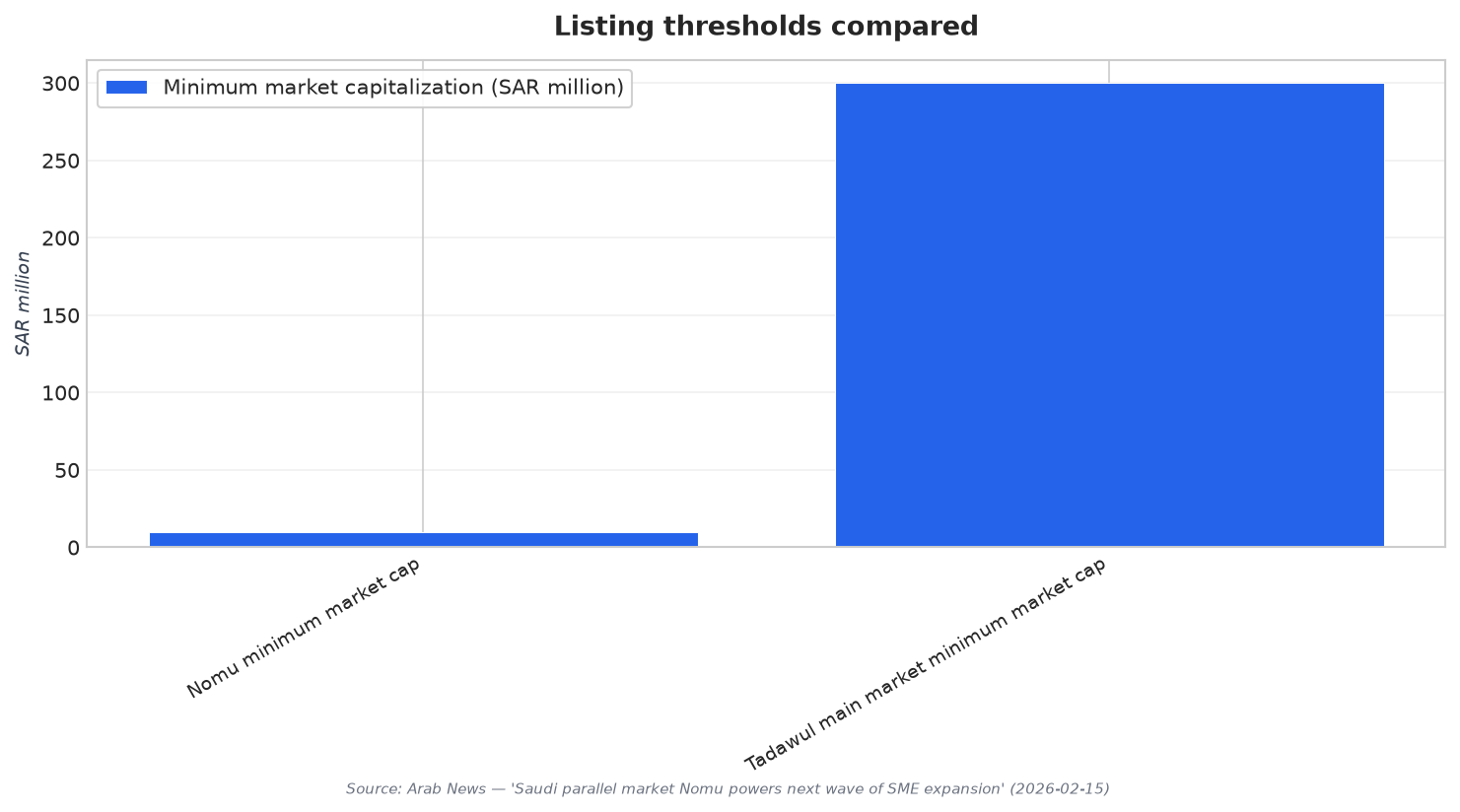
Entry requirements illustrate why Nomu can widen the funnel of publicly visible companies. Wikipedia notes a minimum market cap of SAR 10 million ($2.6 million), at least 20% of shares owned by the public, and at least 50 public shareholders at the time of listing. Arab News also highlights the minimum market capitalization requirement of SR10 million ($2.67 million) and contrasts it with the Tadawul main market’s SR300 million threshold. The same Arab News report adds that, by end-2025, over 125 companies were listed on Nomu. That expanding roster increases the number of companies with market pricing, disclosures, and a public track record—ingredients that can make commercial discussions, including strategic combinations, more structured than purely private negotiations.
Why Nomu Listings Can Translate Into Main-Market Readiness
The bridge from Nomu to the main market is explicit in how advisors and policymakers describe the platform. The Nomu market design requires companies to appoint a nominated advisor (a financial advisor) to guide regulatory compliance and act as an intermediary with the market operator. Arab News adds another practical step: the parallel market can function as a springboard to professionalize management and corporate governance, allowing companies to eventually transition to the main market after being publicly listed on Nomu for at least two years. This sequencing matters because main-market listings, as cited by Zawya, tend to benefit from stable, government-linked revenue tied to large-scale development projects, while Nomu attracts institutional investors looking for smaller companies with solid profitability and disciplined valuations. Together, these dynamics encourage SMEs to formalize operations early, which can also reduce friction when counterparties evaluate partnerships, acquisitions, or consolidation.
Sector mix is another reason Nomu can feed future deal pipelines, especially in areas aligned with diversification. Arab News reports that more than 60% of Nomu-listed firms operate in sectors such as technology, healthcare, and logistics. The Arabian Mirror echoes that non-oil industries including technology, healthcare, consumer services, logistics, and education account for almost 60% of listed businesses. Zawya’s discussion of the renewed pipeline also points to issuer activity returning after cancellations or delays, naming Kesay Clinics and Mayar Holding’s subsidiary Ziorak Company as examples of names advancing. That combination—an expanding base of listed SMEs plus a concentration in scalable service sectors—creates more opportunities for strategic buyers to screen targets, compare valuations, and prioritize add-on acquisitions that fit growth themes.
Nomu’s role sits within a broader push to deepen Saudi capital markets under Vision 2030. A Tadawul-focused pipeline analysis notes the Capital Market Authority’s target to significantly increase the number of Tadawul-listed companies, describing a structural pipeline of offerings. It also outlines three primary sources of new listings: PIF subsidiary listings, private sector IPOs, and international company listings. In parallel, Arab News frames Nomu as a channel that supports diversification and references the goal of raising the SME contribution to GDP from 20% to 35% by 2030. Put together, Nomu is not only a financing venue; it can also standardize governance and disclosure for a growing pool of SMEs. That makes the journey “from Nomu to main market” a practical pathway that can support the visibility and readiness that corporate buyers often want before moving from interest to execution.
What is Nomu, and when was it launched?
How do Nomu listing requirements compare with the Tadawul main market?
How many companies were listed on Nomu by end-2025?
Which sectors dominate Nomu listings?
How can the Saudi Nomu parallel market influence M&A pipelines?
Talk to us for your needs in:
-
Due Diligence and Valuation Services
-
M&A Strategy and Advisory
-
Post-Merger Integration Management
-
Regulatory and Compliance Advisory
-
Market Entry and Expansion Consulting
-
Investment and Financial Analysis
-
In-Depth Market Survey for M&A
-
Market Intelligence and Insights in M&A
-
Feasibility Study and Assessment in M&A
-
Saudi M&A Benchmarking