
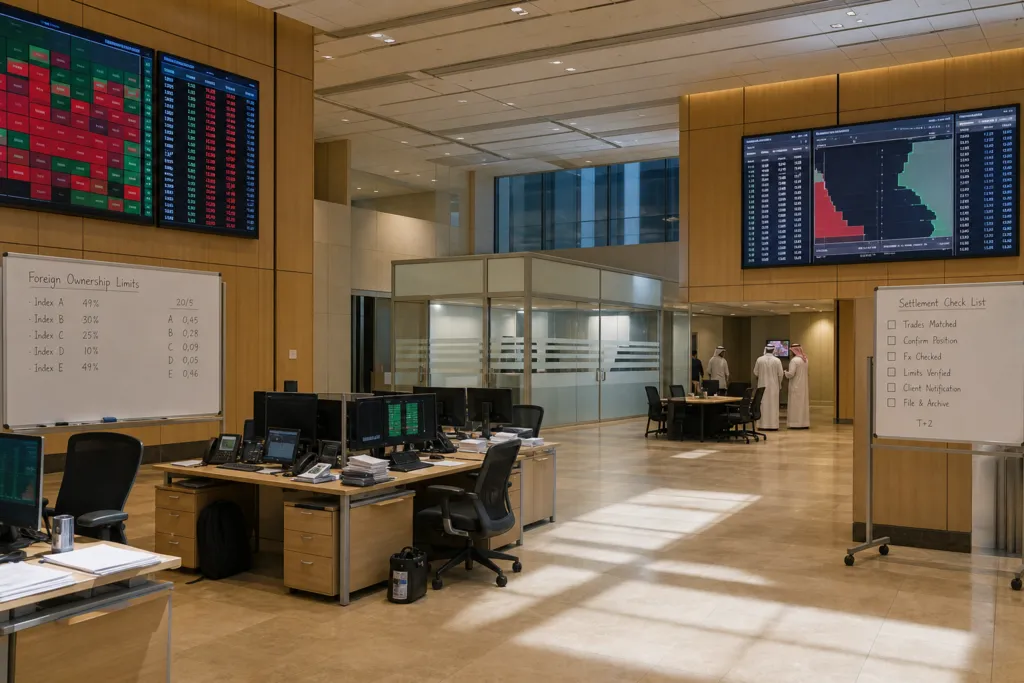
Saudi Arabia’s Capital Market Authority (CMA) has implemented a major reform that changes how non-resident capital can enter listed Saudi equities. Effective Feb. 1, 2026, the CMA opened the Saudi equity market to all categories of foreign investors and abolished the Qualified Foreign Investor (QFI) regime that has governed access since 2015. Under the new approach, foreign investors—both institutional and individual—can invest directly in shares listed on Tadawul’s Main Market (TASI) through licensed Saudi intermediaries, without meeting prior qualification thresholds or obtaining special status. The CMA also removed the regulatory framework for equity swap arrangements, which had been used to provide synthetic exposure when direct access was constrained.
This overhaul matters for dealmaking because it changes how international buyers can build and hold stakes, and how they can approach listed-company influence. Multiple sources emphasize that the reform replaces the prior QFI and swap regimes with a more unified path for non-resident participation and investor rights. At the same time, the opening is not unlimited. Foreign ownership limits remain in place, including a 49% aggregate foreign ownership cap and a 10% limit per single foreign investor, subject to limited strategic investor exceptions. For inbound M&A planning, those caps can shape whether a buyer pursues a listed-to-listed structure, a strategic exception route, or a combination of on-market accumulation and negotiated blocks within permitted thresholds.
What the QFI Overhaul Changes for Inbound M&A Execution
Before the latest amendments, Saudi Arabia’s framework gated direct participation. The CMA designed QFI as a phased liberalization tool, and at launch the minimum assets under management were described as high at approximately $5 billion. Another source notes that under previous rules, QFIs were required to maintain around $500 million in assets under management to participate. Regardless of which historic threshold applied at different times, the practical impact was that smaller institutions and individuals faced structural and administrative barriers, and the market relied on synthetic exposure structures. With the QFI concept removed from the Main Market rulebook and the swap framework eliminated, foreign investors can now hold direct legal title to listed securities and exercise shareholder rights—features that can matter when buyers seek voting outcomes, board influence, or clean proof of ownership during a transaction.
Inbound M&A interest often follows liquidity and participation signals, and the sources provide several indicators of growing foreign involvement. International investor ownership in the Saudi capital market exceeded SAR 590 billion by the end of Q3 2025. In the same period, international investments in Tadawul’s TASI reached around SAR 519 billion, up from SAR 498 billion at the end of 2024. Another market commentary adds that in January, foreign investors were net buyers of roughly SR 5 billion (about $1.33 billion). It also reports that by late January, foreign-held shares climbed to about $124.1 billion, with foreign investors holding nearly 13% of free-floating shares and 4.9% of total listed shares, and representing about 41.7% of total market purchases in January. In an M&A context, these figures can support the investment case for deeper foreign engagement, while also highlighting the need to understand how free float, total listed shares, and caps interact when building a compliant stake.
For practitioners, the practical takeaway is that Tadawul foreign investor access is now structurally simpler, but transaction strategy still depends on regulatory perimeter and ownership math. The CMA described the amendments as part of a gradual approach, with further complementary phases aimed at enhancing market openness and positioning the capital market to attract greater foreign capital inflows. For inbound M&A teams, that suggests three immediate workstreams: confirm target-level foreign ownership headroom against the 49% aggregate and 10% per-investor limits; reassess whether any legacy swap-based exposure is still needed (the framework has been abolished); and update diligence and execution steps to reflect that non-residents can hold shares directly and exercise shareholder rights from Feb. 1, 2026 onward. The result is a cleaner entry route, paired with clearer constraints that must be engineered into the deal from day one.
When did Saudi Arabia open Tadawul’s Main Market to all foreign investors?
What happened to the Qualified Foreign Investor (QFI) and swap regimes?
What foreign ownership limits still apply after the reforms?
What do recent figures show about foreign participation in Saudi equities?
How does the opening affect Tadawul foreign investor access for inbound M&A planning?
Talk to us for your needs in:
-
Due Diligence and Valuation Services
-
M&A Strategy and Advisory
-
Post-Merger Integration Management
-
Regulatory and Compliance Advisory
-
Market Entry and Expansion Consulting
-
Investment and Financial Analysis
-
In-Depth Market Survey for M&A
-
Market Intelligence and Insights in M&A
-
Feasibility Study and Assessment in M&A
-
Saudi M&A Benchmarking