Saudi Arabia’s data center market is expanding quickly, and that growth is turning infrastructure into a strategic asset. One set of forecasts values the market at USD 2.08 billion in 2025 and projects it reaching USD 6.17 billion by 2031, a CAGR of 19.84%. The same snapshot points to 308 MW of power capacity and 1,232 thousand sq. feet of area by 2031, with colocation revenue projected at USD 2.16 billion. That combination—rising demand plus clearer capacity roadmaps—helps explain why platform control is becoming a core goal for acquirers, not just optional exposure.
Policy and procurement are another accelerant because they shape demand into contracted, sovereign workloads. Mandatory cloud-first directives require ministries and public agencies to offload legacy workloads into sovereign infrastructure by 2027. The Saudi Data and Artificial Intelligence Authority’s Million Saudis for AI program aims to graduate 20,000 local experts by 2030, which supports long-term compute adoption. The same source notes multi-year procurement contracts already signed by core ministries, creating more predictable cash flows for operators. It also cites HUMAIN’s USD 100 billion backing as a factor that de-risks long-tenor infrastructure returns by reinforcing domestic consumption.
Hyperscalers, Networks, and Smart Cities Are Redrawing the Map
Hyperscalers are locking in long-horizon plans that can reshape where capacity clusters, and that can elevate the value of scarce, well-connected platforms. AWS committed USD 5.3 billion to launch its first local cloud region by 2026, while Microsoft established a regional headquarters in Riyadh with additional capacity pipelines expected to follow. The same analysis argues that hyperscaler arrival triggers a multiplier effect as systems integrators, security vendors, CDNs, and SaaS providers co-locate to reduce latency and interconnect fees. In parallel, the Communications, Space and Technology Commission auctioned 600 MHz, 700 MHz, and 3.8 GHz bands in 2024, expanding licensed mobile spectrum by 27% and enabling urban 5G download speeds beyond 250 Mbps.
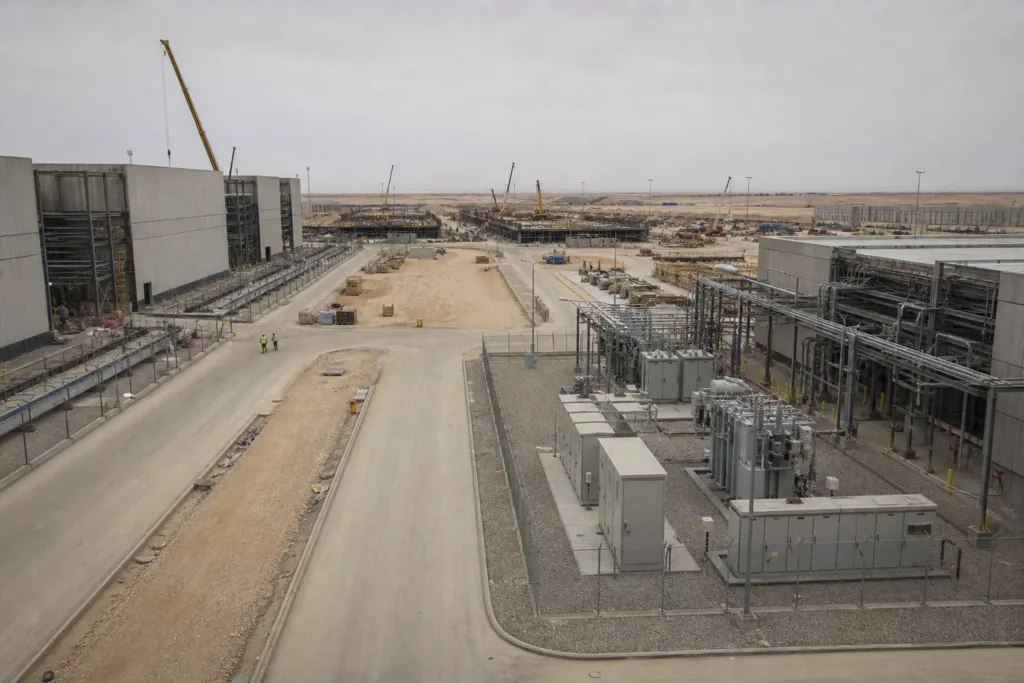
Megaprojects and AI-ready builds add another layer of urgency because they can require high-density, high-uptime design. NEOM’s DataVolt partnership lines up USD 5 billion for 1.5 GW of AI-optimized capacity by 2028, described as a net-zero “compute refinery” powered largely by solar and wind. In December 2025, center3 (a subsidiary of stc) signed an MoU with HUMAIN to develop multiple AI-ready data centers across the Kingdom. Separately, another market source points to around USD 18 billion in investments for hyperscale data centers, with a target of reaching 1,300 MW of data center capacity before 2030, while noting a 25% shortage of skilled engineers and technicians reported by TVTC in early 2024.
In this environment, acquisition logic becomes clearer: buyers can seek platforms that already control land, power paths, delivery teams, and customer pipelines across multiple cities. Expansion is no longer framed as a single-hub story; Riyadh, Jeddah, NEOM, Makkah, Madinah, Al Qassim, and Al Ahsa are all cited as gaining traction for new projects, while Dammam is described as a leading destination due to fiber, dependable power infrastructure, and proximity to industrial zones. Sustainability is also becoming an investment filter. IRENA reports renewables were approximately 5% of Saudi Arabia’s total electricity generation in 2024, with solar around 92% of renewable output and wind roughly 8%—a context that supports operators investing in lower-carbon infrastructure, including liquid cooling and HVO-powered backup alternatives.
What market growth signals are shaping Saudi data center deals in 2026?
How do government directives change demand for data-center platforms?
Which hyperscaler commitments are most cited in Saudi Arabia?
What AI and megaproject capacity plans are driving new builds?
Why is sustainability now part of data-center investment decisions in Saudi Arabia?
Talk to us for your needs in:
-
Due Diligence and Valuation Services
-
M&A Strategy and Advisory
-
Post-Merger Integration Management
-
Regulatory and Compliance Advisory
-
Market Entry and Expansion Consulting
-
Investment and Financial Analysis
-
In-Depth Market Survey for M&A
-
Market Intelligence and Insights in M&A
-
Feasibility Study and Assessment in M&A
-
Saudi M&A Benchmarking