

Provider roll-ups are becoming a defining theme in Saudi private hospitals. Sector reporting describes “high consolidation amid low bed density,” while warning that rising bed density in Riyadh can elevate execution risk and margin sensitivity, especially for operators concentrated in one region. The competitive context is broad: the Kingdom’s healthcare landscape has 516 hospitals, and the public sector has been ceding share to the private sector. In that environment, scale is not just about branding. It is about having the operational depth to ramp new sites, standardize service lines, and withstand pricing pressure as more beds and more providers compete for similar patient flows.
These roll-ups sit inside a wider investment cycle. Vision 2030 allocates SAR 260 billion for health and social development in the 2025 budget, described as a 12% increase from the previous year. The same source links funding to 12 new medical cities and upgrades to 150 existing facilities, each driving multi-year purchasing needs for disposables, sterilizers, and monitors. A privatization roadmap is also cited, covering 290 hospitals and 2,300 primary health centers, and it introduces pay-for-performance models that reward outcomes such as lower infection rates. For hospital platforms, acquisitions can be a way to spread the fixed cost of compliance, procurement, and clinical governance across a larger base while keeping pace with system-wide modernization.
Why Scale Matters More When Payors and Procurement Go Digital
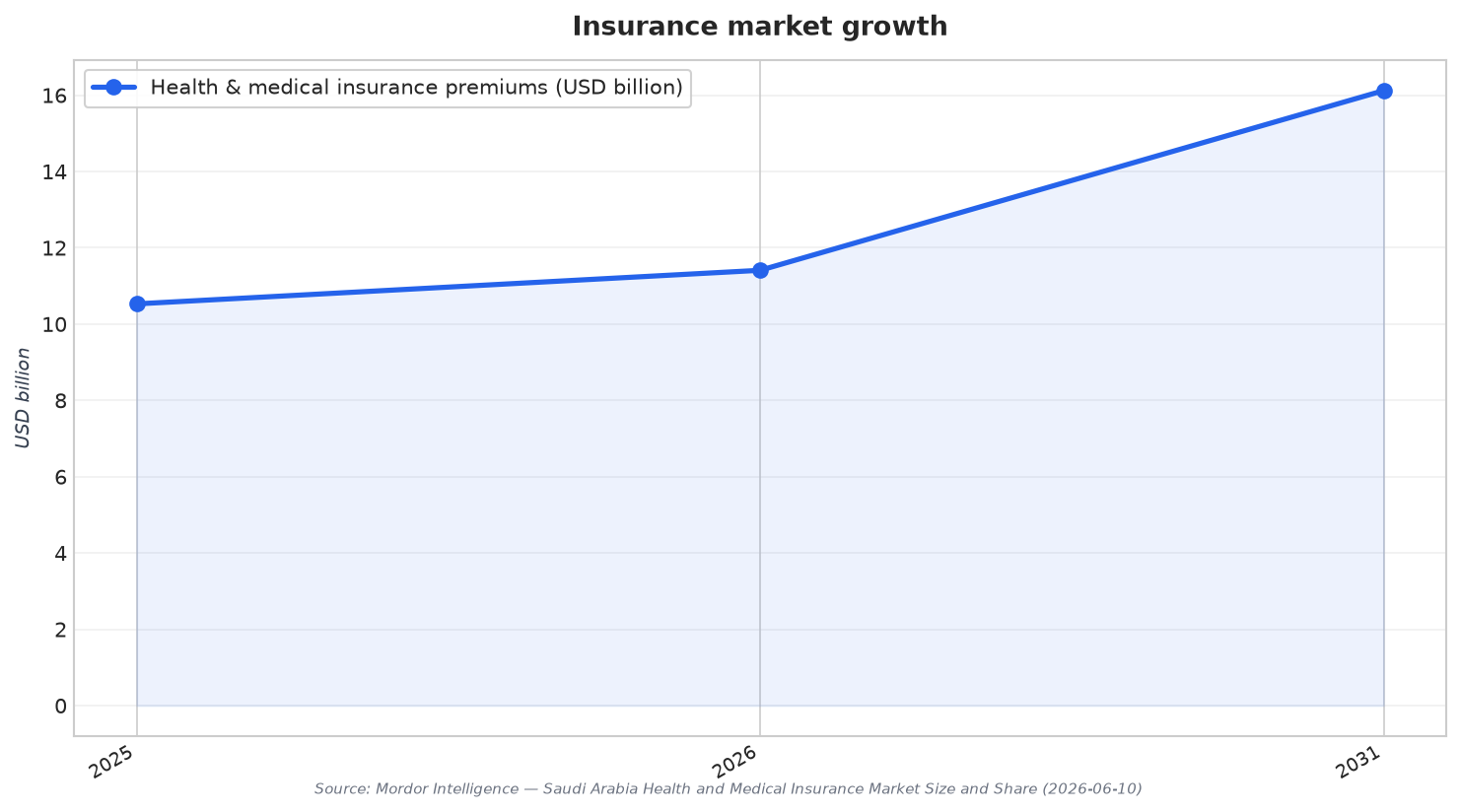
The payor layer is expanding, and it is getting more digital, which changes the operating model for providers. Saudi Arabia’s health and medical insurance market (premium value) was valued at USD 10.53 billion in 2025 and is estimated to grow from USD 11.41 billion in 2026 to USD 16.12 billion by 2031, at a 7.16% CAGR. Group health led with a 71.33% share in 2025, and inpatient cover accounted for 67.44% of the market that year. Mordor Intelligence also notes that real-time e-claims through NPHIES can improve settlement speeds, lower denial rates, and reduce working-capital pressures for providers. Digital consumer behavior reinforces this shift: the Sehhaty app has over 24 million users, about 68.5% of the population. Larger hospital groups can use scale to invest in billing, claims, and patient access systems that match these evolving expectations.
Consolidation also influences how hospital groups buy and manage equipment and supplies, where standardization can translate into negotiating leverage. In the hospital supplies market, disposable hospital supplies held 48.81% share in 2025, while hospitals captured 64.38% of spending that year. Surgical and trauma care led with a 37.73% revenue share in 2025, and operating-room equipment is projected to expand at a 7.73% CAGR through 2031. Device procurement dynamics show similar operational incentives. In Saudi Arabia’s cautery machine market, overseas suppliers account for an estimated 80–90% of total unit supply, and SFDA medical device registration is described as creating a 6–12 month qualification timeline for new suppliers. For acquirers, a unified procurement and compliance playbook can reduce friction across newly added sites and support faster integration.
Within this backdrop, a Dallah Healthcare acquisition strategy can be read as part of a broader provider response to competition, digitization, and capacity ramp-up risk. Sector commentary flags how long ramp-ups can take in Riyadh, citing Fakeeh’s acquisition of a 180-bed Riyadh hospital in 2022 and its relaunch in March 2023 as an illustration of prolonged ramp-up cycles. It also references negotiations around a possible divestment of a 31% stake in Dr. Mohammed Rashid Al-Faqih Company to Fakeeh Care Group, describing it as a 350 beds hospital, while noting the transaction was not incorporated into a base case due to ongoing talks. Globally, a scoping review of 133 studies—most centered on the U.S. context (>70%)—catalogs 22 market strategies private hospitals use to reduce rivalry, raise entry barriers, and increase buyer and seller power. In Saudi Arabia, the practical outcome is straightforward: roll-ups aim to build resilient platforms that can scale services, align with payor workflows, and compete in an increasingly concentrated private market.
What is driving provider roll-ups in Saudi private hospitals?
How does insurance growth affect hospital consolidation in Saudi Arabia?
Why do digital tools matter for hospital groups pursuing acquisitions?
What operational risks come with expanding hospital capacity in Riyadh?
How can a Dallah Healthcare acquisition strategy connect to procurement advantages?
Talk to us for your needs in:
-
Due Diligence and Valuation Services
-
M&A Strategy and Advisory
-
Post-Merger Integration Management
-
Regulatory and Compliance Advisory
-
Market Entry and Expansion Consulting
-
Investment and Financial Analysis
-
In-Depth Market Survey for M&A
-
Market Intelligence and Insights in M&A
-
Feasibility Study and Assessment in M&A
-
Saudi M&A Benchmarking