
Saudi Arabia’s deal environment in 2026 is being framed around exits and consolidation. Philip Bahoshy, CEO of venture data platform MAGNiTT, told Arab News he expects a shift from 2025’s funding momentum to a year defined by exits, including “a record year of merger and acquisition transactions.” He also said Saudi Arabia is “likely to see one, if not two, IPOs happening within the Kingdom.” That mix matters for capital planning, because acquisitions often need a blend of committed liquidity and refinancing options, not just equity stories or late-stage venture rounds.
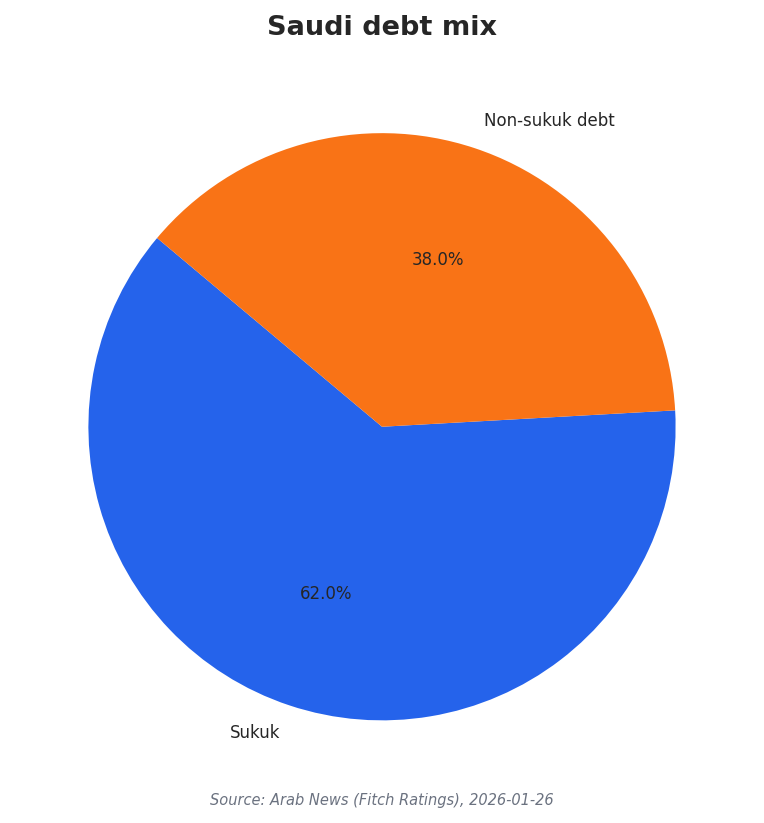
Debt markets are a central part of that backdrop. Fitch Ratings said outstanding Saudi debt surpassed $520 billion in 2025, an annual increase of 21 percent, and that sukuk accounted for roughly 62 percent of the total. Fitch also expects Saudi Arabia’s debt capital market to reach $600 billion in outstanding issuance by the end of 2026. Within this context, Saudi acquisition financing can lean on structures that investors already understand, especially where Shariah-compliant issuance is a large share of the market rather than a niche product.
Why Sukuk Benchmarks and Tranches Matter for M&A Funding
Saudi Arabia’s government sukuk program is being used to build a curve across maturities, which can support pricing and refinancing around corporate activity. Economy Middle East reported Saudi Arabia raised $4.11 billion in its March 2026 sukuk issuance, split into six tranches. The first tranche was SAR 1.154 billion maturing in 2029, the second was SAR 11 million maturing in 2031, and the third was SAR 365 million maturing in 2033. The National Debt Management Center also said the fourth tranche was SAR 3.452 billion maturing in 2036, and the fifth was SAR 5.4 billion maturing in 2039. Separately, official data cited by GCMA said Saudi Arabia raised SR 10.57 billion ($2.81 billion) through its June sukuk issuance, up 338.58 percent from the previous month.
Large, planned issuance sits alongside retail-style instruments that can broaden participation. Arab News reported Saudi Arabia opened subscriptions for its January “Sah” savings sukuk with an annual return of 4.73 percent, up from 4.68 percent in the previous month, and said the instrument carries no fees and offers easy redemption. Traders Union also reported that in May the National Debt Management Center issued SAR 60 billion (US $16 billion) of sukuk and bought back debt due from 2025 to 2029. These actions signal active debt management and refinancing, which can influence how acquirers structure timelines, bridge needs, and post-deal liability profiles.
Syndicated debt is another pillar that can sit next to sukuk in a capital stack. Arab News reported the National Debt Management Center successfully arranged a seven-year syndicated loan amounting to $13 billion aimed at supporting power, water, and public utilities projects. Fitch also highlighted that private funding channels, syndicated financing, and certificates of deposit for banks are expected to remain among the prominent alternative funding sources in Saudi Arabia. At the same time, Fitch cautioned that Saudi Arabia’s debt capital market is exposed to oil price sensitivity, interest rate volatility, evolving Shariah requirements for sukuk, and geopolitical risks, all of which can affect funding costs and investor sentiment during acquisition cycles.
What is driving expectations for more M&A activity in Saudi Arabia in 2026?
How big is Saudi Arabia’s debt market according to Fitch, and why does that matter for acquisitions?
What role does sukuk play in Saudi debt, based on Fitch’s figures?
What recent 2026 sukuk activity shows how Saudi Arabia is building maturities?
How do syndicated loans fit into Saudi acquisition financing strategies mentioned in the sources?
Talk to us for your needs in:
-
Due Diligence and Valuation Services
-
M&A Strategy and Advisory
-
Post-Merger Integration Management
-
Regulatory and Compliance Advisory
-
Market Entry and Expansion Consulting
-
Investment and Financial Analysis
-
In-Depth Market Survey for M&A
-
Market Intelligence and Insights in M&A
-
Feasibility Study and Assessment in M&A
-
Saudi M&A Benchmarking