Saudi cybersecurity deal logic in 2026 is being shaped by a simple reality: demand is rising, and delivery capacity matters. MarketsandMarkets projects the Kingdom of Saudi Arabia cybersecurity market will grow from USD 4.98 billion in 2026 to USD 7.81 billion by 2031, at a 9.4% CAGR. Mordor Intelligence estimates a different baseline and curve, placing the Saudi Arabia cybersecurity market at USD 2.42 billion in 2026 and projecting USD 4.02 billion by 2031 at a 10.66% CAGR. Even with different models, both narratives point to expanding spend, which can pull buyers toward firms that already have customers, clearances, and operational depth inside the Kingdom.
Why do acquirers look at cybersecurity services first? Because the market mix favors ongoing operations over one-time implementations. MarketsandMarkets says managed services account for the largest market share, citing organizations outsourcing security operations to address evolving threats and workforce shortages. The same source highlights demand for managed SOC, MDR, cloud security, and continuous monitoring, with NCA and sector regulators accelerating requirements for 24/7 monitoring, incident response, and compliance support. In parallel, Mordor Intelligence reports Solutions led with a 55.30% revenue share in 2025, while Services are projected to grow at an 11.53% CAGR through 2031, creating an incentive to buy delivery teams and recurring contracts rather than only product capability.
Cloud, Controls, and Localization: The M&A Pull Factors
Cloud adoption adds another acquisition angle: buyers need secure platforms that align with national controls and local infrastructure. MarketsandMarkets states that cloud deployment is rapidly increasing in the Kingdom due to national digital initiatives and a shift to SaaS and IaaS, with cloud-delivered cybersecurity favored for scalability and quick deployment. Mordor Intelligence quantifies the direction: on-premise held 70.85% of market share in 2025, while cloud deployments are advancing at a 14.15% CAGR to 2031. Corporate buyers may prefer acquiring cloud security specialists and managed providers that can migrate and monitor workloads, especially as global vendors expand local data centers and operations in Riyadh, including Kaspersky and Kalaam Telecom, and as Cisco announced cloud security and Webex collaboration data centers in Saudi Arabia in February 2025.
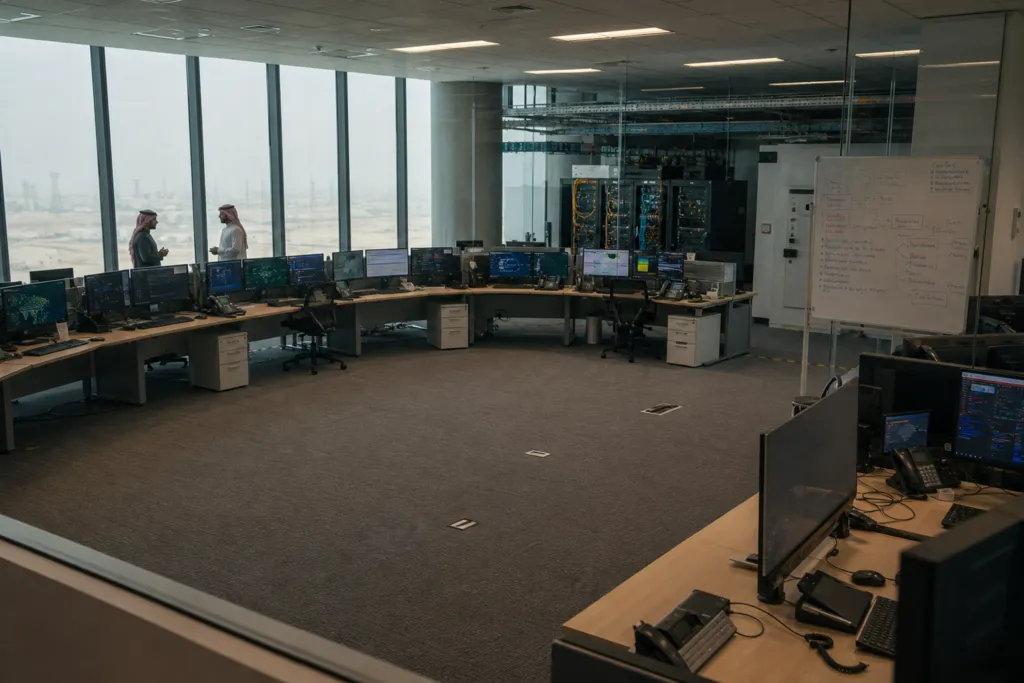
Compliance and critical infrastructure also push acquirers toward firms with proven governance and operational technology (OT) experience. MarketsandMarkets cites rising investment in industrial cybersecurity, pointing to Honeywell’s New Jubail center focused on critical infrastructure protection. Mordor Intelligence links national strategy to operational buildout, stating Saudi Arabia’s National Cybersecurity Strategy has unlocked record spending on fully staffed SOC and enterprise-grade SIEM deployments across ministries and critical agencies, and that forty-nine federal bodies now integrate AI into threat-detection workflows. It also says AI-enabled monitoring is expected to penetrate 94% of large organizations by 2026, which increases the value of firms that can operationalize tooling, workflows, and response playbooks under Saudi regulatory expectations.
For Saudi cybersecurity M&A 2026 decisions, strategic partnerships can be a preview of what targets buyers may want to own. IMARC, via an openPR release, states that private sector entities account for roughly two-thirds of total cybersecurity spend in the Kingdom, largely through managed-service and platform contracts. The same source notes several market participants and highlights developments including a February 2026 memorandum of understanding between CrowdStrike and Saudi Aramco to advance AI-powered cybersecurity capabilities and build a unified, Kingdom-wide security model protecting critical infrastructure, plus UNITAR launching its first dedicated cybersecurity office in Riyadh in June 2026 in cooperation with the NCA. Add in GMI Research’s estimate that approximately 33.3% of users in Saudi Arabia faced cyber threats in 2022 and its note that USD 27.2 billion was allocated in Saudi Arabia’s 2020 budget for security and regional administration including cybersecurity, and the acquisition thesis becomes clearer: buyers will prize localized, compliant, always-on operators with credible relationships in regulated sectors.
What market-growth signals are shaping Saudi cybersecurity acquisition interest in 2026?
Why are managed security service providers attractive acquisition targets in Saudi Arabia?
How does cloud adoption influence which cybersecurity firms buyers may target?
What compliance and government factors can increase the value of cybersecurity targets?
How does Saudi cybersecurity M&A in 2026 connect to spending patterns in the Kingdom?
Talk to us for your needs in:
-
Due Diligence and Valuation Services
-
M&A Strategy and Advisory
-
Post-Merger Integration Management
-
Regulatory and Compliance Advisory
-
Market Entry and Expansion Consulting
-
Investment and Financial Analysis
-
In-Depth Market Survey for M&A
-
Market Intelligence and Insights in M&A
-
Feasibility Study and Assessment in M&A
-
Saudi M&A Benchmarking