Saudi Arabia is positioning 2026 as a year to lock in access to battery materials beyond its borders, with copper, nickel, and cobalt central to the plan. The move sits inside a wider battery storage growth narrative, where industry projections indicate installed capacity could expand ninefold between 2024 and 2040, driving demand for materials including cobalt, nickel, and copper. The Kingdom’s approach is repeatedly described as supply-chain integration, including vertical integration to secure raw material sources, while also building credibility as a midstream and downstream player rather than only a capital provider. In this context, overseas participation can act as a fast route to feed future refining and manufacturing ambitions.
Saudi Arabia’s outbound play is also tied to what is happening in critical-minerals markets across the Gulf. Manara Minerals, a joint venture formed in 2023 between Maaden and the Saudi Public Investment Fund (PIF), acquired 10% of Vale Base Metals, an example of how Saudi capital is being deployed abroad to connect with globally relevant metals. The same regional pattern shows up in other Gulf states, such as Abu Dhabi’s International Resource Holding (IRH) buying a controlling 51% stake in Mopani Copper Mines in Zambia in 2024. Separately, in January 2025, Abu Dhabi’s ADQ and Orion Resource Partners agreed to establish a 50-50 joint venture with an initial $1.2 billion commitment to secure critical minerals supply, reinforcing the competitive landscape Saudi Arabia is operating in.
Why Copper, Nickel, and Cobalt Matter for 2026 Supply Security
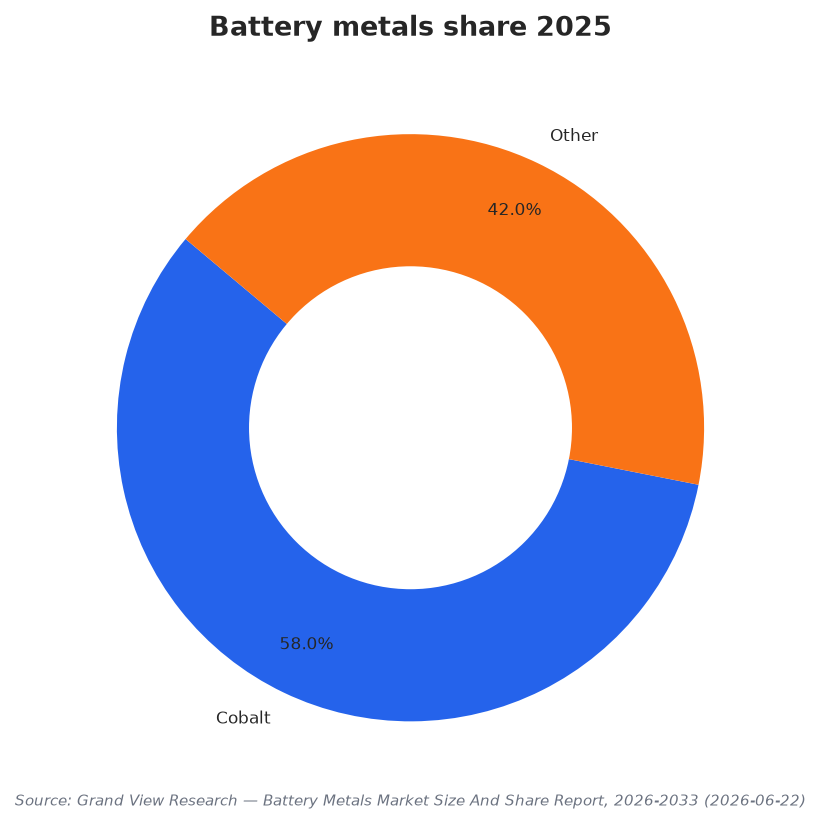
The immediate driver is supply security and bargaining power as battery supply chains scale. One cited constraint is processing concentration: European battery manufacturers currently source processed lithium, cobalt, and nickel exclusively from Chinese refiners due to a lack of alternative processing capacity. That dependency increases supply risk and limits pricing leverage, which is why Saudi-linked processing capacity is framed as a potential non-Chinese alternative for European manufacturers. On the market side, global signals support the urgency: the global battery metals market was valued at $15.3 billion in 2025 and is projected to grow from $16.5 billion in 2026 to $22.6 billion by 2033, while cobalt held the largest market share at 58.0% in 2025.
Saudi Arabia is pairing this external push with domestic groundwork that links directly back to metals. Saudi mining exploration spending reached a record 1.05 billion riyals ($279.8 million) in 2024, according to Ministry of Industry and Mineral Resources (MIM) data cited by Fastmarkets. Downstream, a planned lithium salts refinery is set to be built by EV Metals Group, and two domestic electric vehicle brands are now established: Ceer and Lucid. In the automotive battery market, Saudi Arabia’s ICE vehicle parc exceeds 12 million units, creating replacement demand for lead-acid batteries estimated at 4.5–5.5 million units annually, valued at roughly USD 600–800 million. For lithium-ion demand, passenger BEVs are estimated to account for 65–75% of GWh deployed in 2026, with PHEVs at 10–15% and commercial/heavy-duty EVs at 10–15%.
For copper specifically, price signals and trade realities add pressure to build resilient access. An IndexBox profile notes copper futures holding steady at $6.4 per pound in late May 2026, with demand linked to AI data center buildout and the clean energy transition, alongside availability tightening tied to Chile output cuts and rising US imports. The same report describes Saudi Arabia’s refined copper market as operating in a global context where Chile leads production and China is the world’s largest consumer, while Saudi trade is characterized by significant imports primarily from Central African nations. In that setting, Saudi battery metals stakes abroad are not just financial assets; they are a practical lever to reduce exposure to bottlenecks and align raw materials with processing and end-use growth.
What is driving Saudi Arabia’s 2026 push to secure copper, nickel, and cobalt abroad?
What Saudi-linked overseas stake is cited as an example of this strategy?
How does processing concentration shape the strategy for nickel and cobalt supply?
Which segment dominates lithium-ion battery demand in Saudi Arabia’s auto market in 2026?
How do Saudi battery metals stakes connect to copper market conditions mentioned in the sources?
Talk to us for your needs in:
-
Due Diligence and Valuation Services
-
M&A Strategy and Advisory
-
Post-Merger Integration Management
-
Regulatory and Compliance Advisory
-
Market Entry and Expansion Consulting
-
Investment and Financial Analysis
-
In-Depth Market Survey for M&A
-
Market Intelligence and Insights in M&A
-
Feasibility Study and Assessment in M&A
-
Saudi M&A Benchmarking