
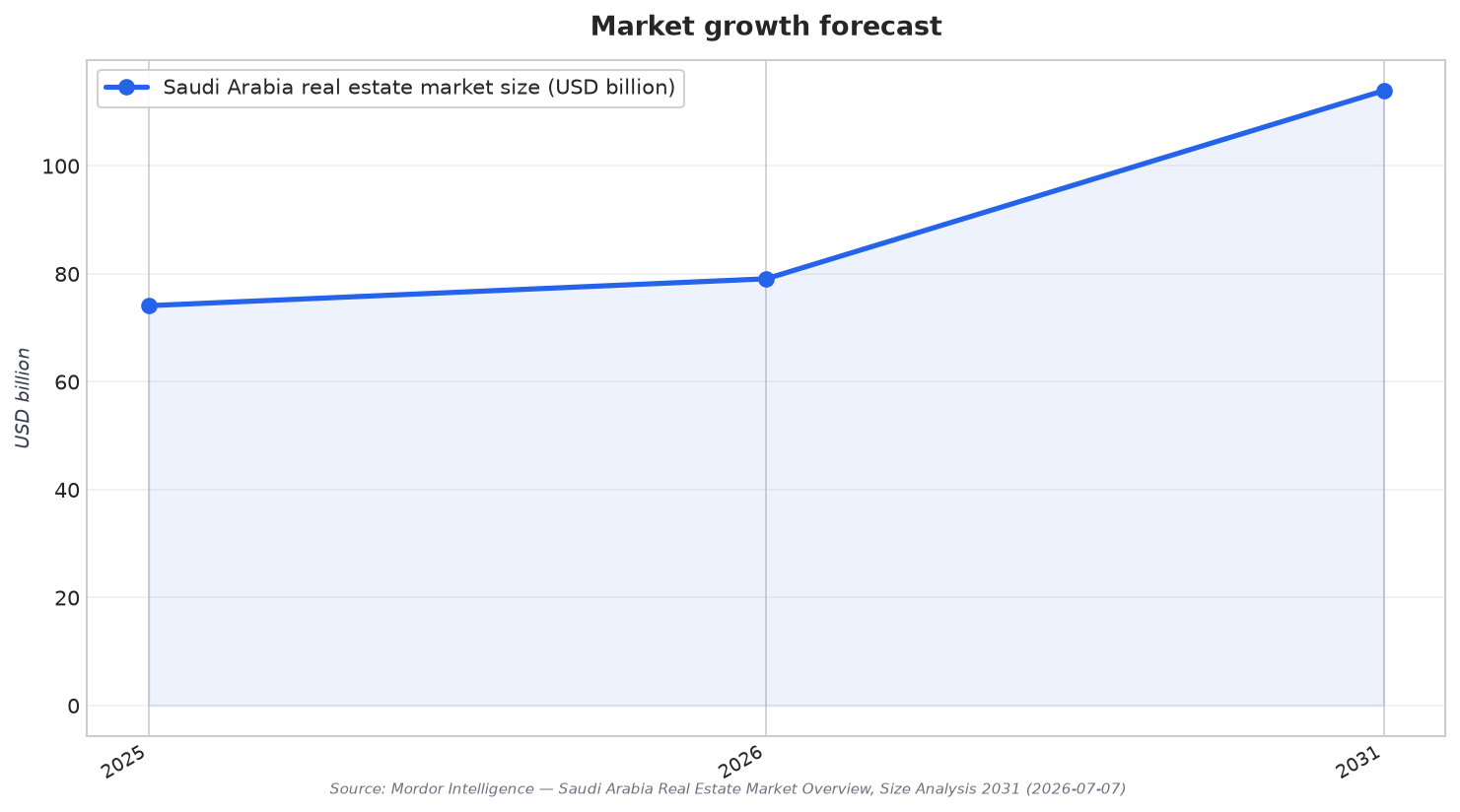
Saudi Arabia’s listed real estate market sits inside a fast-expanding property backdrop that is changing how investors think about scale. Mordor Intelligence projects the Saudi Arabia real estate market to expand from USD 74.11 billion in 2025 and USD 79.09 billion in 2026 to USD 113.96 billion by 2031, a 7.58% CAGR for 2026–2031. Another Saudi deal-focused analysis cites a separate Mordor estimate of USD 72.84 billion in 2026 rising to USD 102.96 billion by 2031 at a 7.17% CAGR. In parallel, IMARC values the market at USD 77.2 billion in 2025 and projects USD 141.6 billion by 2034 at a 6.73% CAGR (2026–2034). As capital moves through this growth cycle, listed real estate M&A is increasingly framed as a way to build platforms that can acquire, integrate, and finance assets more efficiently.
That platform logic matters because the Kingdom’s development model is both large and multi-year. Mordor links the outlook to Vision 2030’s giga-project pipeline and capital-market reforms that broaden institutional participation. It also notes PIF financing of at least USD 40 billion a year as a liquidity support even as global conditions tighten. On the demand side, the residential market alone is expected by Mordor to rise from USD 44.85 billion in 2025 to USD 47.58 billion in 2026 and reach USD 65.58 billion by 2031, at a 6.63% CAGR for 2026–2031. For listed vehicles, that combination of supply execution and funding conditions pushes consolidation discussions toward scale, governance, and the ability to underwrite projects and acquisitions with tighter capital discipline.
Why Scale Is Becoming a Listed Real Estate Advantage
The Saudi REIT market itself was built as a regulated route into income-producing assets after the CMA introduced listed real-estate fund rules in 2016. Vision2030.ai notes that nearly twenty REIT funds have listed on Tadawul, offering exposure across malls, offices, hotels, logistics assets, healthcare properties, and residential portfolios. In that setting, consolidation can be less about “one-off” assets and more about combining portfolios to improve diversification and operating leverage. Mordor’s broader real estate view also highlights that residential demand skews toward mid-market apartments, while logistics, data-center, and branded-hospitality assets are described as commanding the fastest growth. A larger listed platform can potentially rotate capital toward these areas while using the disclosure and governance framework of REIT regulation to attract a wider set of investors.
Rates and valuation signals add another layer to why public real estate scale can matter in 2026. A Saudi mid-market M&A analysis cites GAStat data showing the Kingdom’s residential real estate index fell 2.24% during the year to Q4 2025, following a 0.9% decline in the prior quarter. In the same ecosystem, the Saudi residential report points to financing-market changes, including Vision 2030’s homeownership target of 70% and a reduction of down-payments to 5% alongside securitization efforts to enhance mortgage liquidity. It also cites the Saudi Real Estate Refinance Company’s USD 906 million portfolio acquisition from Saudi National Bank as the Kingdom’s largest secondary-market transaction. For listed real estate, these data points reinforce why balance-sheet strength, refinancing access, and portfolio quality can become central themes in Saudi REIT consolidation 2026.
Outside REITs, deal behavior in adjacent real assets offers a reference point for how consolidation narratives evolve. Saudi Tourism Consulting reports that Saudi Arabia recorded 24 M&A deals worth USD 689 million in Q1 2026, a 4% annual increase in deal volume, based on Ansarada figures reported by Arab News. In hospitality, the same source describes a shift toward platforms and curated portfolios, supported by Mordor’s estimate of Saudi Arabia’s hospitality market at USD 29.02 billion in 2026, projected to reach USD 40.58 billion by 2031 at a 6.93% CAGR (2026–2031). It also cites concentration and pipeline indicators, including chain hotels holding 57.74% share in 2025 and independent hotels trailing as chains outpace them with an 11.62% CAGR through 2031. For listed real estate M&A, that is a useful comparison: consolidation tends to accelerate where buyers can build repeatable operating models and finance growth through scale.
What is driving Saudi REIT consolidation in 2026?
How big is the Saudi Arabia real estate market in 2026 according to the sources?
What facts show financing and liquidity themes in Saudi housing?
What market signal suggests pricing pressure before 2026?
How does hospitality M&A provide a comparison for listed real estate consolidation?
Talk to us for your needs in:
-
Due Diligence and Valuation Services
-
M&A Strategy and Advisory
-
Post-Merger Integration Management
-
Regulatory and Compliance Advisory
-
Market Entry and Expansion Consulting
-
Investment and Financial Analysis
-
In-Depth Market Survey for M&A
-
Market Intelligence and Insights in M&A
-
Feasibility Study and Assessment in M&A
-
Saudi M&A Benchmarking