Saudi pharmaceutical M&A is moving from a niche topic to a practical strategy. The local market is expanding, and both local and multinational players are trying to secure distribution, manufacturing, and therapy breadth. Consolidation and strategic innovation are now part of the competitive landscape in Saudi Arabia, according to Future Market Insights.
The growth backdrop is clear in market size figures. Grand View Research puts Saudi Arabia pharmaceutical market revenue at USD 11,830.9 million in 2024, rising to USD 15,577.9 million by 2030. Credence Research reports USD 7,902.15 million in 2018, USD 12,038.16 million in 2024, and a forecast of USD 21,160.70 million by 2032. These numbers create a strong incentive to build scale through deals.
Demand drivers matter for M&A logic. Future Market Insights highlights repeat demand linked to chronic disease treatment, plus pharmacy network expansion across hospital and retail channels. It also notes that prescription products lead demand, and that hospital pharmacies hold the leading channel position due to institutional dispensing in regulated therapy use. Credence Research adds that prescription drugs held a 63% share in 2024, while OTC drugs held 18%.
What Is Actually Driving Consolidation?
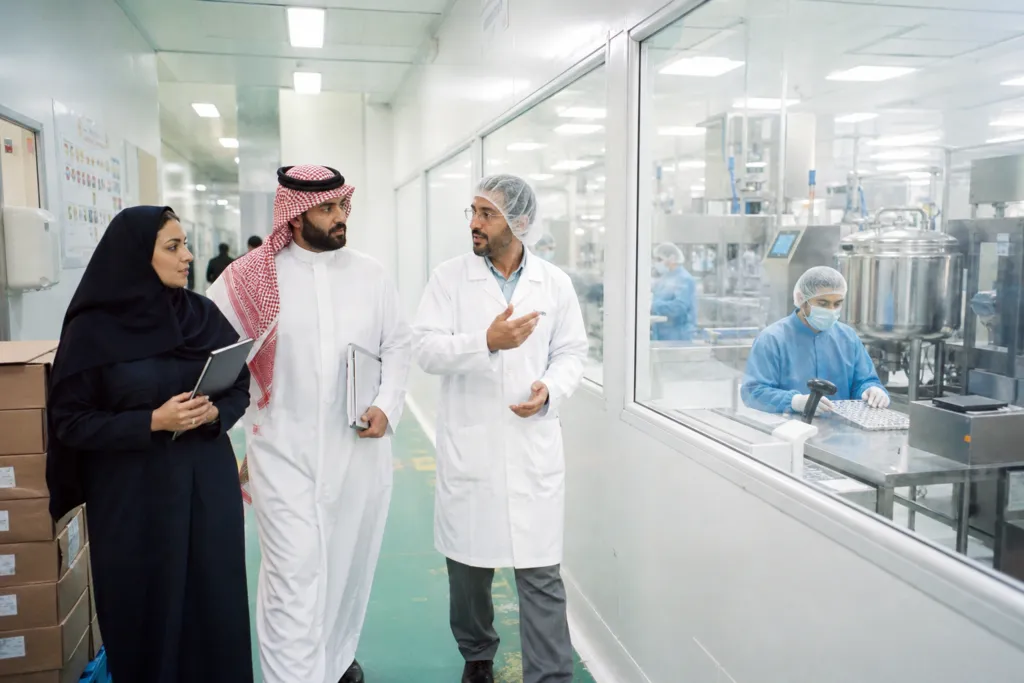
One driver is import reliance and the push to localize production. Grand View Research notes that many pharmaceuticals are imported and that Saudi Arabia depends heavily on imports to meet active pharmaceutical ingredient (API) requirements. Grand View Research also states that only GlaxoSmithKline and Sanofi currently manufacture locally, and that many multinationals prefer to partner with Saudi drug makers for contract manufacturing to reduce costs. This creates a deal pathway that mixes M&A with contract manufacturing partnerships.
Vision 2030 also shapes the strategic outlook. Pharma Boardroom reports a target to raise local drug production from around 20% to 40% of domestic demand by 2032. It also reports more than 55 SFDA-approved pharmaceutical factories already operational across the kingdom. In 2025, the Public Investment Fund launched Lifera, described as a new CDMO focused on vaccines, insulin, and biologics, supporting a broader push to reduce import dependency.
CDMO capacity growth supports deal activity as well. Grand View Research reports the Saudi pharmaceutical CDMO market generated USD 1,713.3 million in revenue in 2024 and is expected to reach USD 2,783.1 million by 2033, with a 5.5% CAGR from 2025 to 2033. It also reports that API was the largest segment with an 81.39% revenue share in 2024. For buyers, this strengthens the case for acquiring or partnering with capabilities that support reliable supply.
Deal details in the sources are limited, but the strategic direction is not. Future Market Insights lists leading companies such as SPIMACO, Tabuk Pharmaceuticals, Hikma Pharmaceuticals, Julphar Saudi Arabia, Jamjoom Pharma, and Nahdi Medical Company, alongside multinationals. As competition centers on therapy breadth and dependable channel access, Saudi pharmaceutical M&A is likely to stay focused on scale, regulated distribution strength, and manufacturing pathways that help meet Vision 2030 localization goals.
What is pushing Saudi pharmaceutical M&A right now?
How large is the Saudi pharmaceutical market, based on the sources?
Why do manufacturing and CDMOs matter in Saudi pharmaceutical M&A?
Which channel and product type are important in Saudi pharma demand?
Talk to us for your needs in:
-
Due Diligence and Valuation Services
-
M&A Strategy and Advisory
-
Post-Merger Integration Management
-
Regulatory and Compliance Advisory
-
Market Entry and Expansion Consulting
-
Investment and Financial Analysis
-
In-Depth Market Survey for M&A
-
Market Intelligence and Insights in M&A
-
Feasibility Study and Assessment in M&A
-
Saudi M&A Benchmarking