

In today’s higher-rate environment, valuation gaps are harder to ignore. Higher interest rates and tighter credit terms can reduce buyer appetite and make it tougher for sponsors to meet aspirational valuations. Sellers can face fewer potential buyers willing or able to meet their expectations. This dynamic pushes deal teams to look for structures that let transactions proceed without forcing a single, fixed view of future performance. One of the most common tools is the earn-out. Earn-out provisions are often used when a buyer and seller cannot finalize a concrete purchase price for a transaction. They can give the seller a way to participate financially in post-closing success.
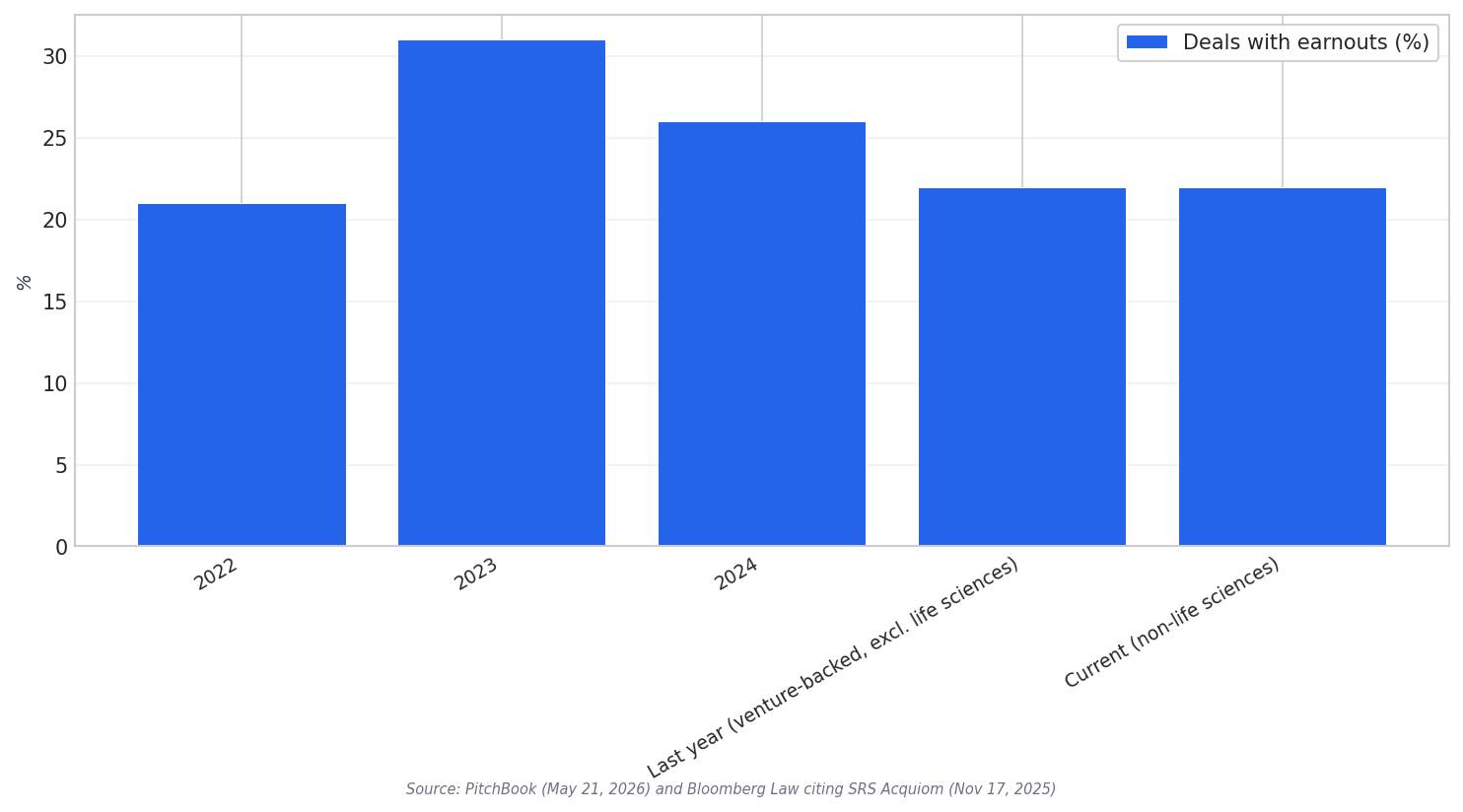
Earn-outs are not niche anymore. They were originally common in life sciences, where the post-closing value of an asset could be unpredictable due to variables such as regulatory approval, clinical trials, and net sales. Over time, earnouts became prevalent in many types of M&A. Excluding life sciences, SRS Acquiom reported earnout provisions were included in 22% of non-life sciences M&A transactions. PitchBook also reported that, excluding life sciences, 22% of venture-backed startup sales last year came with an earnout, down from 26% in 2024 and 31% in 2023, but up from 21% in 2022. These data points show how normal contingent consideration has become when pricing is contested.
How Earn-Outs Work in Practice—and Why They Get Risky
The basic mechanics are simple. An earnout provision typically gives the seller a percentage of the profits or revenue of a product or target after closing. In concept, it should align the interests of the buyer and seller in maximizing post-closing profitability. In reality, interests can diverge. Buyers must consider overall business operations when deciding how to run the business post-closing. Sellers’ goals can be focused on maximizing the earnout outcome. Because of these competing interests, disputes can arise, and courts may end up balancing a buyer’s post-closing business interests against a seller’s pre-closing expectations. This is why earn-outs are as much about governance and drafting as they are about valuation.
In Saudi dealmaking, the legal and process context also matters. Reforms to the commercial court system have improved the speed and predictability of dispute resolution, which can increase investor confidence when contingent payments may be disputed. There is also a push toward standardisation of legal documentation and transaction processes, aimed at letting parties transact efficiently without prolonged negotiations. One trade-finance focused report noted that the use of standard documentation has, in many instances, led to legal fee reductions of up to 80%, while cutting transaction timelines from months to weeks. For Saudi M&A earn-out structures, that kind of process discipline can help reduce misunderstandings about performance metrics, reporting, and decision rights after closing.
Real-world earn-out sizing can be meaningful, and outcomes can be uneven. In one consumer example, e.l.f. Beauty acquired Rhode for $1 billion in May 2025, with $800 million up front and a potential earnout of up to $200 million based on a post-deal three-year growth target. In biopharma, SRS Acquiom data on 64 deals inked from mid-2023 to mid-2025 showed a mean earnout potential of $437 million, down from $494 million for mid-2021 to mid-2023 and $683 million during the COVID-19 era. That same dataset highlights performance risk: for 128 biopharma deals with at least one milestone due by mid-2025, 45% had not collected any earnout money, and only 5% collected 75% to 100% of their potential earnout.
What are Saudi M&A earn-out structures?
Why do earn-outs help in a higher-rate environment?
How common are earn-outs outside life sciences?
What is a real example of an earn-out amount?
What is a key risk with earn-outs?
Talk to us for your needs in:
-
Due Diligence and Valuation Services
-
M&A Strategy and Advisory
-
Post-Merger Integration Management
-
Regulatory and Compliance Advisory
-
Market Entry and Expansion Consulting
-
Investment and Financial Analysis
-
In-Depth Market Survey for M&A
-
Market Intelligence and Insights in M&A
-
Feasibility Study and Assessment in M&A
-
Saudi M&A Benchmarking