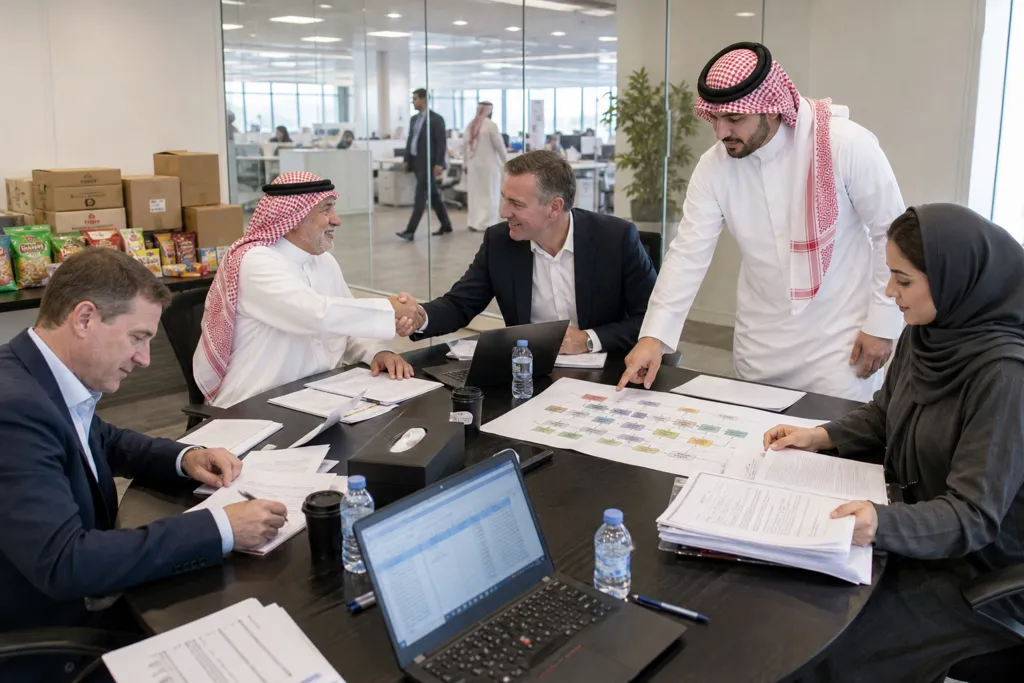
Saudi F&B M&A 2026 will be shaped by the same forces pushing global food and beverage dealmaking into a high-velocity cycle. PitchBook reported that food and beverage M&A was positioned to sustain record momentum into 2026 and was pacing toward $120 billion in annual deal value in 2025. The same report tied deal appetite to private equity capital deployment and improved debt financing conditions that enable more aggressive acquisition strategies. In parallel, FoodNavigator described a shift away from “empire-building” and toward portfolio architecture, where buyers decide which categories deserve capital and which no longer fit the long-term story.
That portfolio logic is visible in the categories attracting capital. PitchBook highlighted health-oriented portfolios and noted heavy focus on protein snacks, prebiotic sodas, and functional energy drinks, where leaders are commanding significant valuation premiums. FoodNavigator also put functional foods and beverages at the top of the most desirable targets, describing them as operating at the crossroads of health, lifestyle, and daily habit. For Saudi acquirers and operators, this matters because it frames what a “roll-up” targets: repeat-purchase categories with pricing power and margin resilience, then platform capabilities to scale them through procurement, logistics, and distribution.
Roll-Ups Meet Local Champions and Premiumization
A clear Saudi example of local-champion consolidation is BinDawood Holding Co.’s agreement to acquire a 51% stake in Vaza Food Co. for SR217.9 million ($58.06 million), subject to regulatory approvals and certain SPA adjustments. Arab News reported the rationale as expansion into higher-margin premium food segments and diversification beyond core grocery retail, targeting premium confectionery and specialty foods. The filing also emphasized value-chain integration via Vaza’s manufacturing capabilities and operational efficiencies through improved procurement and logistics, plus consolidation of certain support functions. Vaza’s portfolio includes the Pocodor premium chocolate brand, plus bakery and traditional sweets labels and several food concepts.
Saudi F&B M&A 2026 also intersects with cross-border platform building that touches Saudi distribution and manufacturing footprints. Just Food reported that BRF planned to move distribution businesses in Kuwait, Oman, Qatar, Saudi Arabia, and the UAE into BRF Arabia Holding, alongside manufacturing plants in Saudi Arabia and the UAE and direct export operations serving wider MENA customers. The JV links to Saudi capital through HPDC, owned by the Public Investment Fund, with HPDC holding 10% at closing and plans to lift its stake to 30%, with the right to increase to 40%. The transaction was anticipated in the first quarter of 2026, subject to customary approvals including antitrust clearance.
QSR demand signals matter even when the deal targets are not restaurant brands themselves, because they change what “scale” looks like in packaging, logistics, and omnichannel routes to market. IndexBox noted that food service operators, particularly in expanding quick-service restaurant and fine-dining segments, increasingly require bulk jumbo rolls of aluminum foil with consistent thickness and perforation, and that few suppliers currently offer dedicated B2B branded lines in Saudi Arabia. Separately, IndexBox observed that in a Saudi maple syrup market view, competition was moderate, with the top three brands accounting for an estimated 50–55% of value, while DTC and e-commerce native brands were still nascent but growing via Amazon.sa and Noon.
For acquirers, that combination of consolidation and channel fragmentation raises the premium on execution. FoodNavigator reported that better-for-you brands and premium beverages offer repeat-purchase behavior, scalable margins, and cross-category expansion opportunities that acquirers prioritize. Another FoodNavigator piece also noted that the rise of e-commerce has lowered capital needs for early-stage entry, increasing competition and purchase and sale transactions, while also contributing to business failures in the middle market and below. In Saudi F&B M&A 2026, roll-ups and local champions can use M&A to add manufacturing, premium brand equity, and distribution control, while staying aligned with the categories buyers are actively rewarding.
What is the main theme of Saudi F&B M&A 2026?
What Saudi deal shows local champion consolidation in premium food?
How does PIF-linked capital appear in regional F&B platform building?
Why do QSR dynamics matter to Saudi M&A even outside restaurant acquisitions?
What global deal context supports the outlook for Saudi F&B M&A 2026?
Talk to us for your needs in:
-
Due Diligence and Valuation Services
-
M&A Strategy and Advisory
-
Post-Merger Integration Management
-
Regulatory and Compliance Advisory
-
Market Entry and Expansion Consulting
-
Investment and Financial Analysis
-
In-Depth Market Survey for M&A
-
Market Intelligence and Insights in M&A
-
Feasibility Study and Assessment in M&A
-
Saudi M&A Benchmarking