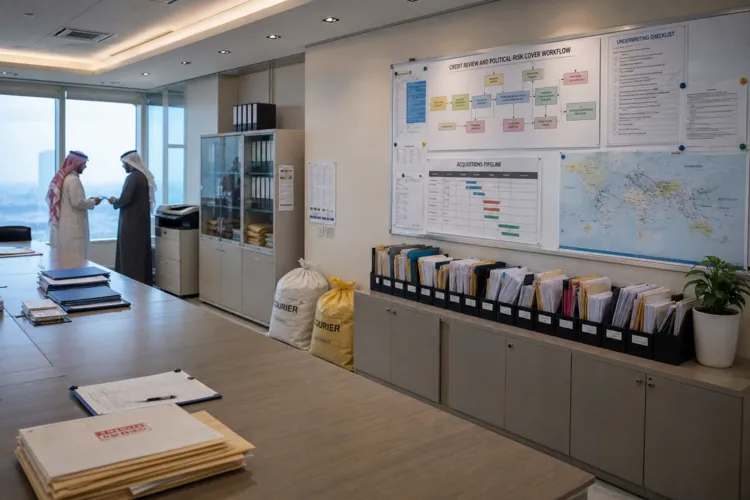

Saudi family office M&A is being shaped by a wider shift toward institutional behavior in the region’s capital. Sources point to tighter discipline in how money is deployed. Bloomberg reporting on Saudi Arabia’s investment posture described “greater discipline in capital allocation” and a sharper focus on investments that boost the local economy. This matters for consolidation. When investors formalize governance and become more return-focused, they often prefer fewer counterparties, clearer ownership, and scalable platforms. That environment tends to reward structured acquisitions, mergers, and the grouping of assets under more professionalized vehicles.
One visible signal is the Public Investment Fund’s emphasis on returns and portfolio performance. The $1 trillion PIF said it would step up efforts to boost returns and turn portfolio companies into global champions. That statement followed months of “tough spending decisions” in Riyadh, including reviews of projects like Neom and a pivot toward areas more likely to attract foreign investment. This is not a direct read-through on every private family office. But it reinforces the tone of the market. Capital becomes more selective. Deal rationales become more measurable. That can accelerate Saudi family office M&A when assets look duplicative or sub-scale.
Why Fewer Deals Can Still Mean More Consolidation
Global deal conditions also support a “fewer but larger” pattern. CNBC reported that total value of global M&A rose 26% to $1.2 trillion compared with the same quarter last year, while the number of deals fell 17%, based on LSEG data. LSEG also found the second week of March was the worst week for global M&A in over a year, falling below $33 billion. For families institutionalizing wealth, that backdrop can nudge consolidation. If deal volume is down, buyers may concentrate on higher-conviction combinations. If uncertainty rises, families may merge operating assets, centralize treasury, and professionalize decision paths rather than keep fragmented structures.
Saudi-linked transactions highlighted in the sources show that dealmaking has not stopped, even as priorities tighten. Bloomberg noted Savvy Games Group agreed to buy Moonton in March in a deal valuing the mobile games maker at $6 billion. The same reporting said another affiliate committed an additional $550 million to Lucid Group. Elsewhere, Manara, launched in 2023, bought a $2.6 billion stake in Vale’s base metals unit, then faced difficulty finding deals at attractive valuations. For families watching these moves, the message is clear: capital efficiency and valuation discipline now shape how platforms are built and when consolidation makes sense.
Institutionalization is also visible in how family offices talk about governance and structure. The Fintech Times reported a summit with over 250 attendees, including 81 family offices, where governance and strategy shifts were prominent. It also quoted a “20 per cent increase on new entrants coming in,” with Asia managers and European communities participating, alongside the challenge of a “shallow” talent pool. As governance demands rise and the talent constraint persists, consolidation can become a practical response. Combining investment teams, standardizing reporting, and simplifying ownership stacks can reduce operational strain and improve execution in Saudi family office M&A processes.
Regulatory and market-access changes can further influence consolidation pathways. PitchBook reported that effective Feb. 1, Saudi Arabia’s regulator removed the Qualified Foreign Investor regime that had been in place since 2015. Foreign institutional investors no longer need minimum AUM of $500 million to invest directly, and Sahm Capital said the change can unlock as much as $10 billion in new inflows, building on 519 billion Saudi riyals (around $138 billion) already held by foreign investors as of Q3 2025. There is still a 49% cap on foreign ownership in listed companies. Together, these factors can affect how families position assets for exits, partnerships, and consolidation-friendly structures.
What is driving Saudi family office M&A right now?
How do global M&A conditions affect Saudi family office M&A?
What PIF moves suggest a more institutional approach to deals?
What does “wealth going institutional” look like for family offices?
How could market reforms influence consolidation outcomes?
Talk to us for your needs in:
-
Due Diligence and Valuation Services
-
M&A Strategy and Advisory
-
Post-Merger Integration Management
-
Regulatory and Compliance Advisory
-
Market Entry and Expansion Consulting
-
Investment and Financial Analysis
-
In-Depth Market Survey for M&A
-
Market Intelligence and Insights in M&A
-
Feasibility Study and Assessment in M&A
-
Saudi M&A Benchmarking