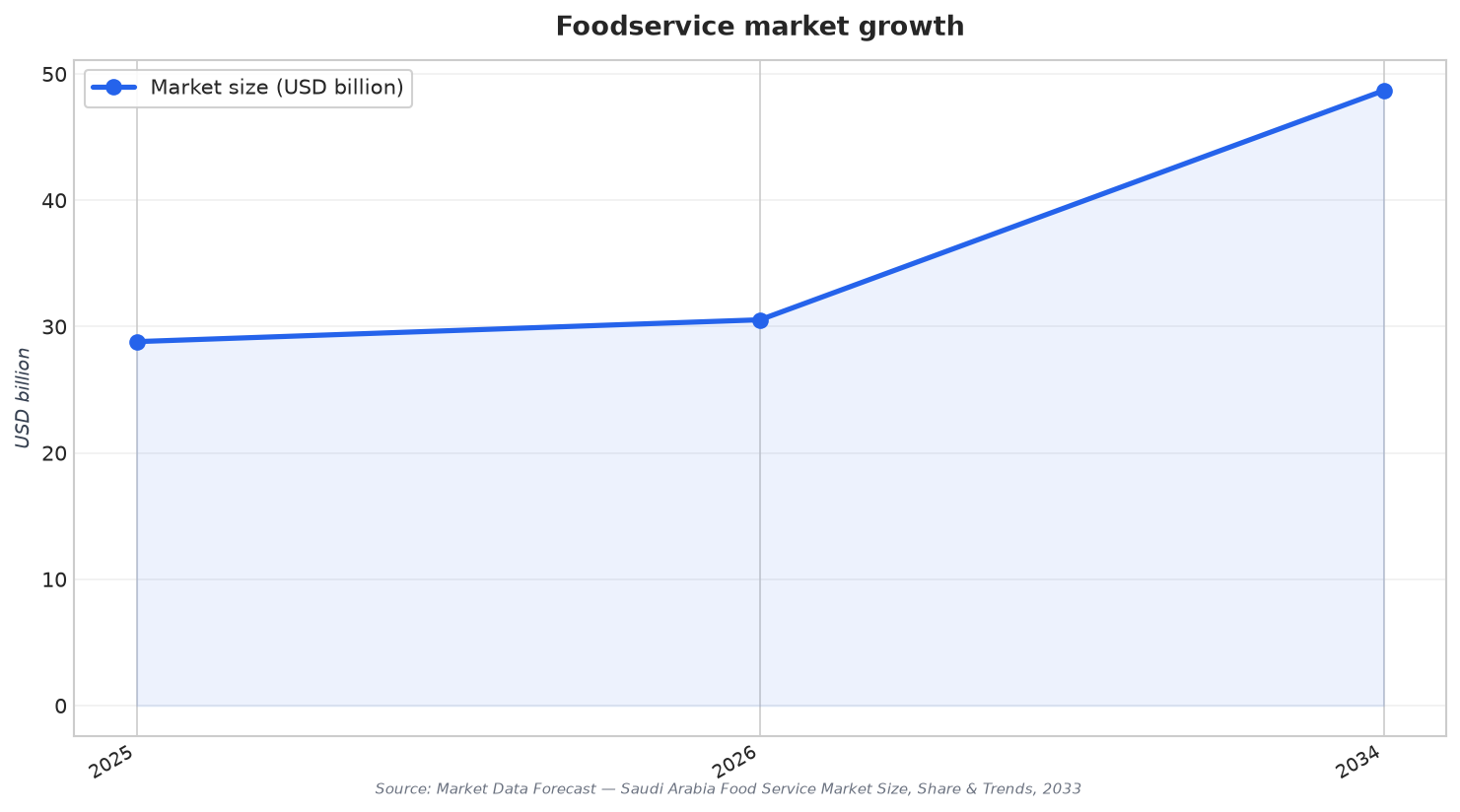
Roll-ups are moving from a buzzword to a playbook in Saudi Arabia’s restaurant and broader food and beverage economy. Mordor Intelligence values the Saudi Arabia food and beverages market at USD 36.35 billion in 2025 and estimates it will grow from USD 38.38 billion in 2026 to USD 50.38 billion by 2031, at a 5.59% CAGR (2026–2031). In parallel, Market Data Forecast values the Saudi Arabia food service market at USD 28.81 billion in 2025 and projects USD 30.54 billion in 2026, reaching USD 48.68 billion by 2034 at a 6% CAGR (2026–2034). Against this backdrop, Saudi F&B sector M&A increasingly rewards operators that can buy, standardize, and scale winning formats across cities.
Scale pressure is also visible in format mix and outlet density. WiFiTalents cites over 55,000 registered food and beverage outlets in the Kingdom, a sign of fragmentation that can invite consolidation. The same source says the QSR segment holds a 40% market share of the total foodservice sector, while Market Data Forecast places QSR as the largest “place type” segment in 2025 with a 42.3% share. Larger groups can use that demand base to apply standardized menus, tighter procurement, and shared back-office systems across multiple brands. As roll-ups mature, the logic is less about a single flagship store and more about repeatable unit economics across dozens of outlets.
Why Consolidation Is Speeding Up: Delivery, Compliance, and Integration
Digital ordering is reshaping how restaurants acquire customers, and that shift can favor scaled operators. WiFiTalents reports online food delivery penetration is expected to reach 42% by 2025, and that 60% of Saudi consumers prefer ordering food via mobile apps rather than phone calls. MarkWide Research adds that food delivery platform architecture is fragmenting as third-party aggregators and native restaurant apps compete for order volume, changing kitchen utilization and customer acquisition economics across Riyadh and Jeddah. In full-service dining, Mordor Intelligence notes consolidation within the delivery sector has concentrated market power among platform operators, which may lead to higher commission rates and reduced profitability for restaurants reliant on third-party delivery. Roll-ups can help by spreading delivery tech costs and negotiating from a larger base.
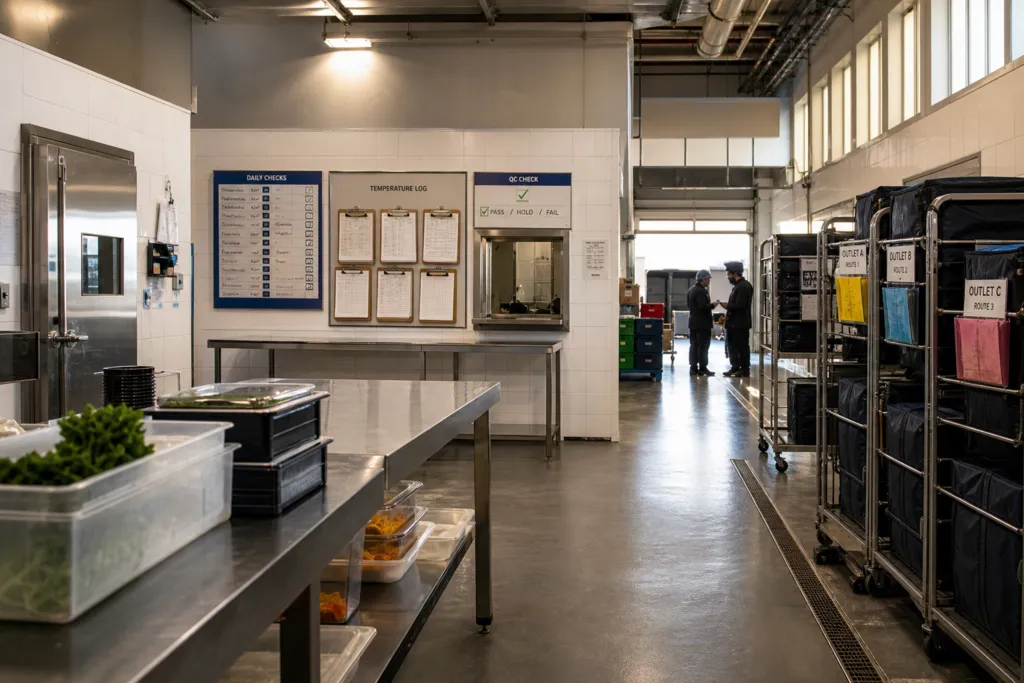
Regulation and operational standards also raise the value of “professionalized” platforms. MarkWide Research says SFDA food safety licensing, SASO quality certification requirements, and MOHAP hospitality sector standards collectively elevate operational barriers and compliance costs for new entrants. It also states SFDA’s updated food safety protocols are digitizing kitchen compliance, forcing operators to deploy real-time monitoring systems and cold-chain traceability platforms. Consolidation can reduce per-outlet compliance cost through centralized QA, training, and systems. Mordor Intelligence describes retailers tightening supply chains through vertical integration to protect margins, while MarkWide highlights players such as Tamimi Global using vertically integrated supply chains spanning procurement, central kitchens, and on-site delivery. Those same integration themes appear in deal rationales focused on procurement, logistics, and support-function consolidation.
Deal narratives are increasingly about value-chain depth, not just brand count. A Saudi M&A-focused insight article highlights filings that emphasized value-chain integration via manufacturing capabilities and operational efficiencies through improved procurement and logistics, plus consolidation of certain support functions, citing Vaza’s portfolio that includes the Pocodor premium chocolate brand alongside bakery and traditional sweets labels and several food concepts. The same piece notes BRF planned to move GCC distribution businesses, including Saudi Arabia, into BRF Arabia Holding, with HPDC (owned by PIF) holding 10% at closing and planning to lift to 30%, with the right to increase to 40%. Mordor Intelligence also points to a USD 70 billion government investment being funneled into processing plants as part of initiatives to strengthen domestic agri-food capabilities. Together, these signals suggest roll-ups will keep focusing on supply reliability, shared infrastructure, and scalable operating control.
What is driving consolidation in Saudi Arabia’s restaurant and F&B market?
How large is Saudi Arabia’s food service market, based on the sources?
How important are QSR formats to roll-up strategies?
How does food delivery influence Saudi F&B sector M&A decisions?
What examples of integration-related deal themes appear in the sources?
Talk to us for your needs in:
-
Due Diligence and Valuation Services
-
M&A Strategy and Advisory
-
Post-Merger Integration Management
-
Regulatory and Compliance Advisory
-
Market Entry and Expansion Consulting
-
Investment and Financial Analysis
-
In-Depth Market Survey for M&A
-
Market Intelligence and Insights in M&A
-
Feasibility Study and Assessment in M&A
-
Saudi M&A Benchmarking