Closing pricing gaps in Saudi transactions starts with the macro reset. In October, the IMF projected Saudi Arabia’s real GDP would fall by 3.3% in 2026 and rise by 7.9% in 2027. The same update implied a five-percentage-point downgrade versus the IMF’s July view for 2026, alongside a 2.4-point upgrade for 2027. That pairing matters for valuation work. Buyers do not only price the rebound year. They price the survival year, too. When the path changes from continued expansion to contraction-first, cash timing, liquidity needs, and near-term utilisation assumptions shift. That shift feeds directly into what buyers are willing to pay today.
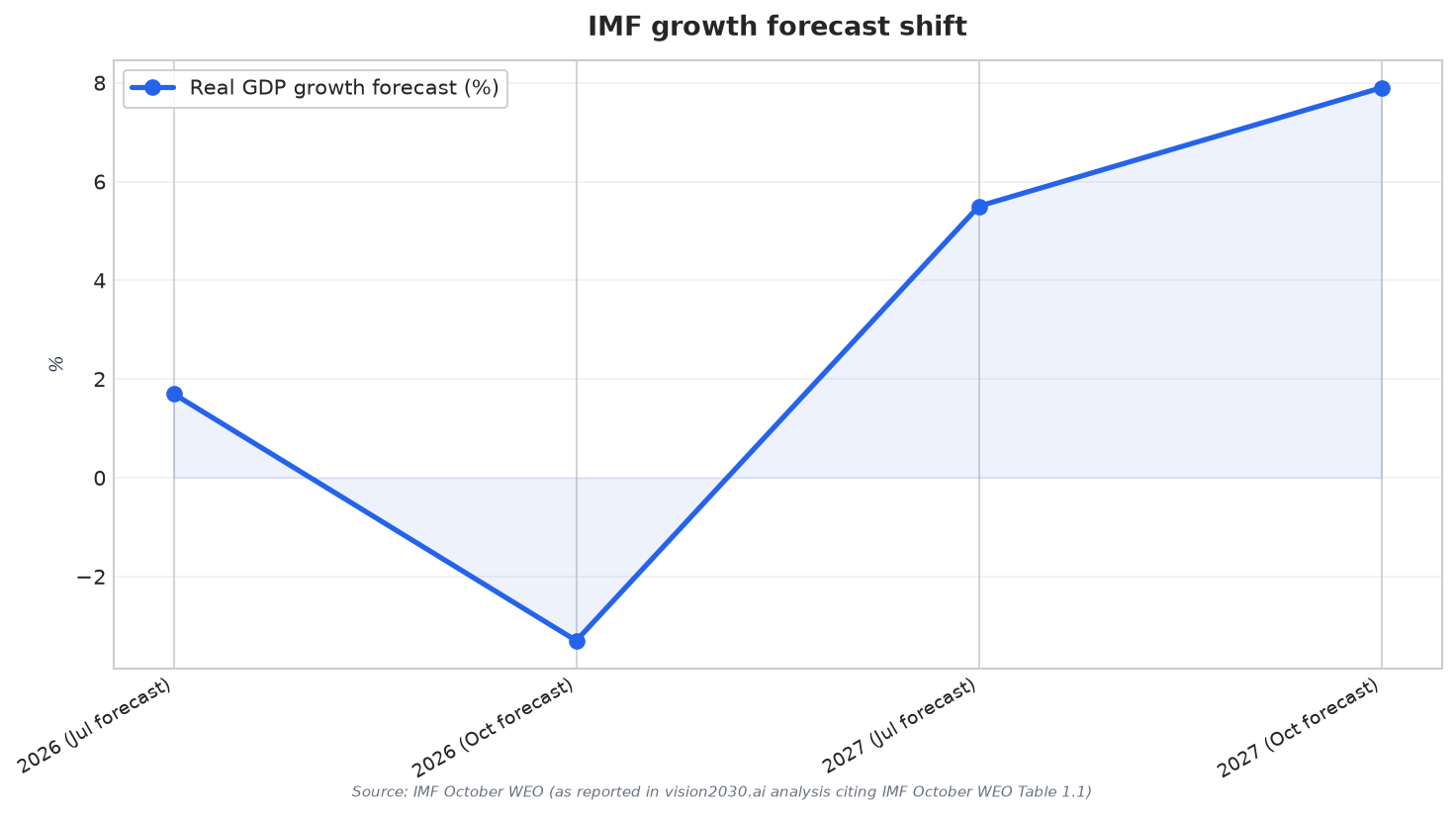
The IMF revision also comes with conditional mechanics that affect discount rates and scenario weighting. The IMF assumes reopening of the Strait of Hormuz resumes in March 2027, with conditions broadly returning to their pre-war state by October. That is a modelling assumption, not a confirmed timetable. Even when headline growth looks strong, the level of output can still lag. Using an illustrative index with 2025 set to 100, the October path leaves 2027 output about 2.75% below the level implied by the earlier July path (104.34 vs 107.29). For valuation negotiations, that gap is a reminder: faster growth after a deeper fall can coexist with a smaller economic base than sellers may be anchoring to.
Why Deals Stall: Anchored Sellers, Re-priced Risk
Across the Gulf, the market language increasingly resembles “repricing” rather than distress, and the mechanics translate cleanly into M&A. In hotel investment, one report describes a valuation gap where sellers remain anchored to earlier pricing, while buyers require higher returns for the risk they now see. The implication is that lower transaction volume does not automatically signal collapsing underlying value. It can signal a standoff between assumptions. The same article notes Saudi Arabia leads the regional pipeline with 387 projects and 105,648 rooms, versus the UAE’s 103 projects and 24,985 rooms, with Dubai alone at 60 projects and 13,828 rooms. That contrast helps explain why liquidity can slow even when long-lead development remains active.
Saudi fiscal and corporate cash-flow signals can also harden buyer return hurdles. Aramco reported second-quarter free cash flow of $12.3 billion against a declared base dividend of $21.9 billion. On the public finance side, the government revised its 2026 deficit forecast to SAR 245 billion, up from SAR 165.4 billion budgeted, described as 48% above the original target. Separately, Saudi Arabia’s pre-budget statement on September 30 projected a 21.8% decline in oil activities for 2026. These are not deal-specific inputs. But they shape financing conditions, confidence, and the “price versus volume” risk framing that parties bring into negotiations when underwriting earnings resilience.
So what closes the Saudi M&A valuation gap 2027 without forcing fire-sale pricing? First, align on scenario logic. The IMF’s 7.9% 2027 rebound rests on a slow reopening assumption, while Saudi Arabia’s finance ministry projects a 12.8% rebound that implies faster normalisation. Second, push valuation discussions down to cash flow drivers and timing rather than relying on broad growth narratives. Real estate research on Riyadh describes a “contraction” as a trading slump where transaction numbers fall while sellers cling to yesterday’s prices and buyers wait for tomorrow’s, and it resolves when both meet in a realistic middle. That is the practical playbook: reconcile earnings, risk, and financing assumptions until bid and ask are built from the same base case.
What changed in the IMF outlook that affects Saudi deal pricing?
How does the IMF’s modeling of Hormuz reopening influence valuation assumptions?
Why can transaction liquidity fall even without distressed selling?
What numbers illustrate the cash-flow and fiscal pressures shaping buyer return hurdles?
How can Saudi buyers and sellers narrow the Saudi M&A valuation gap 2027 in practice?
Talk to us for your needs in:
-
Due Diligence and Valuation Services
-
M&A Strategy and Advisory
-
Post-Merger Integration Management
-
Regulatory and Compliance Advisory
-
Market Entry and Expansion Consulting
-
Investment and Financial Analysis
-
In-Depth Market Survey for M&A
-
Market Intelligence and Insights in M&A
-
Feasibility Study and Assessment in M&A
-
Saudi M&A Benchmarking