On September 29, 2025, a consortium made up of Saudi Arabia’s Public Investment Fund (PIF), Silver Lake, and Affinity Partners announced a leveraged buyout of Electronic Arts (EA), the American video game company founded in 1982. The transaction valued EA at about $55 billion and was structured as an all-cash take-private. EA shareholders approved the deal on December 22, 2025, with roughly 99% of votes cast in favor, and EA confirmed by July 30, 2026 that all required regulatory approvals had been obtained, including CFIUS. The deal successfully closed on August 4, 2026, and EA stock was delisted from the Nasdaq.
The core lesson sits inside the capital stack and the sequencing. Multiple sources describe the buyout as funded by roughly $36 billion to $36.4 billion of equity commitments alongside a $20 billion debt commitment arranged by JPMorgan. One account notes that JPMorgan wrote the $20 billion debt commitment on its own balance sheet at signing, and another reports that the bank later syndicated portions of the debt to a broader lender group. In March 2026, a high-yield bond tranche of about $8 billion was marketed to distribute part of the risk into credit markets, while the remainder was carried through term loans that were progressively spread among more than a dozen additional banks.
Leveraged Finance Lessons for Saudi-Backed Sponsors
First, this deal underlines how sponsor equity can be the real gating item in mega-transactions. Commentary on the transaction argues that, since 2007, the constraint on mega-buyouts was not the debt market’s willingness to lend but the equity market’s difficulty assembling a check large enough to make the leverage sensible. In this case, the equity contribution was described as “enormous by LBO standards” and reportedly north of $30 billion, pushing leverage well below the 7x–8x associated with the 2006–2007 mega-buyout wave. For Saudi sponsors, the takeaway is that scale can shift negotiations: a large equity base can make the debt portion more digestible for lenders and can reduce reliance on extreme leverage.
Second, the underwriting and syndication path matters as much as the headline terms. The reporting emphasizes that JPMorgan initially committed roughly $20 billion of financing at signing and then worked to distribute exposure via a mix of a marketed high-yield bond tranche and syndicated term loans. That design offers a practical template for Saudi-led consortia that want certainty at signing while still tapping broader credit-market capacity later. It also highlights the tradeoff between speed and concentration of risk: one bank’s balance sheet can bridge the moment of signing, but successful syndication becomes the next operational hurdle.
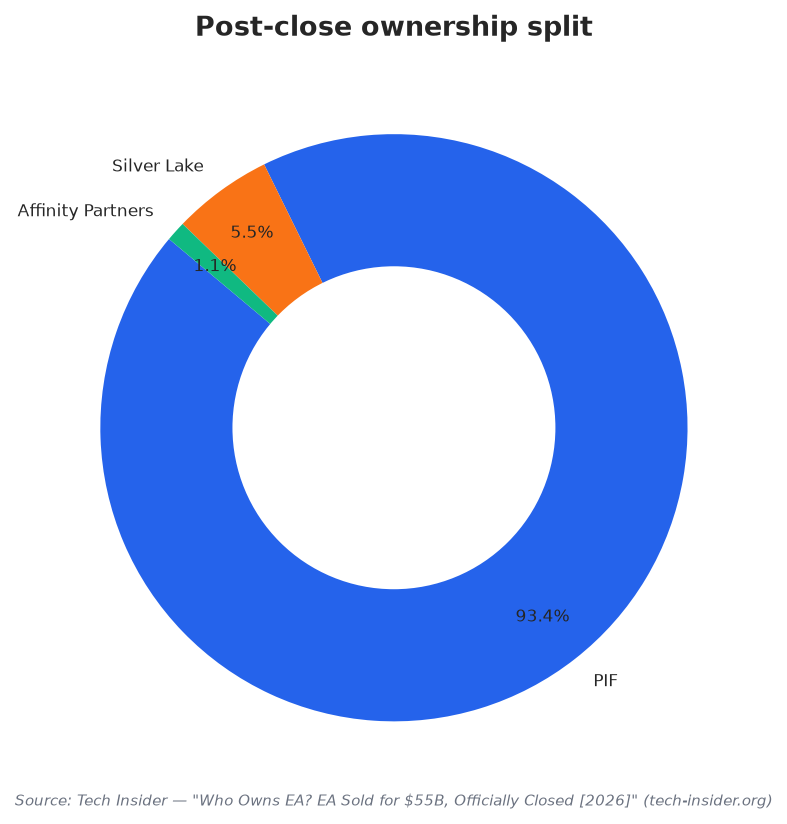
Finally, the post-close ownership and operating context frame how “EA buyout debt financing” is ultimately judged. After closing, PIF held 93.4% of EA, Silver Lake held 5.5%, and Affinity Partners held 1.1%, and shareholders were paid $210 per share in cash. EA had carried minimal debt as a public company, yet the transaction added a $20B-plus debt stack onto franchises described as cash-generative but cyclical, including Madden, EA Sports FC, and The Sims. Credit investors will watch how post-close leverage metrics reconcile with sponsor guidance, while sponsors will test whether the capital structure can absorb uncertain demand and weaker outlook conditions noted in EA’s earlier forecasting.
When did the EA take-private deal close, and what approvals were required?
How was the buyout funded in broad terms?
What did the debt distribution process look like after signing?
What ownership stakes did the consortium hold after closing?
What’s the key takeaway from EA buyout debt financing for Saudi sponsors?
Talk to us for your needs in:
-
Due Diligence and Valuation Services
-
M&A Strategy and Advisory
-
Post-Merger Integration Management
-
Regulatory and Compliance Advisory
-
Market Entry and Expansion Consulting
-
Investment and Financial Analysis
-
In-Depth Market Survey for M&A
-
Market Intelligence and Insights in M&A
-
Feasibility Study and Assessment in M&A
-
Saudi M&A Benchmarking