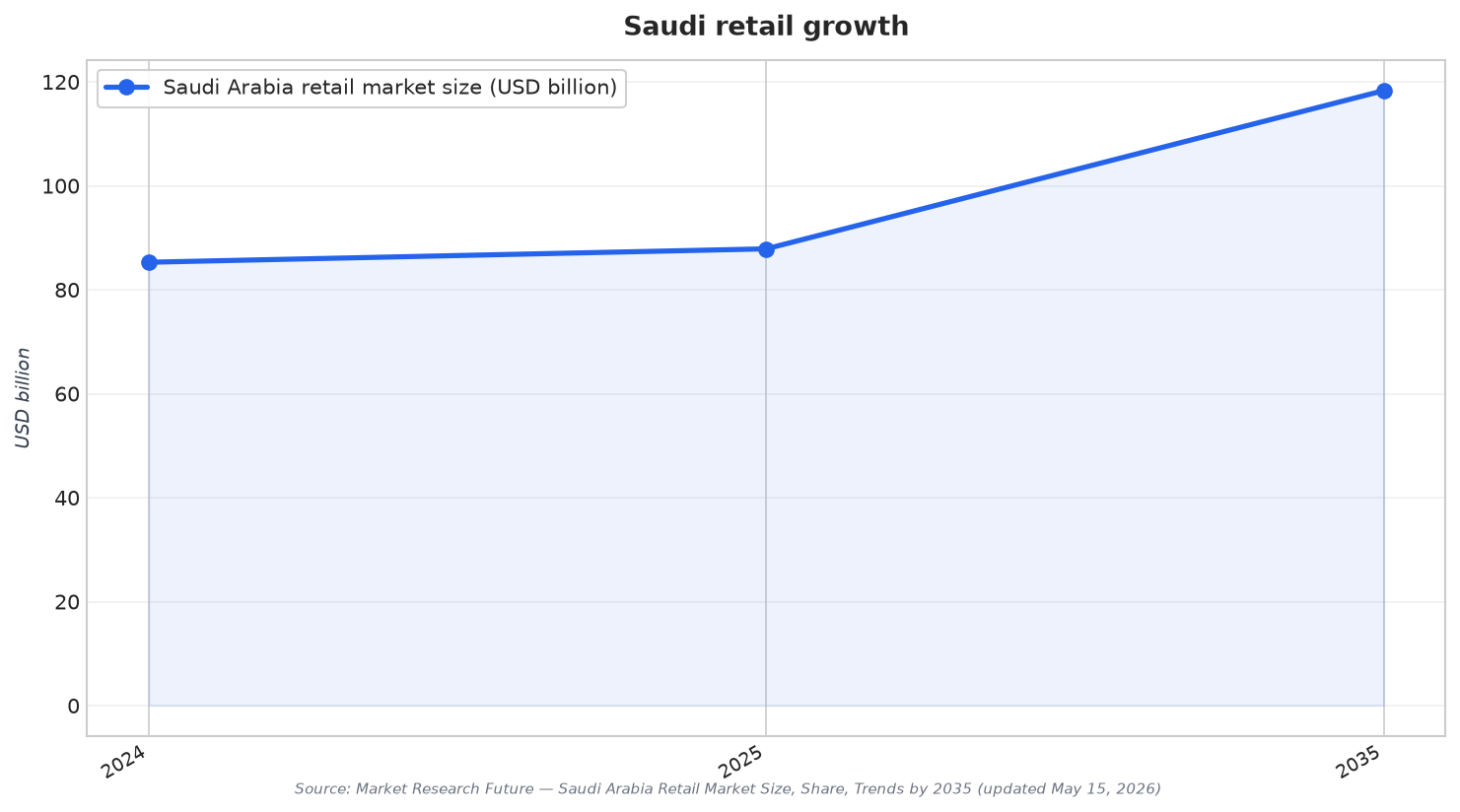
Saudi Arabia’s modern retail landscape is increasingly shaped by scale. Market Research Future estimates the Saudi Arabia retail market at USD 85.29 billion in 2024 and projects growth to USD 118.31 billion by 2035, with a 3.02% CAGR over 2025–2035. In that context, operators that can fund store rollouts, distribution, and technology are better positioned to compete. The same source lists Panda Retail Company and Tamimi Markets among the market’s major players. Consolidation is not only about buying competitors. It is also about building operational leverage as hypermarkets, supermarkets, and online retail evolve side by side.
Evidence of this scale-driven environment shows up in how food retail is described across research. Technavio characterizes Saudi Arabia’s food retail market as highly active, with major players driving consolidation and expansion and capturing over 65% of the modern trade sector. It also states that modern retail formats now account for over 70% of grocery sales, a marked change versus a decade ago. Those numbers matter because they indicate where growth and bargaining power sit: in organized, high-volume formats. Technavio also links the shift to practical outcomes, including product freshness and a reduction in transport-related spoilage by over 10% compared with traditional import-heavy models.
Panda and Tamimi: Scale Becomes a Strategy, Not Just a Size
Store networks illustrate why a “grocery roll-up” logic can emerge even without a single headline deal. USDA’s Retail Foods Annual reports one leading retailer with 185 retail outlets (hypermarkets and supermarkets) in Saudi Arabia, plus two hypermarkets in Egypt and one in Dubai, UAE. In the same report, Tamimi Supermarkets is described as an upscale supermarket with 165 branches in Saudi Arabia and one in Bahrain. Larger networks tend to support centralized buying and more direct sourcing options; the USDA report also notes that companies may purchase locally while also importing directly. As chains expand, they can standardize merchandising, strengthen private label programs, and demand tighter compliance from suppliers.
Category-level data shows how consolidation dynamics play out on shelves. IndexBox notes that in Saudi Arabia’s biscuits market, modern trade channels now account for over 55% of biscuit sales, and it adds that retail shelf space consolidation favors large brand owners with trade marketing budgets. It also estimates private-label penetration at 15–20% of category sales by 2026, up from about 10% in 2020. These pressures help explain why scale retailers invest in own brands and category management. As more volume flows through fewer, larger outlets, distribution becomes harder for smaller innovators, while leading chains can use assortment and pricing architecture to defend traffic.
The regional backdrop reinforces the same story. Mordor Intelligence projects the MENA retail market to expand from USD 0.92 trillion in 2025 and USD 1 trillion in 2026 to USD 1.31 trillion by 2031, a 5.67% CAGR for 2026–2031. It also reports Food, Beverage, and Grocery at 34.81% revenue share in 2025, while offline channels still account for 70.12% of revenue and hypermarkets and supermarkets represent 30.94% of revenue in 2025. For Saudi Arabia specifically, Mordor states that the food retail market exceeded USD 50 billion in 2024 and highlights major chains including Panda and Tamimi. Together, these signals point to consolidation pressures that reward operators able to run dense store networks while building omnichannel capability.
What is driving Saudi Arabia’s move toward larger grocery operators?
How do Panda and Tamimi fit into consolidation pressures in modern retail?
How does private label relate to consolidation in grocery retail?
How big is the food retail market in Saudi Arabia according to the sources?
What does “Saudi grocery retail consolidation” mean in practical terms here?
Talk to us for your needs in:
-
Due Diligence and Valuation Services
-
M&A Strategy and Advisory
-
Post-Merger Integration Management
-
Regulatory and Compliance Advisory
-
Market Entry and Expansion Consulting
-
Investment and Financial Analysis
-
In-Depth Market Survey for M&A
-
Market Intelligence and Insights in M&A
-
Feasibility Study and Assessment in M&A
-
Saudi M&A Benchmarking