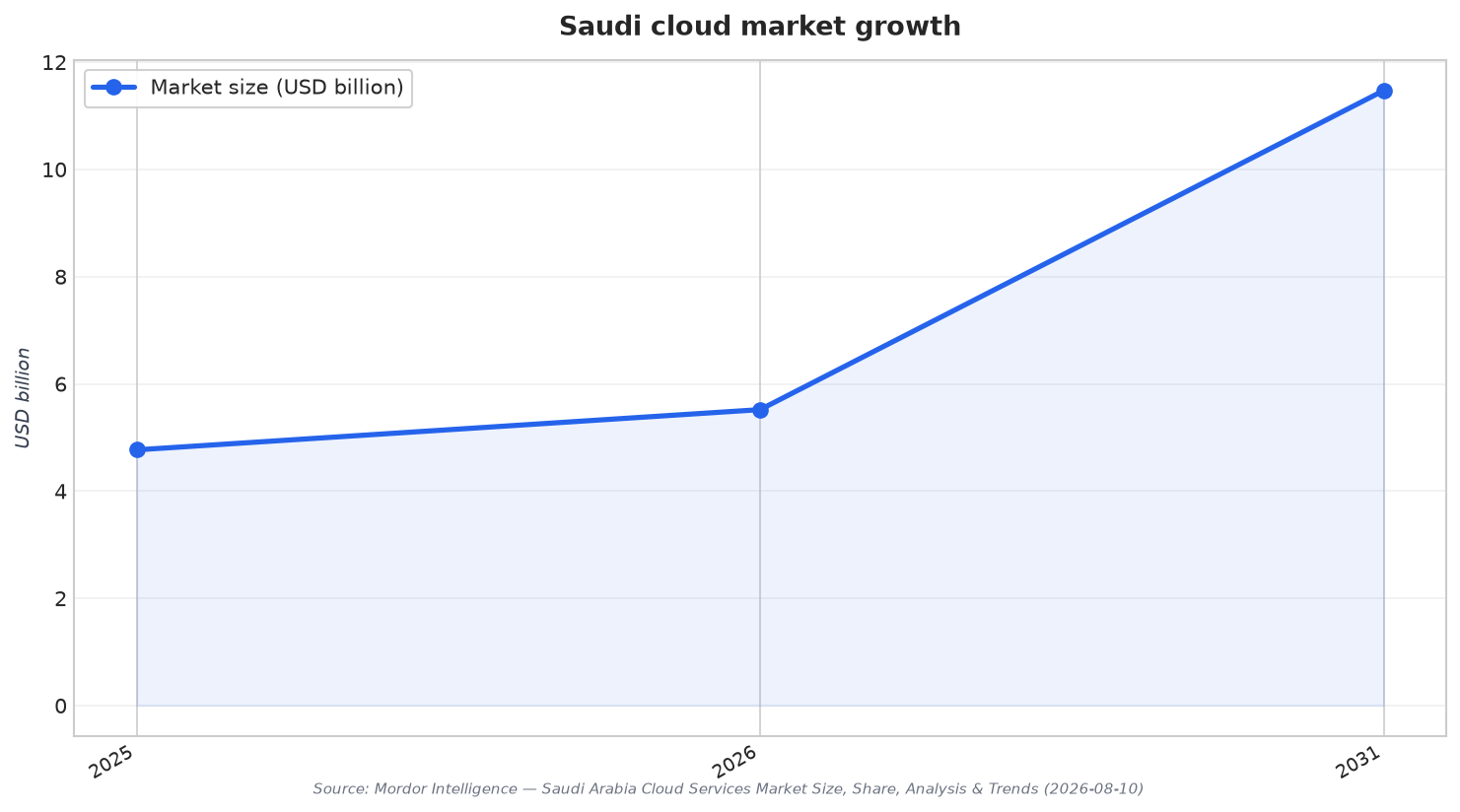
Saudi Arabia’s cloud market is already scaling quickly, and hyperscaler entry is a key part of the story. Mordor Intelligence values the Saudi Arabia cloud services market at USD 4.77 billion in 2025, with estimates that it grows from USD 5.52 billion in 2026 to USD 11.47 billion by 2031 at a 15.74% CAGR (2026–2031). Adoption is anchored in enterprise buying patterns: Software-as-a-Service led with a 44.02% revenue share in 2025, and public cloud accounted for 65.72% of market share that year. Large enterprises captured 73.65% of 2025 spending, while BFSI held a 27.06% share. These splits matter for M&A because they point to where services demand concentrates: large-account migrations, regulated-industry controls, and operating models designed for public cloud at scale.
Against that backdrop, the Microsoft Saudi cloud region becomes an inflection point for services strategy and deal-making. Microsoft confirmed its Saudi Arabia East datacenter region will be available to customers in November 2026, comprising three Azure Availability Zones in the Eastern Province. Another 2026 guide notes Microsoft publicly confirmed in February 2026 that the region is targeted for customer workloads in Q4 2026, also with three availability zones, and that until then Azure workloads for Saudi customers often run from other regions, which affects residency requirements. This is why the launch is framed as a compliance and sovereignty play: it removes a structural blocker for organizations that need local data residency to move beyond pilots for cloud and AI workloads. For IT services acquirers, that changes the value of delivery capabilities that are tightly aligned to in-Kingdom operations and regulated migrations.
Why Hyperscaler Regions Reprice IT Services Deal Theses
When hyperscaler capacity arrives locally, it can reprice both infrastructure-heavy managed services and compliance-led advisory work. IMARC reports that “massive data centers” represent 21.7% and are hyperscaler-owned campuses operated by AWS, Microsoft, and Google within their Saudi cloud regions, and it also ties sovereign cloud requirements to measurable demand: the National Data Management Office (NDMO) oversees data sovereignty requirements, and the mandate for government agencies to migrate to sovereign cloud hosted in Saudi facilities is described as generating USD 450+ million in annual data center demand by 2025. IMARC also states cloud adoption across Saudi enterprises grew from 28% in 2020 to 67% in 2025, translating into co-location and managed services demand at hyperscale-adjacent facilities. In M&A terms, these signals can favor targets with cloud operations, migration factories, and managed-service delivery that can attach to hyperscaler footprints while meeting sovereignty expectations.
Regulation and qualification gates can further shape which IT services platforms are “buyable” at strategic premiums. MarkWide Research describes how SDAIA’s ECC-1:2019 cybersecurity framework and SAMA’s cloud computing guidelines for financial institutions structurally bifurcate vendor qualification tiers, forcing operational partnerships between foreign hyperscalers and licensed domestic entities for market access. It also notes NITC certification mandates can constrain foreign provider access unless operational partnerships with licensed local entities are established. For corporate buyers, this can elevate the M&A value of Saudi-licensed operators, compliance-ready managed security and governance services, and delivery teams already embedded in regulated verticals like BFSI, which Mordor Intelligence puts at 27.06% share of the cloud services market in 2025.
Finally, hyperscaler buildouts can intensify competitive pressure on local hosting, while still expanding the overall services pool. IMARC characterizes the tier-one domestic colocation layer as moderately concentrated, with stc, Mobily, and DETASAD Cloud collectively holding approximately 55–62% of domestic colocation revenue in 2025, while international hyperscalers command the managed cloud segment. A separate 2026 guide also distinguishes a “region” from an edge presence, warning buyers not to confuse a Riyadh edge node with in-country data residency. For M&A, that distinction supports a simple diligence rule: prioritize targets that can implement sovereign architectures in live or imminent regions—especially as Microsoft’s Saudi Arabia East Azure region becomes available—rather than firms anchored only to non-residency solutions that may not clear regulated workload requirements.
When will Microsoft’s Saudi Arabia East Azure region be available to customers?
How is the Microsoft Saudi cloud region expected to affect regulated workloads?
What cloud market figures in Saudi Arabia matter most for IT services M&A screening?
What does Saudi enterprise cloud adoption look like, according to the sources?
Which compliance and certification factors can influence cloud-related deal theses in Saudi Arabia?
Talk to us for your needs in:
-
Due Diligence and Valuation Services
-
M&A Strategy and Advisory
-
Post-Merger Integration Management
-
Regulatory and Compliance Advisory
-
Market Entry and Expansion Consulting
-
Investment and Financial Analysis
-
In-Depth Market Survey for M&A
-
Market Intelligence and Insights in M&A
-
Feasibility Study and Assessment in M&A
-
Saudi M&A Benchmarking