Saudi Arabia’s cement market is projected to grow, but the path looks uneven for producers. Technavio forecasts the Saudi Arabia cement market size will increase by USD 2.57 billion at a 6.4% CAGR from 2025 to 2030, with Vision 2030 giga-projects cited as a key driver. At the same time, Technavio flags rising production costs linked to energy subsidy reforms and notes that clinker inventory management can intensify price competition. That combination—demand growth alongside cost and pricing pressure—creates the setup for tougher decisions on asset efficiency, logistics discipline, and whether scale becomes the most practical defense.
Several source signals point to margin pressure becoming more specific and measurable at company level. IndexBox reports that Al-Jouf Cement projected a 14% increase in production costs after Saudi Aramco notified higher fuel prices, prompting the firm to evaluate financial impact and mitigation strategies. Technavio similarly frames the challenge as rising production costs that push manufacturers toward waste heat recovery systems and other efficiencies. When the cost base moves faster than selling prices in a competitive market, merger math can start to look attractive: consolidate higher-cost positions into more efficient portfolios, and spread compliance and efficiency investments across a larger operating base.
Why the Next Cycle Favors Scale, Compliance, and Portfolio Quality
Compliance and sustainability requirements add another layer that can accelerate consolidation. A ResearchAndMarkets.com databook summary states that compliance requirements may encourage further consolidation of high-cost or technologically outdated facilities into more efficient portfolios, and it also points to selective restructuring among higher-cost operators. Technavio describes an industry shift toward sustainability, including carbon capture utilization technologies and more supplementary cementitious materials to lower the carbon footprint. Separately, an IMARC-based market overview says the Saudi Building Code and Aramco procurement rules prioritize certified green cement, and it notes that industry consolidation through mergers is streamlining operations and boosting efficiency to match rising demand.
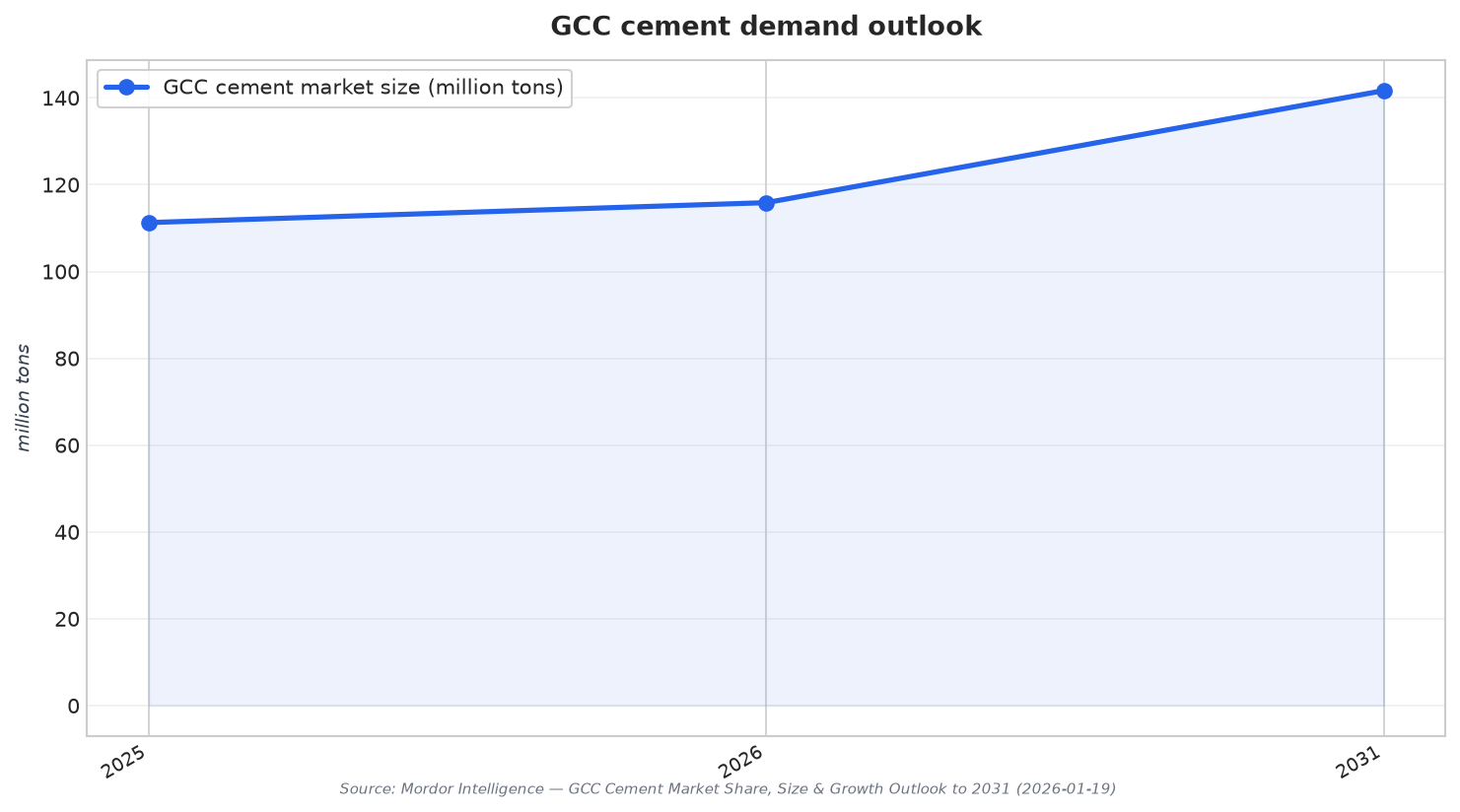
Regional market structure adds context for how scale could work in practice. Mordor Intelligence estimates the GCC cement market size at 115.86 million tons in 2026, rising to 141.67 million tons by 2031 at a 4.12% CAGR. In that same report, Saudi Arabia accounts for 51.62% of the GCC cement market size in 2025 and is advancing at a 5.31% CAGR through 2031. The report also highlights that competitive intensity remains high because regional capacity continues to outstrip domestic need, while companies with scale and modern kilns can improve utilization rates and protect margins. That dynamic aligns with the logic behind Saudi cement sector consolidation, where larger groups can manage utilization, logistics, and upgrades more consistently across assets.
Consolidation also links to product mix and where demand is strongest. Technavio reports the residential segment was valued at USD 4.14 billion in 2024, and it says blended cement accounted for the largest market revenue share in 2024. In the GCC, Mordor Intelligence reports Portland cement held a 71.68% share in 2025, while blended cement is forecast to post the highest CAGR at 5.18% through 2031; it also places the residential end-user share at 64.12% in 2025. As producers weigh merger options, the strategic prize is not only bigger volume, but a portfolio that can serve residential-heavy demand, meet evolving green requirements, and compete on delivered cost when price competition and exports become the pressure valve.
What is driving consolidation among Saudi cement producers?
What cost pressure example has been reported in Saudi Arabia’s cement industry?
How large is the GCC cement market expected to be by 2031?
How does Saudi Arabia’s role in the GCC market shape merger logic?
What does Saudi cement sector consolidation mean for product strategy?
Talk to us for your needs in:
-
Due Diligence and Valuation Services
-
M&A Strategy and Advisory
-
Post-Merger Integration Management
-
Regulatory and Compliance Advisory
-
Market Entry and Expansion Consulting
-
Investment and Financial Analysis
-
In-Depth Market Survey for M&A
-
Market Intelligence and Insights in M&A
-
Feasibility Study and Assessment in M&A
-
Saudi M&A Benchmarking