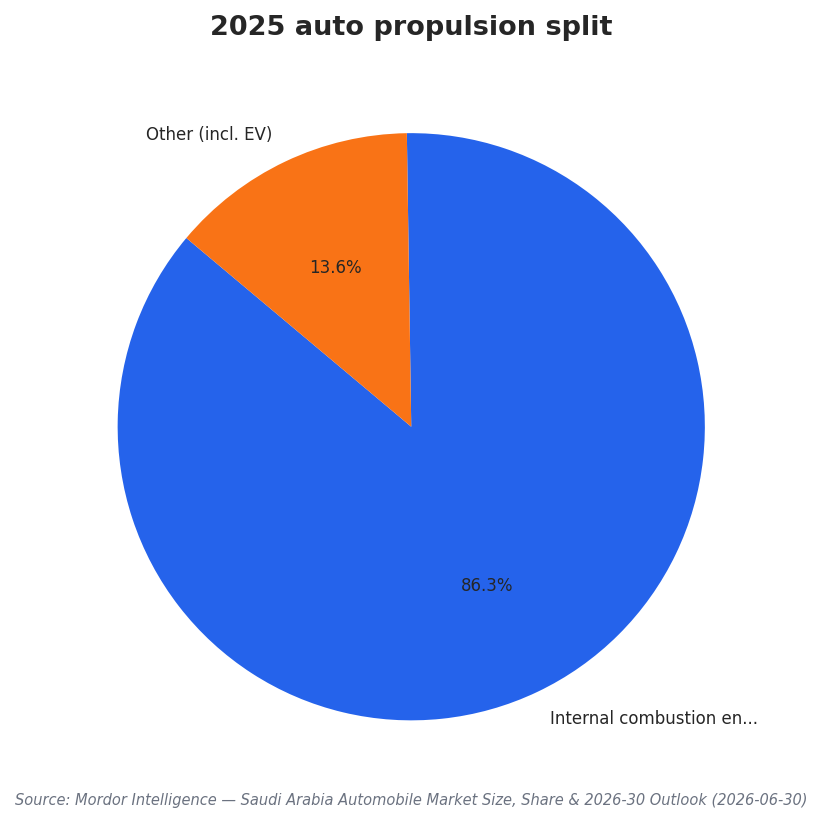
Saudi Arabia’s auto market is growing, and that creates urgency to localize more of the EV stack. Mordor Intelligence valued the Saudi Arabia Automobile Market at USD 47.46 billion in 2025 and estimated growth from USD 50.33 billion in 2026 to USD 67.55 billion by 2031, at a CAGR of 6.05% (2026–2031). Passenger cars held a 76.55% share in 2025, while internal combustion engines still commanded 86.35% share. Yet EV incentives and localized production commitments from Lucid and Ceer are framed as catalysts for faster power-train transition, which helps explain why supply chain consolidation themes are rising alongside new assembly plans.
The EV-only lens shows a smaller base but faster expansion. Mordor Intelligence expects the Saudi Arabia EV market to grow from USD 0.51 million in 2025 to USD 0.64 million in 2026 and reach USD 1.91 million by 2031, at a 24.51% CAGR (2026–2031). Passenger cars made up 76.81% of EV share in 2025, and Riyadh accounted for 38.73% of 2025 sales. The same source links adoption to Vision 2030 priorities, sovereign capital deployed through PIF, and a 10-year government purchase commitment for up to 100,000 Lucid units. As manufacturing and procurement concentrate, the logic of tighter supplier networks becomes more visible.
From Assembly Announcements to Supply Chain Consolidation
Regional planning signals scale, but near-term reality still depends on imports. In Mordor Intelligence’s GCC EV view, Ceer Motors, Lucid, and Hyundai together committed more than USD 5 billion to Saudi assembly capacity slated to start output in 2026, with a Vision 2030 domestic-production mandate of 500,000 units and EVIQ’s 5,000-charger plan. At the same time, IndexBox stresses bottlenecks: local content for battery packs, power electronics, and electric drivetrains is expected to remain near zero for several years, leaving continued exposure to imported cells, modules, and semiconductors. That gap is exactly where Saudi EV supply chain M&A narratives can form, because consolidation often follows when OEM assembly needs reliable localized inputs.
IndexBox also quantifies how import-heavy the market remains. It states that over 95% of Battery EVs sold in Saudi Arabia in 2026 are imported, primarily from China, Europe, and the United States, and that domestic production is not commercially meaningful in 2026 (less than 1% of sales). The same report expects domestic production to reach 20–30% of total market volume by 2030 and 40–50% by 2035, assuming Ceer and Lucid hit their targets, with meaningful local production volumes not reaching commercial scale until late 2027–2028. Those timelines encourage dealmaking and partnerships that can shorten qualification cycles for components and reduce fragility in procurement.
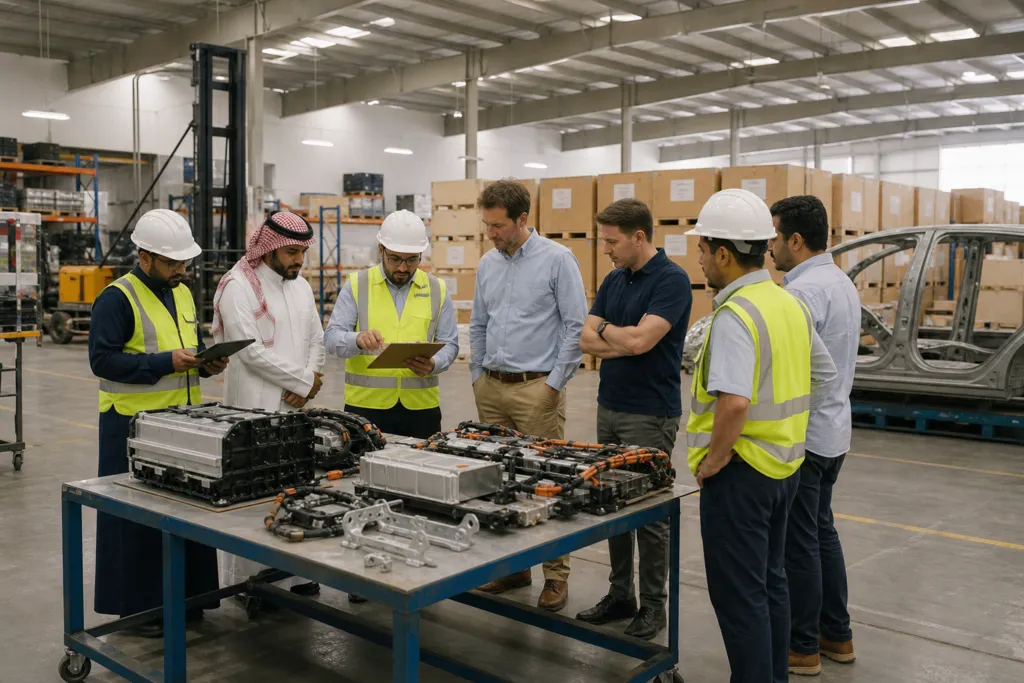
Luxury EV localization adds more detail on what is, and is not, being built locally. IndexBox describes Lucid’s AMP-2 facility in King Abdullah Economic City as focusing on semi-knocked-down (SKD) assembly, with body panels, powertrain components, and battery packs imported from Lucid’s Casa Grande, Arizona facility. It also states that Ceer, a joint venture between PIF and Foxconn, is developing a dedicated EV manufacturing plant in King Abdullah Economic City, targeting production under its own brand by 2027 with an initial capacity of 150,000 units annually. As of 2026, it notes no local production of battery cells, SiC semiconductors, or advanced LiDAR sensors, and says over 90% of luxury EV units are supplied through imports in 2026. These constraints make consolidation discussions practical: local clusters need suppliers that can scale, certify, and finance capacity alongside OEM ramp-ups.
Why are Lucid and Ceer central to Saudi Arabia’s EV localization push?
How import-dependent is Saudi Arabia’s EV market right now?
What are the key supply chain gaps that could drive consolidation activity?
How does Saudi EV supply chain M&A relate to domestic production targets and timelines?
What market figures show EV adoption is accelerating in Saudi Arabia?
Talk to us for your needs in:
-
Due Diligence and Valuation Services
-
M&A Strategy and Advisory
-
Post-Merger Integration Management
-
Regulatory and Compliance Advisory
-
Market Entry and Expansion Consulting
-
Investment and Financial Analysis
-
In-Depth Market Survey for M&A
-
Market Intelligence and Insights in M&A
-
Feasibility Study and Assessment in M&A
-
Saudi M&A Benchmarking