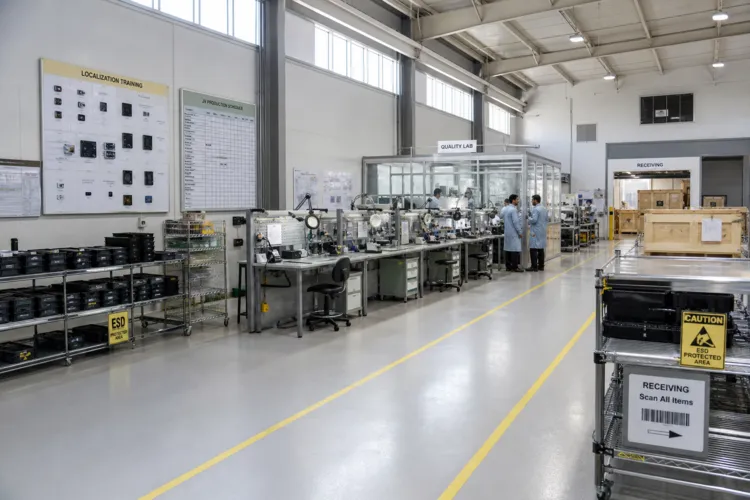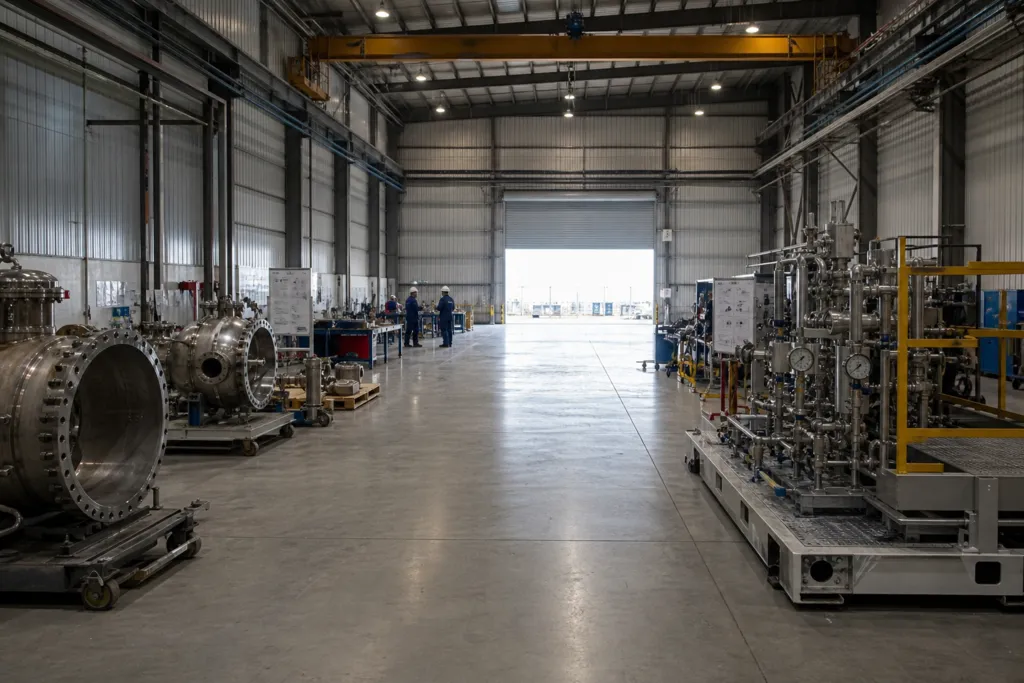
Energy Recovery’s move into Saudi Arabia is a clear case study in how a water-tech supplier can enter a strategic market without an acquisition. The company finalized a lease for a new manufacturing facility near Dammam Second Industrial City, establishing its first in-Kingdom manufacturing operation and its first production facility outside the US for its proprietary PX Pressure Exchanger technology. The plant is designed to serve desalination customers across Saudi Arabia and the wider Middle East and North Africa region, reflecting the industry need to place manufacturing closer to customers as regional demand for reliable and affordable water grows.
The Dammam site is described as a 3,750-square-meter manufacturing facility, and another report describes the facility as approximately 40,000 square feet in the Dammam 2nd Industrial Zone. Energy Recovery said the facility will carry out key stages of its manufacturing process, including machining, assembly, and testing. Production was reported as scheduled to begin in the first quarter of 2027, while full-scale operations were also reported as targeted for the first half of 2028. The company will continue to manufacture important ceramic components at its San Leandro Center of Excellence and ship them to Dammam for finishing, assembly, and testing.
Greenfield Entry vs. Acquisition: What Dammam Signals
As a Saudi water technology investment decision, the Dammam plant reads like a deliberate greenfield play: build, localize, and export, rather than buy scale through acquisition. According to the Saudi Water Authority, the plant will produce 2,000 energy recovery devices annually, exceeding estimated domestic demand of about 1,200 units a year. Around 40% of output is expected to be exported to Gulf Cooperation Council countries, Africa, and Asia. This design embeds the facility into regional trade flows, while still prioritizing local supply for the Kingdom’s desalination buildout and operations.
The economic and localization claims further support the greenfield thesis. The project is expected to contribute SR137 million (about $36.54 million) to Saudi GDP by 2033 and create more than 50 direct jobs. The Saudi Water Authority also said the project is expected to achieve a localization rate of more than 80% across the product’s value chain. In addition, the authority estimated the market opportunity for the technology at more than $145.9 million, including approximately $65.9 million in Saudi Arabia and $80 million across the wider Middle East and North Africa region.
Energy Recovery positioned the plant as part of a broader manufacturing footprint strategy that complements its existing California operations. The company noted that operating expenses in Dammam, including facility, manufacturing, and utilities costs, are expected to be meaningfully lower than comparable costs in the San Francisco Bay Area. In terms of technology relevance, the company said its PX Pressure Exchanger technology is used in facilities producing 43.6 million cubic meters of fresh water each day and can reduce energy consumption in seawater desalination by up to 60%. For investors and industry watchers, this is a practical example of how localization, supply-chain proximity, and cost structure can shape market entry more than buying an incumbent.
Where is Energy Recovery’s Saudi manufacturing facility located?
What production volume is planned for the Dammam plant?
How does the project support localization and jobs?
How should investors think about Saudi water technology investment choices like greenfield vs. acquisition in this case?
What performance claims are cited for PX Pressure Exchanger technology?
Talk to us for your needs in:
-
Due Diligence and Valuation Services
-
M&A Strategy and Advisory
-
Post-Merger Integration Management
-
Regulatory and Compliance Advisory
-
Market Entry and Expansion Consulting
-
Investment and Financial Analysis
-
In-Depth Market Survey for M&A
-
Market Intelligence and Insights in M&A
-
Feasibility Study and Assessment in M&A
-
Saudi M&A Benchmarking