

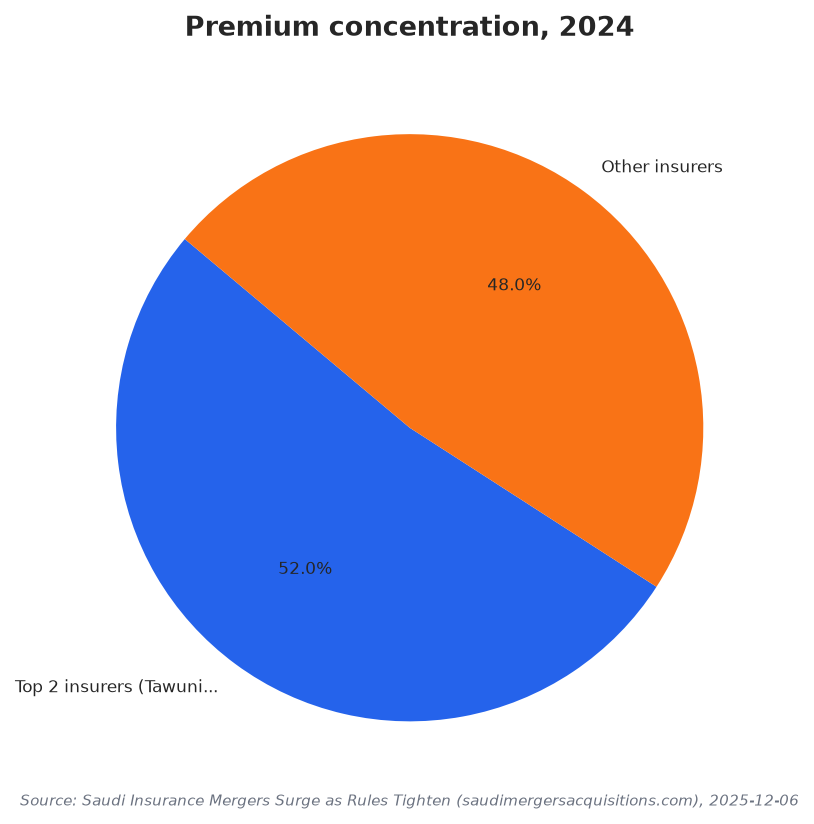
Saudi Arabia’s insurance sector is moving into a solvency-first era, and consolidation is becoming the default response. Fitch Ratings and S&P Global both forecast intensified merger activity through 2026, as smaller insurers face higher compliance costs and capital requirements. The concentration is already clear. Tawuniya and Bupa Arabia controlled 52% of gross written premiums as of 2024, highlighting how hard it is for sub-scale firms to compete. In parallel, S&P has pointed to a market where five large insurers control 70–75% of total revenues, reinforcing the idea that balance sheet strength and distribution reach matter as much as underwriting ambition.
Within that context, the Saudi Enaya Salama merger stands out as a solvency-driven transaction designed to create a larger, more resilient platform. On August 14, 2025, Enaya and Salama signed a binding merger agreement under which Enaya will be absorbed into Salama. Enaya shareholders are set to receive 0.8215 Salama shares for each Enaya share, and the deal is structured around issuing 18.89 million new ordinary shares with a nominal value of SAR10 each. Once completed, Enaya shares will be delisted and all Enaya assets, rights, obligations, and liabilities will transfer into Salama. The companies have said that a detailed timeline and cost estimates will be disclosed after regulatory approvals are secured.
Regulation Tightens, and Weak Players Exit
The consolidation push is not only strategic; it is also regulatory. The Saudi Insurance Authority took over regulatory duties in 2023 and is driving a transformation that includes a risk-based capital framework slated for implementation by 2027. The clampdown has already been visible in enforcement actions. In May 2025, 28 insurance licenses were canceled following corrective measures initiated in August 2024, a move framed as supporting stability and protecting policyholders. This tougher environment is also widening the merger pipeline. Malath extended a memorandum of understanding for six months to continue evaluating a potential merger in which Liva could be folded into Malath, underscoring how companies are repositioning for the next phase of supervision.
Operational strain is another factor that makes scale attractive. Even with expansion, profitability is uneven. In Q1 2025, only six of the ten largest insurers posted underwriting profits, with several described as marginal, while the remaining four reported losses. Segment dynamics add to the pressure. Medical insurance, the largest segment by premium volume, is described as delivering weak returns except for a few dominant firms. Motor insurance, the second-largest segment, remains under intense pricing pressure, especially in compulsory third-party cover. These conditions help explain why mergers and capital raising are being positioned by S&P as essential tools to bolster solvency rather than just optional growth plays.
At the same time, the market’s growth outlook keeps the consolidation story from being purely defensive. Mordor Intelligence projects the Saudi Arabia property and casualty market to expand from USD 9.62 billion in 2025 and USD 11.17 billion in 2026 to USD 23.59 billion by 2031, with a CAGR of 16.12% between 2026 and 2031. Penetration is described as low at 1.5%, pointing to a protection gap. The same source notes that the five largest carriers controlled 67.75% of gross written premiums in 2024. Against that backdrop, deals like Enaya into Salama can be read as an attempt to meet stricter solvency expectations while competing in a market where scale and concentration are already defining outcomes.
What is the Enaya-Salama deal structure?
Why is solvency a central theme behind consolidation in Saudi insurance?
How does market concentration shape the case for mergers?
What recent regulatory action shows the sector is tightening oversight?
How should investors interpret the Saudi Enaya Salama merger in today’s market?
Talk to us for your needs in:
-
Due Diligence and Valuation Services
-
M&A Strategy and Advisory
-
Post-Merger Integration Management
-
Regulatory and Compliance Advisory
-
Market Entry and Expansion Consulting
-
Investment and Financial Analysis
-
In-Depth Market Survey for M&A
-
Market Intelligence and Insights in M&A
-
Feasibility Study and Assessment in M&A
-
Saudi M&A Benchmarking