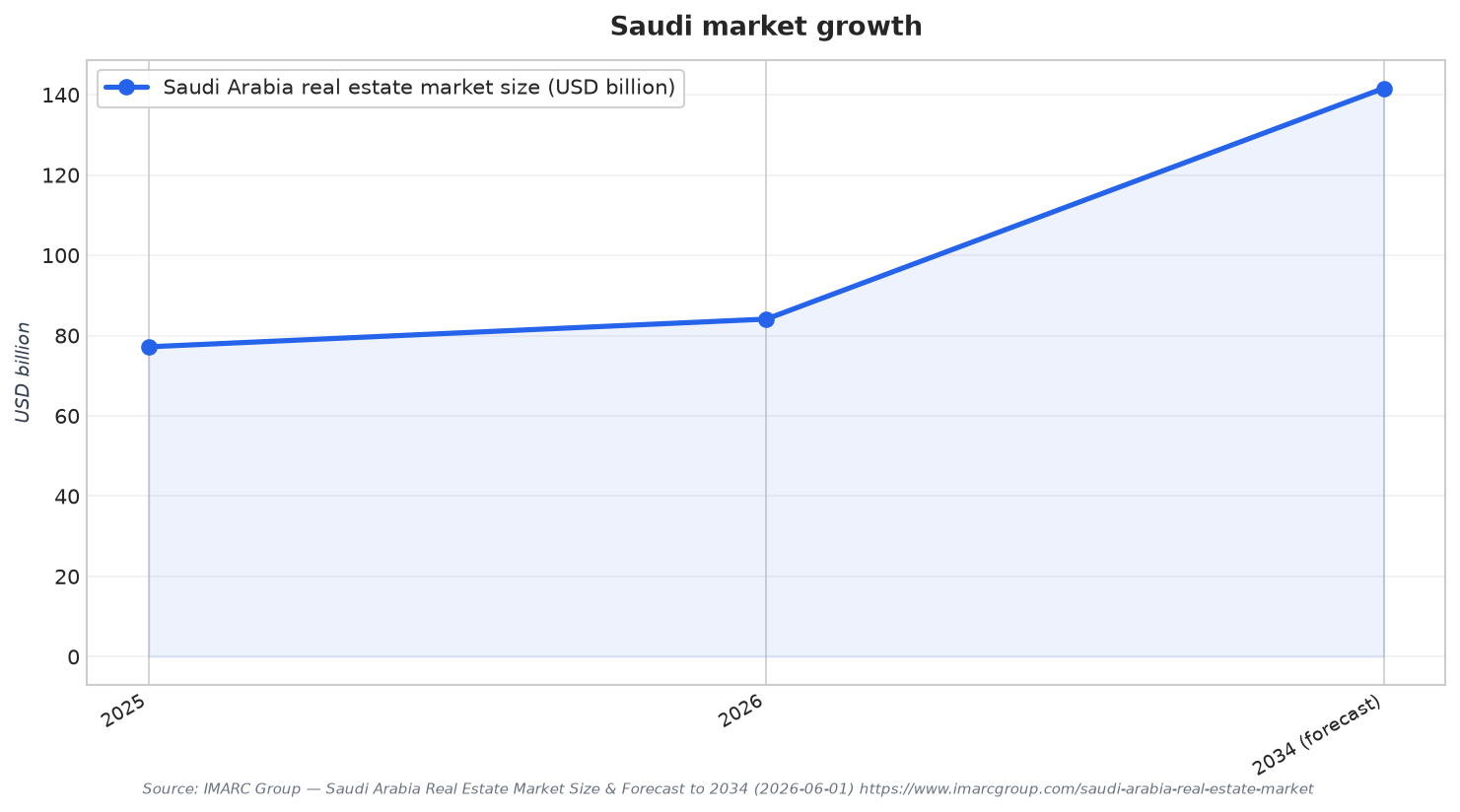
Saudi Arabia’s property cycle is expanding fast, and the industry’s most visible shift is operational. More transactions and leases are moving onto digital rails. IMARC reports the Saudi Arabia real estate market size increased from USD 77.2 billion in 2025 to USD 84.1 billion in 2026, with a projection to reach USD 141.6 billion by 2034 at a CAGR of 6.73% from 2026–2034. The same source cites General Authority for Statistics data showing a 1.7% year-on-year rise in Q2 2024 real estate prices, driven by a 2.8% increase in residential property values. In this environment, digitisation becomes a way to handle demand spikes, compress timelines, and reduce friction across listing, verification, leasing, and portfolio operations.
Deal-making is increasingly part of that execution toolkit. A 2025 Saudi M&A-focused analysis argues that PropTech acquisitions in KSA are moving beyond niche transactions and becoming a core strategy for construction and logistics giants. It also cites Saudi Arabia’s PropTech market at about USD 0.86 billion in 2024, expected to reach USD 2.48 billion by 2030, growing close to 19% annually. The same source adds that venture investment in Saudi PropTech reached around USD 9 million in 2023, rising about 35% year on year, and that the Kingdom recorded more PropTech deals than any other market across the Middle East, Africa, Pakistan, Türkiye, and Southeast Asia in that period. Read through a 2026 lens, the Saudi proptech M&A 2026 topic is less about hype and more about who can absorb capability quickly and deploy it at scale.
Why Platforms and Data Infrastructure Are Becoming the New Moat
Digital platforms are already large enough to matter as strategic assets. Ken Research values the Saudi Arabia digital real estate platforms market at USD 1.1 billion, driven by urbanization, internet penetration, Vision 2030 reforms, and PropTech adoption for efficient property transactions. The same source lists key participants across search, classifieds, government-linked services, and leasing, including Property Finder, Bayut, Aqar, Haraj, Sakani, Ejar, OpenSooq, Sakan, and Wasalt. On the infrastructure side, IMARC notes that in December 2023 Ejar recorded 8 million digital leases, a scale signal that matters to investors who need consistent documentation and reporting. As these rails mature, acquisition logic shifts toward combining traffic, listings, verification, and post-lease services into a tighter, more defensible operating system.
Macro drivers reinforce why scale and integration are prized. IMARC links growth to Vision 2030 diversification and massive infrastructure investments, and notes that in October 2025 NEOM secured contracts worth $24 billion, sustaining demand across residential, commercial, and hospitality segments. The same source reports that in 2024 the Public Investment Fund reported $913 billion in assets under management, supporting tourism, entertainment, and urban regeneration projects that create ongoing real estate development opportunities. It also states Saudi Arabia’s population reached 35.3 million in 2024, rising 4.7% year-on-year, with urban concentration at 85% by 2024 and projected to reach 86.3% by 2030. These pressures raise the premium on PropTech tools that cut processing time, expand distribution, and standardize workflows across growing portfolios.
Regulatory and capital signals are also pushing digitisation deeper into the deal stack. IMARC says a new property law effective January 2026 enables foreign ownership in major cities and reduces transaction taxes, and cites the Destination Saudi Report 2024 that 84% of global high-net-worth individuals expressed interest in Makkah and Madinah assets. That kind of cross-border interest amplifies the need for transparent listings, auditable contracts, and scalable onboarding. Meanwhile, market research summaries describe demand for tools such as virtual tours, digital contract platforms, AI-driven valuation, IoT-enabled monitoring, and smart property management. When acquisitions pull these capabilities under larger operators, they can accelerate rollouts across multiple projects and cities, aligning digitised execution with the Kingdom’s building pipeline and investor expectations.
What is driving the acquisition wave in Saudi Arabia’s PropTech scene?
How large is Saudi Arabia’s real estate market in 2026?
What evidence shows real estate workflows are already digitising at scale?
How should investors think about Saudi PropTech M&A in 2026?
Which macro trends are reinforcing demand for PropTech tools in Saudi Arabia?
Talk to us for your needs in:
-
Due Diligence and Valuation Services
-
M&A Strategy and Advisory
-
Post-Merger Integration Management
-
Regulatory and Compliance Advisory
-
Market Entry and Expansion Consulting
-
Investment and Financial Analysis
-
In-Depth Market Survey for M&A
-
Market Intelligence and Insights in M&A
-
Feasibility Study and Assessment in M&A
-
Saudi M&A Benchmarking