
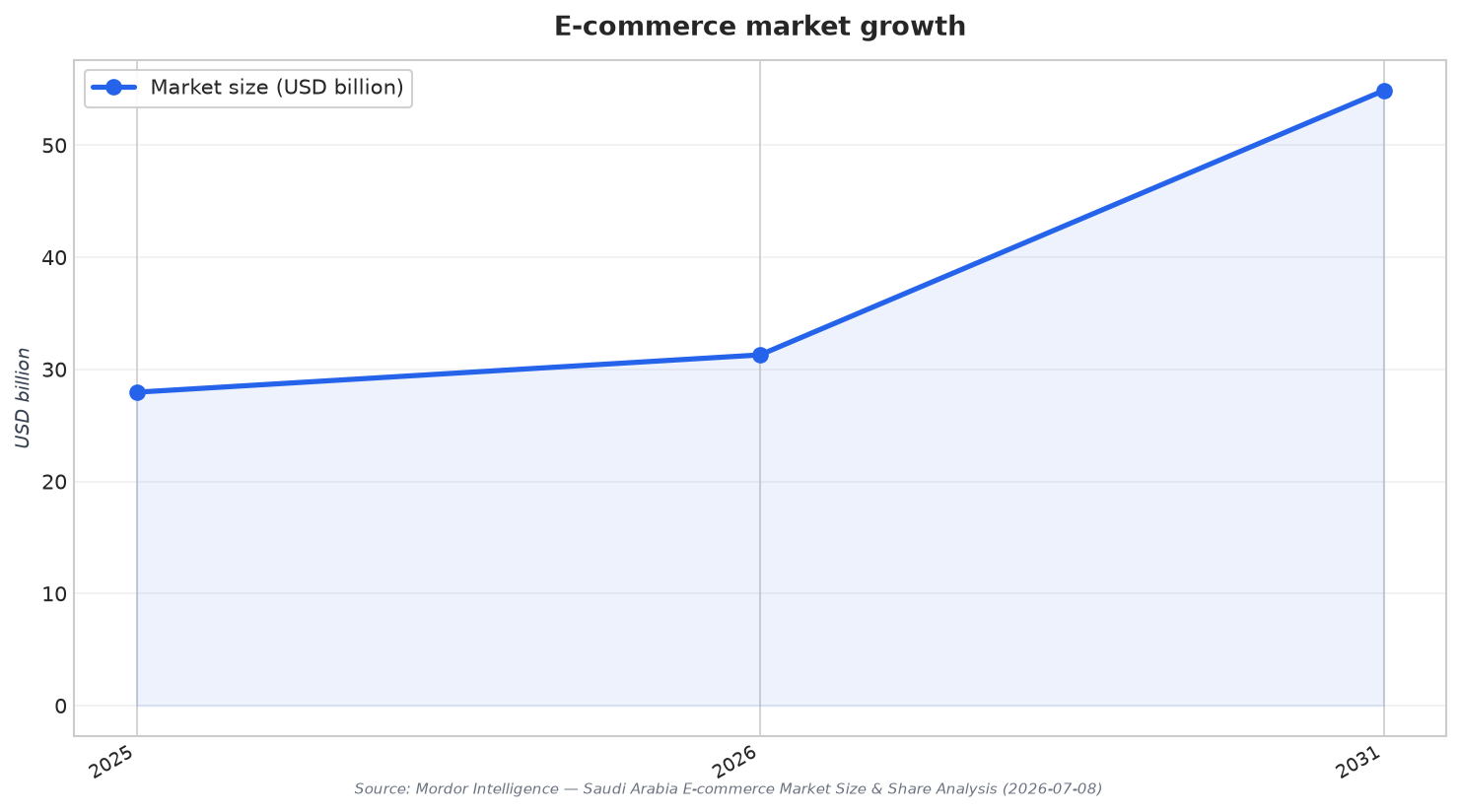
Saudi Arabia’s digital commerce story is no longer only about ordering meals. It is about platform scale, multi-category expansion, and the economics of delivery density. Mordor Intelligence estimates Saudi Arabia’s e-commerce market at USD 27.96 billion in 2025 and USD 31.29 billion in 2026, with USD 54.87 billion projected by 2031 at an 11.92% CAGR (2026–2031). Within that growth, B2C transactions held 73.54% share in 2025, while B2B is projected to advance at a 13.45% CAGR through 2031. This widening surface area makes consolidation a strategic lever, because platforms that can spread fixed costs across more categories and users can defend margins while improving delivery experience.
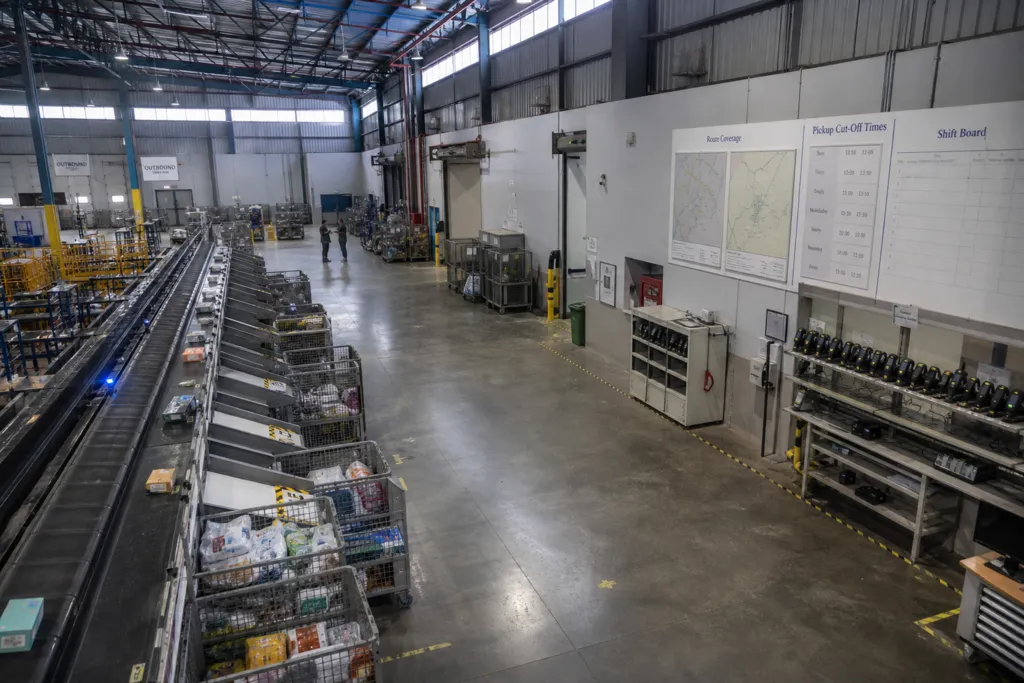
The delivery layer shows why winners try to bundle more than food. Mordor Intelligence values Saudi Arabia’s delivery apps market at USD 8.33 billion in 2025, growing from USD 9.59 billion in 2026 to USD 19.45 billion by 2031 at a 15.18% CAGR. Food delivery still produced USD 6.37 billion in revenue in 2025, equal to 76.48% of delivery apps market share. Yet the same source says grocery delivery will grow fastest at a 14.55% CAGR, supported by dark-store density and higher basket values. As platforms extend from meals to groceries, pharmaceuticals, and essentials, they often need tighter operational integration with retailers, couriers, and payments, pushing the market toward consolidation across adjacent e-commerce services.
Consolidation Signals: Orders, Scale, and the Move Into Quick Commerce
Order volume illustrates how scale concentrates. A GlobeNewswire quick commerce report citing Transport General Authority data says the sector handled approximately 290 million orders in 2024, followed by a 40% increase in 2025. The same source notes that between April and June 2025, more than 50 million parcels and 101 million service orders, including food and express deliveries, were processed. It also reports that Jahez held around one-third of all delivery orders in the Kingdom in 2024, with 91 million of 290 million platform orders. When a few operators command that level of throughput, consolidation becomes a way to secure capacity, widen coverage, and standardize service levels across categories that customers now expect to arrive quickly.
Payments and connectivity also shape which platforms can sustainably scale, and therefore which ones become acquirers or targets. Mordor Intelligence cites 99% internet penetration and 78% 5G coverage in Saudi Arabia, supporting mobile-first commerce, and it reports smartphones delivered 77.98% of B2C e-commerce revenue share in 2025. Payment mix is shifting too: credit and debit cards led B2C e-commerce with a 42.62% share in 2025, while digital wallets are projected to be the fastest-growing payment mode at a 14.71% CAGR to 2031. As regulatory clarity around the Personal Data Protection Law (PDPL) increases shopper confidence and raises entry barriers for under-capitalized newcomers, larger platforms are better positioned to absorb compliance and technology costs, reinforcing consolidation logic.
In practice, Saudi e-commerce M&A often follows the customer journey: discovery, payment, fulfillment, and retention. Market structure details hint at where consolidation can create the most value. In B2C product categories, consumer electronics commanded 27.06% of market size in 2025, while grocery and food and beverages are projected to rise at a 13.72% CAGR toward 2031. Geographic concentration matters as well: Riyadh contributed 35.01% revenue share in 2025, while the Eastern Province posts the highest 12.76% CAGR to 2031. As major ecosystems such as Amazon.sa and Noon compete alongside local enablers like Zid and Salla, the push beyond food delivery increasingly centers on integrating logistics, personalization, and payment experiences at national scale.
Why is consolidation happening across Saudi Arabia’s e-commerce platforms?
How large is Saudi Arabia’s e-commerce market according to the sources?
What do the sources say about delivery order volumes and market concentration?
How is mobile and digital payments usage shaping platform strategies?
What does Saudi e-commerce M&A focus on beyond food delivery?
Talk to us for your needs in:
-
Due Diligence and Valuation Services
-
M&A Strategy and Advisory
-
Post-Merger Integration Management
-
Regulatory and Compliance Advisory
-
Market Entry and Expansion Consulting
-
Investment and Financial Analysis
-
In-Depth Market Survey for M&A
-
Market Intelligence and Insights in M&A
-
Feasibility Study and Assessment in M&A
-
Saudi M&A Benchmarking