Diagnostic laboratories in Saudi Arabia are no longer treated as a back-office hospital function. Multiple market sources describe a shift toward testing as a core input into clinical decisions, especially for chronic conditions that require ongoing monitoring. Nexdigm characterizes the market as having moved beyond an earlier hospital-dependent model, with a steady patient flow arriving via hospital referrals and independent walk-ins. This operational change matters for buyers because scaled networks can standardize turnaround times, expand test menus, and invest in technology that smaller labs may struggle to fund. In that context, roll-ups become a practical way to aggregate volumes and create broader geographic coverage, especially where urban ecosystems concentrate demand.
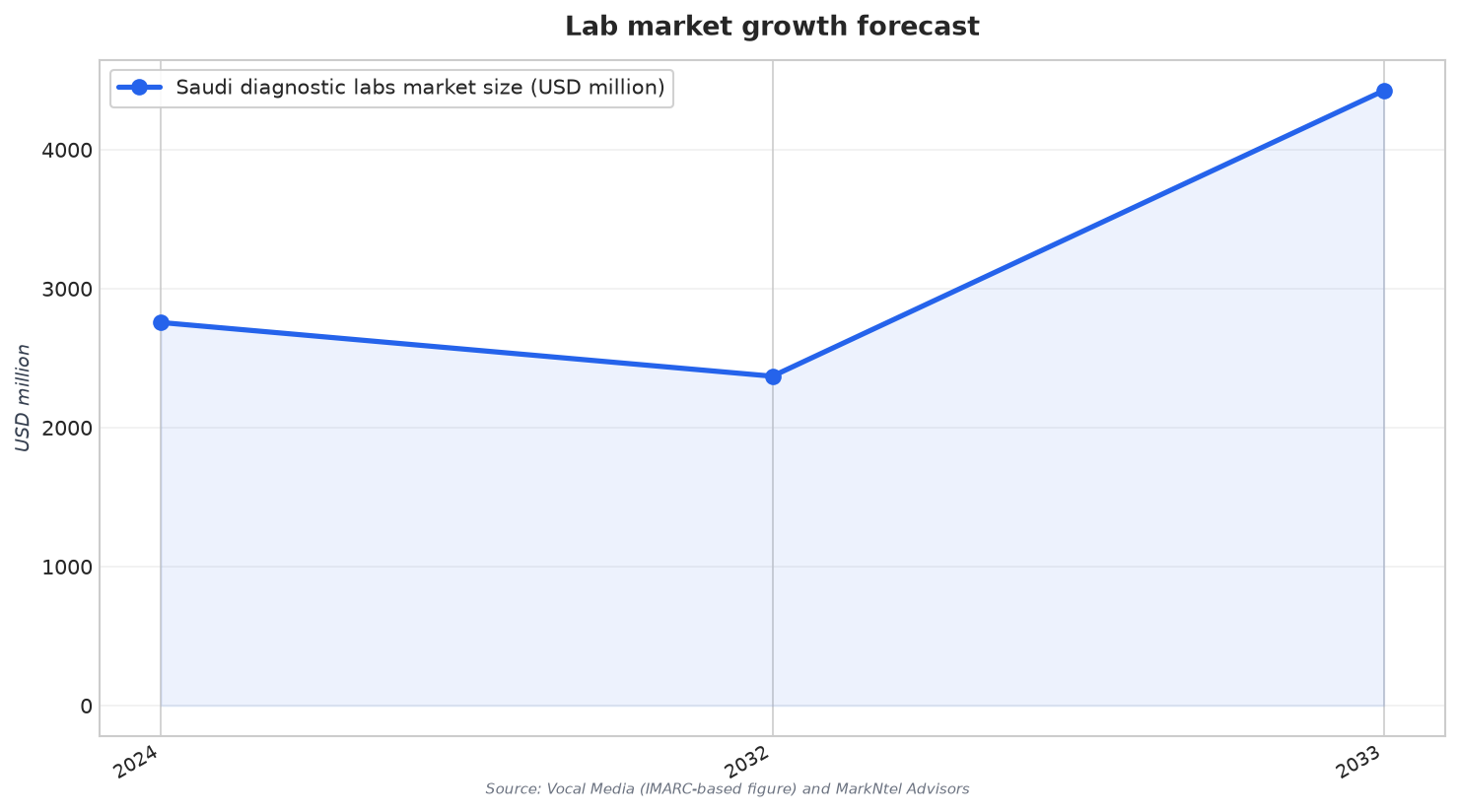
Market growth signals reinforce why consolidation narratives persist. Mobility Foresights estimates the Saudi Arabia Clinical Diagnostics Market at USD 22.4 billion in 2025 and projects approximately USD 40.1 billion by 2031, implying a 10.1% CAGR from 2025 to 2031. For the diagnostic labs segment specifically, an IMARC-based figure reported by Vocal Media places Saudi Arabia’s diagnostic labs market size at USD 2,756.44 million in 2024 and forecasts USD 4,425.01 million by 2033, at a CAGR of 5.40% during 2025–2033. MarkNtel Advisors values the Saudi Arabia diagnostic labs market at USD 1.58 billion in 2025 and projects USD 2.37 billion by 2032, growing at a 5.97% CAGR. Bonafide Research adds that the Saudi Arabia Diagnostic Labs market is projected to add more than USD 1 billion from 2024 to 2029.
Why Scale Matters Now: Prevention, Chronic Disease, and Tech-Heavy Labs
Demand drivers also explain why buyers may prefer platforms that can absorb investment and execute upgrades quickly. Vocal Media cites that 25% of adults face chronic conditions like diabetes and hypertension, alongside a 15% uptick in routine testing. Mordor Intelligence adds a separate demand lens, noting that Saudi Arabia’s diabetic population is projected to grow from 2.69 million in 2020 to 4.21 million by 2030, which it links to demand for HbA1c, lipid, and tumor marker panels. On the policy side, MarkNtel Advisors points to nationwide screening initiatives led by the Saudi Ministry of Health under the National Transformation Program, including diabetes, hypertension, obesity, and cancer screening campaigns delivered through primary healthcare centers and employer-linked health drives. Those programs rely on standardized tests and repeat monitoring, which favors operators that can run consistent workflows at high volume.
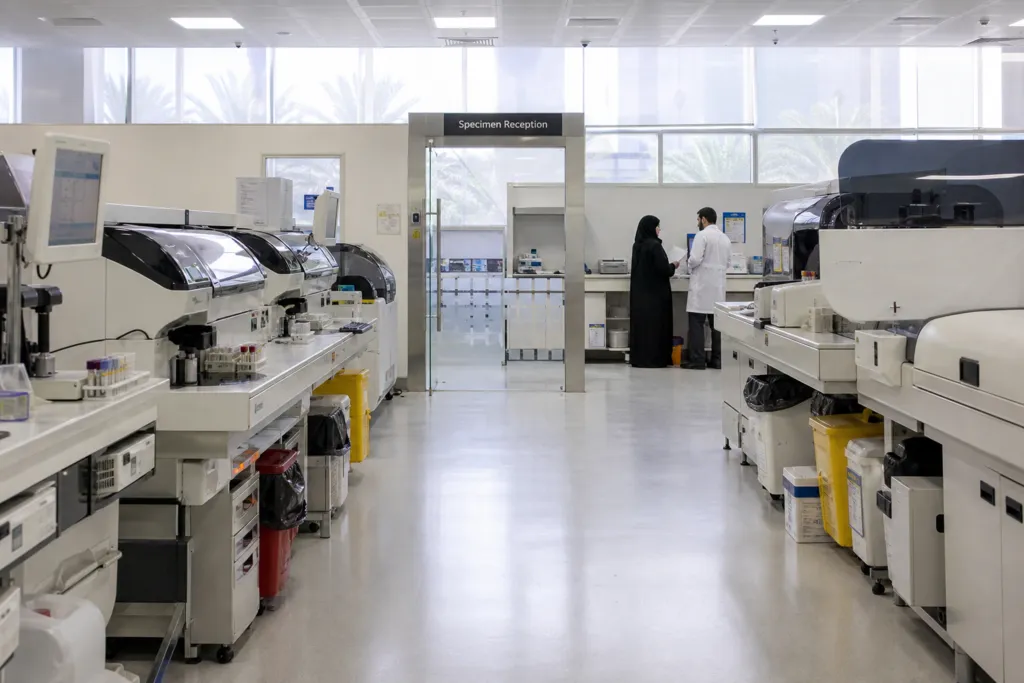
Technology intensity is rising at the same time, and that can widen the gap between premium networks and mid-tier labs. Bonafide Research highlights advanced imaging techniques, molecular diagnostics, genetic testing, and specialist pathology services as areas strengthening diagnostic accuracy and efficiency. Mobility Foresights describes accelerating integration of AI and machine learning in clinical diagnostic devices to improve accuracy and reduce turnaround time, and it also points to a rise in molecular diagnostics and point-of-care testing. Mordor Intelligence provides concrete examples of the upgrade cycle: King Faisal Specialist Hospital inaugurated the region’s largest automated hematology laboratory in December 2024, featuring AI image analysis and multiparametric flow cytometry, and Roche announced a June 2026 roll-out of its next-generation core lab technology, cobas Mass Spec (cobas I 602), in Saudi Arabia. For acquisition-minded buyers, these shifts reward operators that can finance automation, informatics, and higher-complexity testing while scaling those capabilities across multiple sites.
Competitive structure and end-user dynamics add to the logic for consolidation. Nexdigm notes that major urban hubs such as Riyadh, Jeddah, and Dammam dominate the diagnostic laboratory landscape, reflecting their concentration of tertiary hospitals, private diagnostic chains, and specialized medical centers. Nexdigm’s industry commentary also calls the competitive space relatively concentrated, citing large players such as Al Borg Diagnostics and Alfa Medical Laboratories, alongside hospital groups like Dr. Sulaiman Al Habib Medical Group and Saudi German Health operating their own lab networks. Mordor Intelligence reports that, by end user, diagnostic laboratories captured 47.87% revenue in 2025, while home-care and point-of-care settings are set to grow at a 6.54% CAGR over 2026–2031. Together, these factors help explain the current appeal of Saudi diagnostics lab M&A: buyers are not just purchasing test capacity, but also access to urban referral ecosystems, standardization potential, and a pathway to modernize across a broader footprint.
Why are diagnostics roll-ups becoming more attractive in Saudi Arabia?
What market growth signals support buyer interest in Saudi lab platforms?
Which demand drivers are increasing lab testing volumes in Saudi Arabia?
How does technology adoption affect consolidation in lab services?
What does Saudi diagnostics lab M&A typically aim to achieve in this market environment?
Talk to us for your needs in:
-
Due Diligence and Valuation Services
-
M&A Strategy and Advisory
-
Post-Merger Integration Management
-
Regulatory and Compliance Advisory
-
Market Entry and Expansion Consulting
-
Investment and Financial Analysis
-
In-Depth Market Survey for M&A
-
Market Intelligence and Insights in M&A
-
Feasibility Study and Assessment in M&A
-
Saudi M&A Benchmarking