

Saudi Arabia’s asset management industry has turned into a Vision 2030 capital-markets story, with more licensed managers, larger AUM, and wider fund choice for institutional and retail investors. One signal of competitive intensity is the jump from approximately five significant licensed asset managers in 2016 to over 36 by 2025. On the product side, public investment funds registered with the CMA number over 300 across equity, fixed income, money market, real estate, and multi-asset categories. Private placement funds have also proliferated, with over 500 private funds registered, spanning private equity, venture capital, and real estate development vehicles.
Scale is now the defining feature of the Saudi market discussion. Saudi-domiciled funds exceeded SAR 350 billion in total AUM by the end of 2025, representing compound annual growth of approximately 18% since 2020, according to Vision2030.ai. The same source adds that, including discretionary portfolio management mandates and private fund vehicles, the broader market approaches SAR 700 billion in managed assets. A separate S&P Global Ratings view reported AUM at $295 billion as of March 31, 2025, and described average annual growth of around 12% per year between 2015 and 2024, with expectations that AUM could exceed half a trillion USD by the end of 2030, subject to market conditions.
Why Bigger Mandates Can Drive Consolidation Pressure
As mandates scale, operating leverage becomes a strategic issue, not just a finance metric. BCG’s Global Asset Management Report 2025 found that for firms with AuM below $300 billion, increasing AuM significantly reduces costs as a percentage of AuM, with both investment management and trade execution and business management and support costs decreasing as a proportion of total costs at greater scale. BCG also notes that as firms surpass the $300 billion mark and approach $500 billion, rising complexity and operational challenges can emerge, creating “diseconomies” of scale. In that context, Saudi asset management M&A can be framed as a route to scale, broader scope, or capabilities, while trying to manage complexity deliberately.
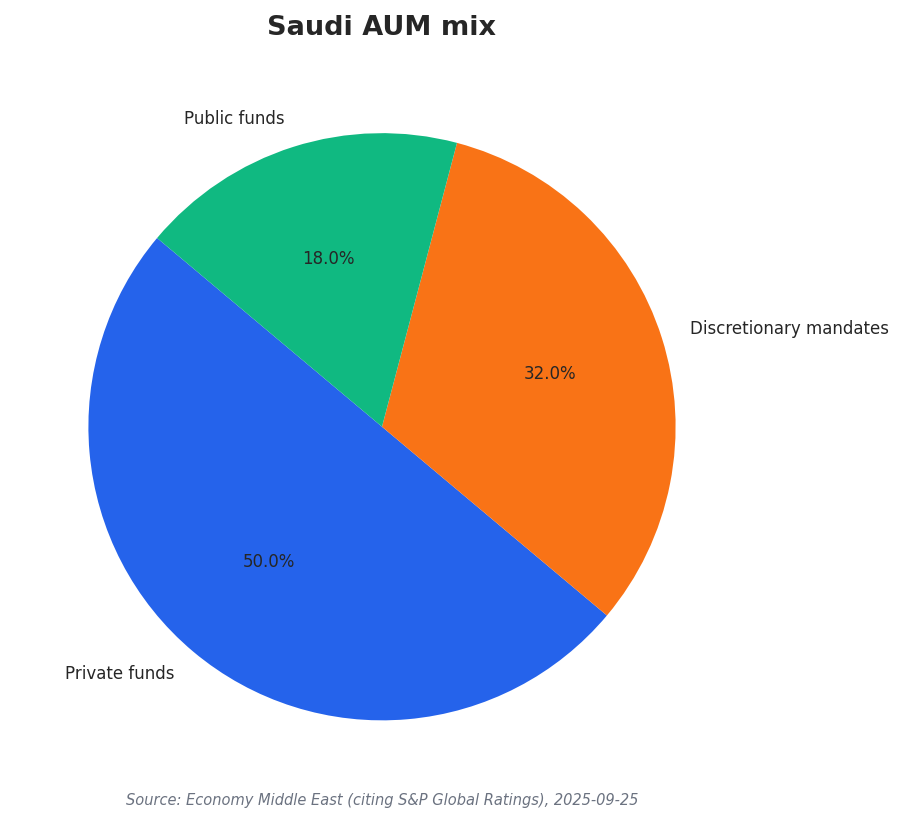
Saudi Arabia’s mix of managed assets also creates different consolidation incentives across business lines. S&P reporting cited private funds as nearly 50% ($148 billion) of AUM, discretionary mandates at close to one-third ($96 billion), and public funds at about 18% ($51.5 billion). Within Saudi private funds, real estate is described as highly popular in the GCC region and accounts for nearly 50% (USD 72.2 billion) of Saudi private-fund AUM, followed by equities. This mix can encourage combinations that add alternatives, real-estate structuring, or discretionary capabilities, depending on where a manager is underweight.
Industry structure helps explain who may lead consolidation and who may become a target or partner. Bank-affiliated managers such as SAB Invest, Al Rajhi Capital, Riyad Capital, and SNB Capital are described as maintaining the largest AUM positions by leveraging parent-bank distribution networks. Independents are described as the fastest-growing segment, including Hassana Investment Company, Jadwa Investment, SEDCO Capital, and Derayah Financial, competing on performance and product innovation rather than distribution scale. International asset managers have also increasingly established Saudi operations through CMA licensing reforms. With the Public Investment Fund (PIF) described as having assets exceeding SAR 3 trillion and allocating a portion through external managers for specialist strategies and international diversification, mandate competition can intensify and keep scale and capabilities at the center of strategic decisions.
How large is Saudi Arabia’s asset management market in the sources?
How has the number of significant licensed asset managers changed?
What is the current mix of AUM across private funds, discretionary mandates, and public funds?
What does BCG say about why consolidation can be attractive for smaller asset managers?
How does Saudi asset management M&A relate to scaling mandates and capabilities?
Talk to us for your needs in:
-
Due Diligence and Valuation Services
-
M&A Strategy and Advisory
-
Post-Merger Integration Management
-
Regulatory and Compliance Advisory
-
Market Entry and Expansion Consulting
-
Investment and Financial Analysis
-
In-Depth Market Survey for M&A
-
Market Intelligence and Insights in M&A
-
Feasibility Study and Assessment in M&A
-
Saudi M&A Benchmarking