U.S. approval of a possible sale of 48 F-35 fighter jets to Saudi Arabia, priced at $24.3 billion, adds urgency to Riyadh’s ongoing push for industrial participation and technology transfer. U.S. disclosures say there is no offset agreement proposed at this time, and that any offset agreement would be defined later in negotiations between the purchaser and the contractor. That sequencing matters for dealmakers, because it means the platform decision can come first, while the work-share, investment commitments, and potential joint ventures (JVs) can be designed afterward, contract by contract.
Those negotiations will land in a market already on a defined growth curve. IMARC Group values the Saudi Arabia defense market at USD 24,034.8 million in 2025 and expects it to reach USD 33,077.1 million at a 3.61% CAGR during 2026–2034. Mordor Intelligence separately values the market at USD 23.91 billion in 2025 and projects growth from USD 24.79 billion in 2026 to USD 33.32 billion by 2031 at a 6.09% CAGR over 2026–2031. The forecasts differ, but both point to sustained expansion that can support multi-year localisation programs and long-cycle defence-tech investments.
Where Offsets and JVs Are Likely to Cluster After Approval
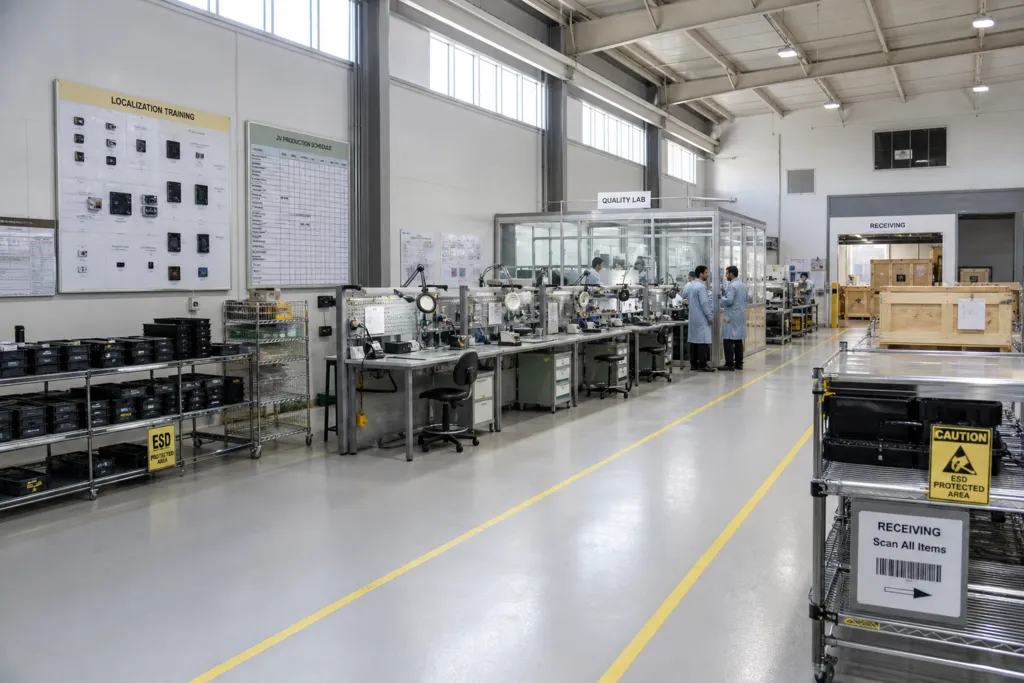
Vision 2030 priorities are shaping how suppliers pitch deals and how authorities structure localisation. Mordor Intelligence describes indigenous production scaling through joint ventures that embed technology-transfer clauses into every prime contract. It also reports that foreign acquisitions accounted for 80.50% of 2025 budgets, while indigenous production is forecast to grow at an 11.40% CAGR through 2031. The U.S. Commercial Service adds that Saudi Arabia aims to localize 50% of its military procurement by 2030 under GAMI and SAMI, and that domestic defense content has reached 19.35%. In this context, offsets can become the mechanism for translating major platform buys into domestic production, MRO capacity, and defence electronics programs.
Deal flow is also being pulled by operational requirements that reward high-tech subsystems, not just airframes. Mordor Intelligence notes that sensors are forecast to grow at a 6.62% CAGR through 2031, and that space is projected to grow at a 10.35% CAGR through 2031 driven by Neo Space Group programs. It also reports the Air Force led spending with a 38.19% share in 2025 and is forecast to grow at a 6.65% CAGR through 2031. These patterns matter because offset JVs often concentrate in areas where local teams can sustain capability over time—such as support, data, and electronics—rather than in the most sensitive core technologies.
Cyber and digital defence are another magnet for partnership structures, including defence-tech deals that sit beside traditional procurement. IMARC highlights that rising cyberattacks targeting sensitive data, energy operations, and defense systems are encouraging heavy investments in advanced cybersecurity frameworks, digital intelligence platforms, and electronic warfare solutions. It adds that collaborations with global tech and defense companies are strengthening Saudi Arabia’s cyber resilience, while domestic programs aim to train specialists in cyber defense. As the Saudi defence tech investment 2026 conversation matures, these cyber and electronic-warfare priorities can provide practical pathways for technology transfer and specialist training that fit within localisation goals.
Was an offset agreement included in the F-35 approval package?
How big is the Saudi Arabia defense market in 2025, according to the sources?
What do the sources say about localisation progress and targets?
In a Saudi defence-tech investment 2026 planning cycle, which areas are forecast to grow faster?
Talk to us for your needs in:
-
Due Diligence and Valuation Services
-
M&A Strategy and Advisory
-
Post-Merger Integration Management
-
Regulatory and Compliance Advisory
-
Market Entry and Expansion Consulting
-
Investment and Financial Analysis
-
In-Depth Market Survey for M&A
-
Market Intelligence and Insights in M&A
-
Feasibility Study and Assessment in M&A
-
Saudi M&A Benchmarking