
Saudi Arabia has become a focal point for Uber’s planned acquisition of Delivery Hero, because Delivery Hero owns HungerStation, one of the kingdom’s major food-delivery platforms. PYMNTS reported that Saudi Arabia’s General Authority for Competition is examining the proposed transaction, highlighting how closely contested the market has become. Earlier reporting cited by Global Competition Review said Uber agreed in July to acquire Berlin-based Delivery Hero in a transaction valued at about $14.8 billion. For Saudi delivery, the practical implication is simple: the buyer already runs a ride-hailing business in the kingdom, and gaining HungerStation would give Uber a substantial position in local delivery through an established network rather than building one from scratch.
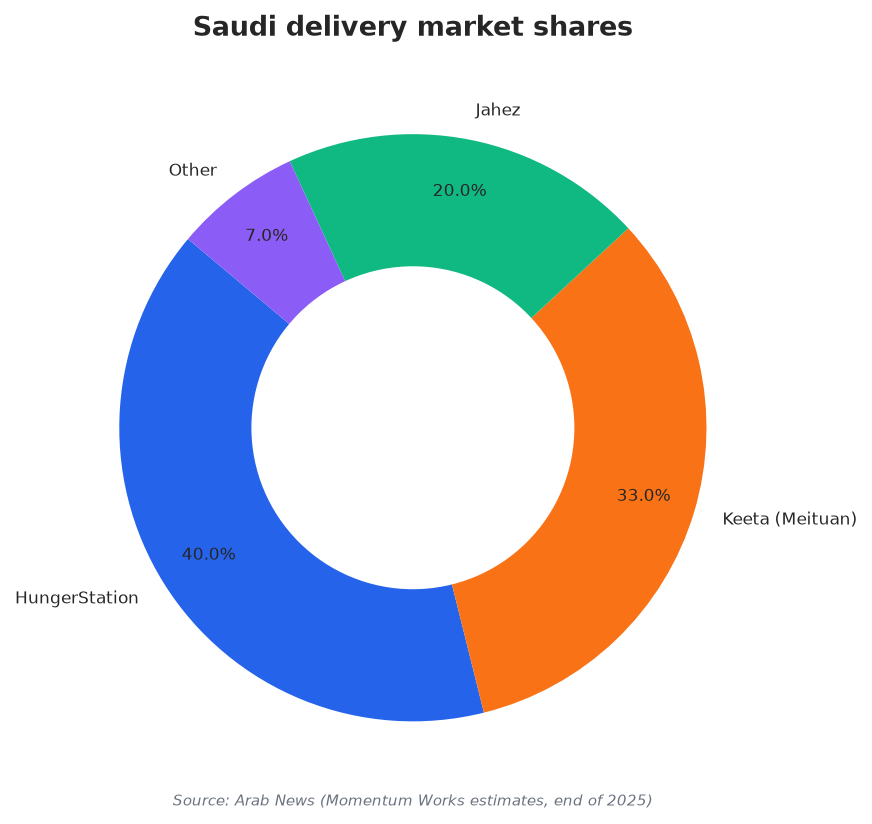
Competition is the core issue regulators will weigh. Momentum Works estimates cited by Arab News put HungerStation’s share at about 40% by the end of 2025, compared with about 33% for Meituan’s Keeta and more than 20% for Saudi-listed Jahez. Those figures frame why any ownership change draws attention, especially in digital markets. In parallel, Global Competition Review coverage cited by PYMNTS described Saudi merger control as seeing record filing activity and tighter notification thresholds, alongside increased attention to digital markets. For shoppers and restaurants, that scrutiny matters because it can affect platform choice, fees, and how quickly new service models appear.
Why HungerStation’s Subscription Mix Matters
Delivery Hero has pointed to Saudi Arabia as an important market for customer engagement, and it has backed that up with a key metric. Company figures previously reported and cited by PYMNTS said about 61% of the value of orders in Saudi Arabia came from customers enrolled in subscription or loyalty programs. Arab News also reported the same 61% share and described it as the highest ratio across Delivery Hero’s markets. In practical terms, a high subscription mix can increase repeat ordering and predictability. For the Uber Delivery Hero Saudi storyline, it also signals why HungerStation is strategic: it is not only scale, but also a loyalty-heavy customer base.
Multiple reports described the acquisition structure as shaped by antitrust realities in overlapping markets. Arab News reported that US investment firm SSW Partners will acquire Delivery Hero’s operations in 14 markets where Uber and Delivery Hero compete, for €1.4 billion. Yamamah Insights also said the deal price was €41.5 per share and described a divestment plan involving 14 overlapping markets for €1.4 billion. Reuters, as cited by PYMNTS, framed the intent as combining two major global delivery networks and creating the largest food-delivery group outside China. The Middle East Observer added that Talabat and HungerStation are among the strategic assets Uber intends to retain, while divestments are used to facilitate approval.
In the kingdom and the wider GCC, analysts and executives are already framing what could change. Arab News quoted a Syrve MENA project owner saying the combination of Uber’s existing ride-hailing footprint with HungerStation’s delivery network could make Uber the biggest player, with potential to expand into a broader super-app ecosystem. Separately, HungerStation’s CEO wrote on X that Delivery Hero joining Uber represents “the biggest growth opportunity for the sector,” pointing to a combined platform spanning ride-hailing, delivery, quick-commerce, and innovation. For regional context, Arab News reported that total order value across the Middle East and North Africa rose 16.1% year on year, driven by strong growth at HungerStation and Talabat.
What is Saudi Arabia’s regulator doing about Uber’s Delivery Hero deal?
How big is HungerStation’s share of Saudi food delivery?
Why is the Uber Delivery Hero Saudi story so tied to subscriptions?
What divestments are linked to the deal structure?
Talk to us for your needs in:
-
Due Diligence and Valuation Services
-
M&A Strategy and Advisory
-
Post-Merger Integration Management
-
Regulatory and Compliance Advisory
-
Market Entry and Expansion Consulting
-
Investment and Financial Analysis
-
In-Depth Market Survey for M&A
-
Market Intelligence and Insights in M&A
-
Feasibility Study and Assessment in M&A
-
Saudi M&A Benchmarking