Electronic Arts agreed to be acquired by a consortium led by Saudi Arabia’s Public Investment Fund (PIF), alongside Silver Lake and Affinity Partners, in an all-cash take-private valued at US$55 billion. The agreement was announced on September 29, 2025, with a $210-per-share cash offer that represented a 25% premium to EA’s unaffected close of $168.32 on September 25, 2025. Shareholders approved the deal on December 22, and it ultimately completed following regulatory approvals on August 4, 2026. Multiple sources describe it as the largest leveraged buyout in history, and one source frames it as the largest all-cash sponsor take-private in private equity history.
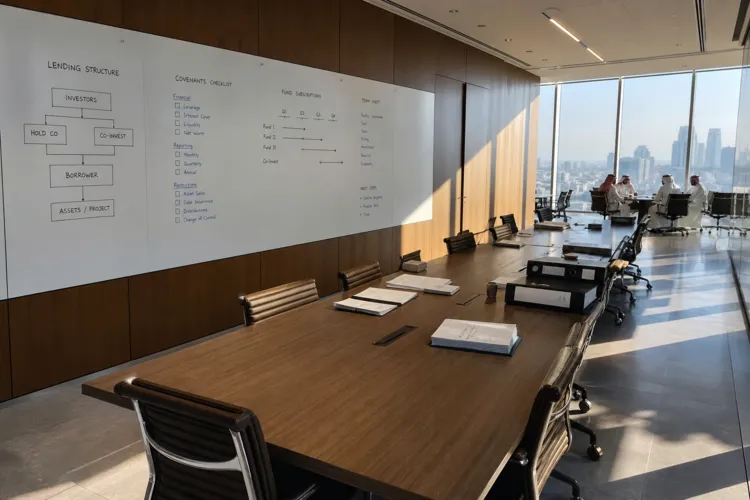
The financing plan is central to understanding why this deal stands out. Sources describe an enterprise value breakdown of roughly $36 billion of equity and $20 billion of debt, with JPMorgan Chase Bank committing the full $20 billion financing package and about $18 billion expected to fund at close. CreditSights analysis cited in reporting put leverage at approximately 6x gross earnings at close. Another source also characterizes the transaction as surpassing the $45 billion TXU Energy acquisition from 2007, highlighting how a single transaction can reset expectations for how large an LBO can be in nominal dollars when lenders and sponsors align.
Who Put Up the Money, and Why the Equity Split Matters
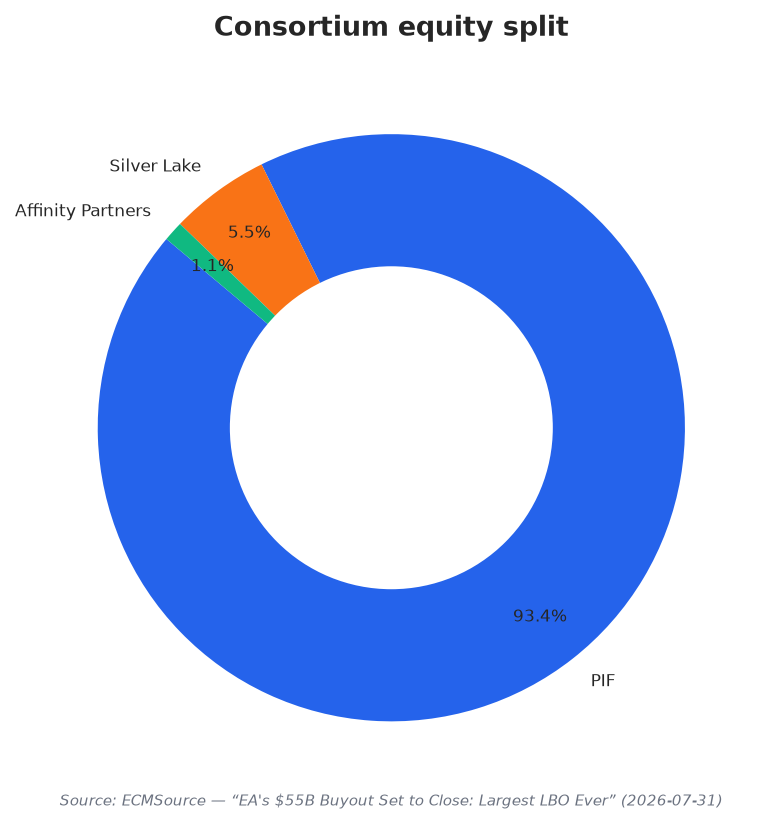
The ownership math is unusually concentrated. One report says PIF controls approximately 93.7% of the consortium, while another breaks the equity contribution out as about 93.4% for PIF, roughly 5.5% for Silver Lake, and about 1.1% for Affinity Partners, as reported in a Brazilian antitrust filing and reflected in post-close ownership. PIF also rolled its existing stake—described as 9.9% in one source and 10% in another—into the new private structure instead of cashing out. The acquiring entity was structured through Oak-Eagle AcquireCo, Inc., with Oak-Eagle MergerCo, Inc. as the merger subsidiary.
For operating strategy, the consortium emphasized continuity rather than a dramatic leadership reset. Sources say EA CEO Andrew Wilson remains in the role after closing. On fundamentals, one source reports EA’s FY2025 net revenue at $7.5 billion, and another estimates the company’s revenue mix at about 70% from live services, about 20% from full game sales, with the remainder from mobile and licensing. The Wikipedia source connects the acquisition to PIF’s strategy of diversifying Saudi Arabia’s economy away from oil by expanding investments in global entertainment and video games, and notes that PIF gained ownership of franchises including FIFA/EA Sports FC, Battlefield, The Sims, Madden NFL, and Need for Speed.
Regulatory and deal-risk guardrails were explicit in the documentation described by the sources. One outlet notes scrutiny tied to the Committee on Foreign Investment in the United States (CFIUS), while another reports the European Commission signed off in late July ahead of the early-August completion. The agreement also included reciprocal $1 billion break fees: a $1 billion termination fee for EA (such as in the event of a superior offer) and a $1 billion reverse break fee tied to regulatory failure or long delay, described as a backstop that became moot once the deal closed. Taken together, these terms explain the anatomy of the PIF Electronic Arts buyout without relying on speculation beyond what was filed and reported.
What price did shareholders get in the EA take-private deal?
How was the buyout financed?
Who owns Electronic Arts after the deal closed?
When did the PIF-led Electronic Arts buyout close?
What makes the PIF Electronic Arts buyout historically significant?
Talk to us for your needs in:
-
Due Diligence and Valuation Services
-
M&A Strategy and Advisory
-
Post-Merger Integration Management
-
Regulatory and Compliance Advisory
-
Market Entry and Expansion Consulting
-
Investment and Financial Analysis
-
In-Depth Market Survey for M&A
-
Market Intelligence and Insights in M&A
-
Feasibility Study and Assessment in M&A
-
Saudi M&A Benchmarking