
As solar matured into a mainstream transaction category, the next renewables deal wave is increasingly framed around wind assets that can deliver bankable, near-term generation. In the United States, Deloitte describes 2025 as challenging for renewables after a new tax law, the One Big Beautiful Bill Act, rolled back many clean energy tax credits and imposed new restrictions that pressured early-stage wind and solar pipelines. In the first half of 2025, wind and solar investments fell 18% to nearly US$35 billion versus the same period in 2024, before the act was enacted. That type of policy volatility and pipeline pressure is the kind of backdrop that can tilt markets toward acquisitions of operating or near-operating projects, rather than greenfield risk.
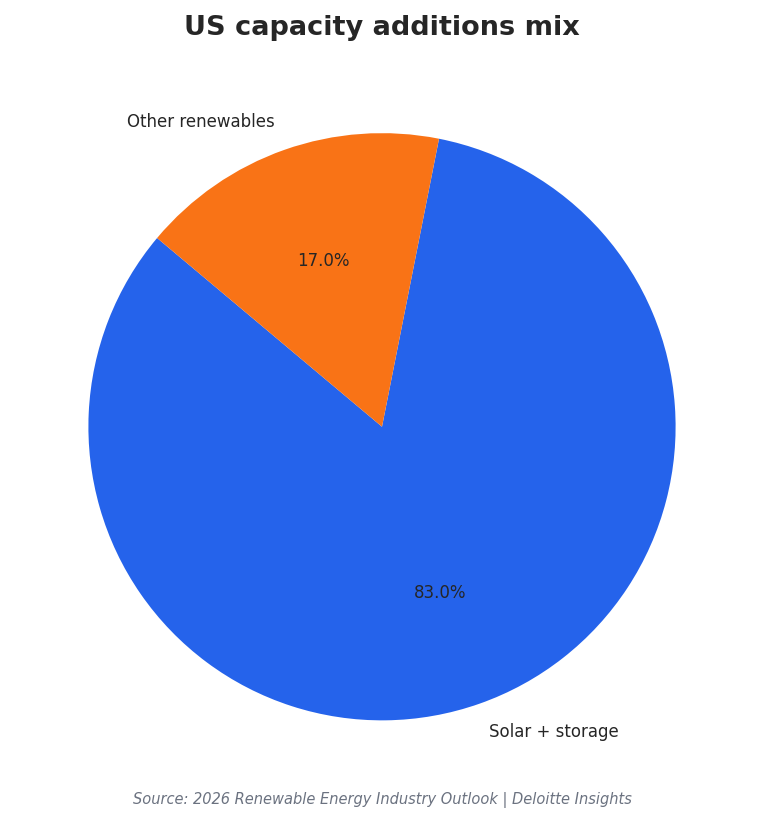
Even with those headwinds, US renewables continued to dominate capacity growth, accounting for 93% of additions (30.2 GW) through September 2025, with solar and storage making up 83%. That mix matters for “after solar” deal narratives: when one technology captures the bulk of near-term additions, investors often look for the next segment where valuations and time-to-market dynamics can be attractive. S&P Global notes that while global renewable M&A volumes declined in 2025, transaction values in early 2026 had already surpassed full-year 2025 levels, driven by large US-centric transactions such as the proposed acquisition of The AES Corp. The same report highlights how improving sentiment, rising power demand, and faster time-to-market compared with conventional generation supported higher valuations for wind and solar assets.
What US Valuation Signals Suggest for Wind Acquisitions
One of the strongest signals in the sources is where capital has concentrated. S&P Global reports that North America accounted for nearly 70% of transaction value since the start of 2025, driven primarily by acquisitions of US gas generation and large-scale renewable platforms. That concentration sharpened the focus on asset-level valuation, with buyers targeting operating assets with predictable cash flows, exposure to rising power demand, and strategic positioning in constrained power markets. For Saudi Arabia-focused deal teams watching Saudi wind energy M&A, the practical takeaway is not that the same numbers apply locally, but that the same buyer logic can travel: shorter timelines, clearer cash-flow profiles, and location-specific risk mapping become central when pipelines are under pressure.
Deloitte’s outlook also points to why “next wave” conversations are accelerating. It expects deployment could surge in 2026 as developers shift to safe-harbor projects, while new foreign entity of concern (FEOC) sourcing rules take effect, adding supply chain pressure through ownership, control, or jurisdiction links to covered nations (China, Russia, Iran, and North Korea). With only 35% of the pipeline under construction, Deloitte expects renewable starts to accelerate despite pressures from FEOC and tariffs. Deloitte analysis also projects that annual solar, wind, and storage additions between 2026 and 2030 could fall to a range of 30 GW to 66 GW, down from 54 GW to 85 GW under pre-OBBBA trajectories. In periods like that, acquisitions can become an execution strategy—buying what is already built, contracted, or de-risked.
Zooming out, broader market forecasts reinforce why renewables remain a strategic target set, even as policy and permitting challenges persist. Grand View Research estimates the renewable energy market size was $1,602 billion in 2025 and projects it could reach $4,860.85 billion by 2033, at a CAGR of 14.7% from 2026 to 2033, while noting barriers such as inadequate storage and limited transmission infrastructure in certain regions. Polaris Market Research values the renewable energy market at USD 1,498.05 billion in 2024 and projects USD 5,840.13 billion by 2034 at a CAGR of 14.6%, adding that Asia Pacific led global revenue share in 2024. Those are global context points, not Saudi-specific measures, but they help explain why investors keep returning to platform deals and asset acquisitions when the next cycle rotates from solar-heavy growth toward wind.
Why are wind project acquisitions gaining attention after solar?
What does S&P Global say about renewable M&A momentum in early 2026?
How concentrated has recent deal value been in North America?
What pipeline indicators does Deloitte highlight that can affect deal strategy?
What should teams evaluating Saudi Arabia wind deals learn from Saudi wind energy M&A trends elsewhere?
Talk to us for your needs in:
-
Due Diligence and Valuation Services
-
M&A Strategy and Advisory
-
Post-Merger Integration Management
-
Regulatory and Compliance Advisory
-
Market Entry and Expansion Consulting
-
Investment and Financial Analysis
-
In-Depth Market Survey for M&A
-
Market Intelligence and Insights in M&A
-
Feasibility Study and Assessment in M&A
-
Saudi M&A Benchmarking