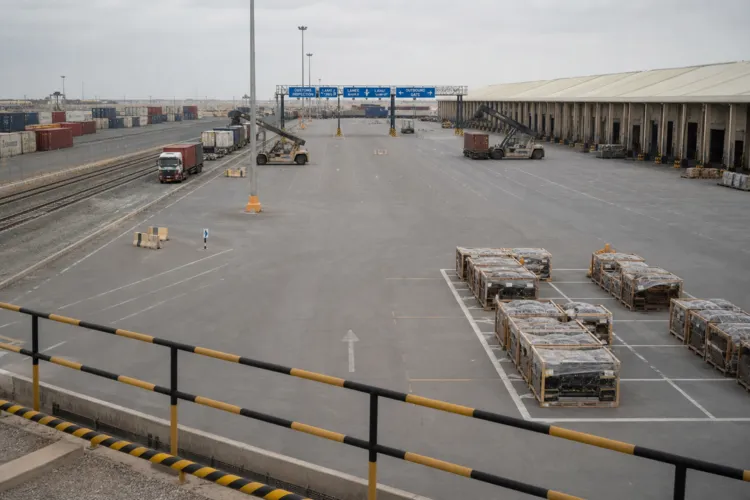
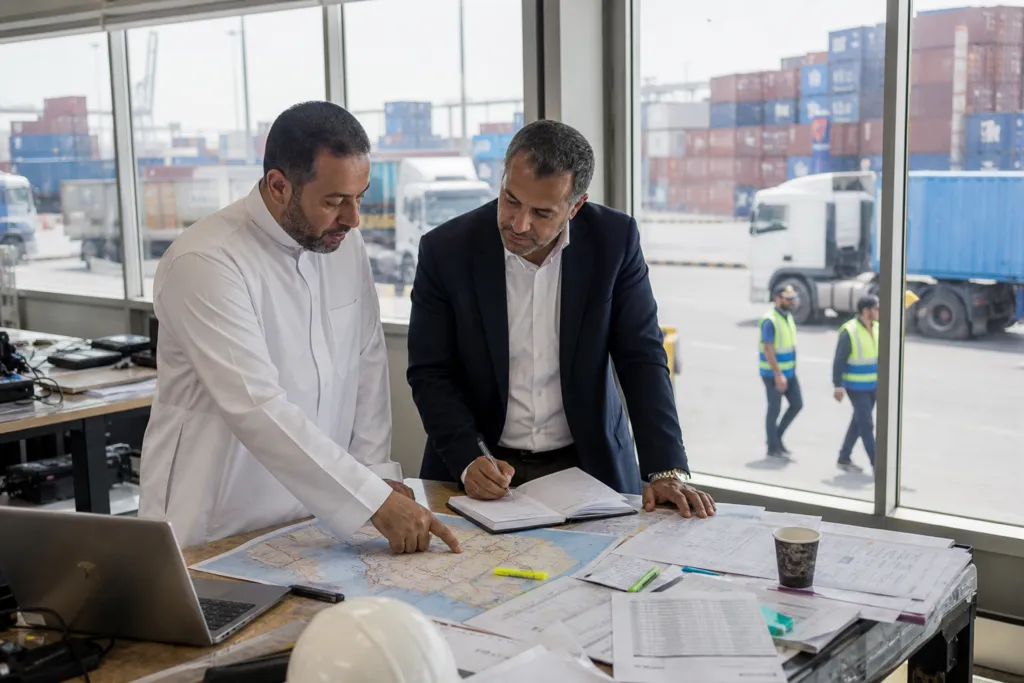
Saudi logistics M&A 2026 is being pulled toward one clear idea. Build corridor capacity. Then consolidate to run it. In July 2025, HE Eng. Saleh bin Nasser Al-Jasser, Minister of Transport and Logistic Services and Chairman of the Saudi Ports Authority, laid the foundation stone for a logistics corridor linking Jeddah Islamic Port to the Al-Khumrah Logistics Park. Mawani framed the move as part of efforts to boost operational efficiency at Jeddah Islamic Port and to leverage the strategic value of Al-Khumrah. The project also includes emergency access points, maintenance facilities, and a complete rainwater drainage system. It is positioned as reducing truck congestion and lowering carbon emissions.
That kind of infrastructure changes deal logic. A corridor that links a major port to a logistics park creates a denser operating footprint. It favors scale in trucking interfaces, yard operations, and intermodal handoffs. It also raises expectations on reliability, which pushes buyers to seek assets that are already integrated into the transport and logistics ecosystem. Mawani linked the corridor to the National Transport and Logistics Strategy (NTLS), aiming to solidify the Kingdom’s standing as a global logistics hub bridging three continents. When a strategy is explicit, it reduces ambiguity for acquirers and sellers. It also increases pressure to professionalize operations, which often aligns with consolidation.
NEOM Procurement Gravity and the Consolidation Flywheel
NEOM adds procurement gravity to this consolidation story. By October 2025, construction contracts worth $24bn had been awarded for Saudi Arabia’s NEOM project and sub-projects, according to Knight Frank. The same source cited that projects worth more than $237bn have been announced across real estate, infrastructure and transportation sectors since 2016, with $44bn already awarded in construction contracts. Even when these figures are not logistics-only, they shape logistics demand indirectly. Large awarded programs increase the need for coordinated movement of materials and equipment. That demand can encourage operators to merge to secure larger, more bankable scopes and to support corridor-style execution.
Deal momentum is also part of the backdrop. Arab News reported an increase in mergers and acquisitions transactions, up 17.4 percent year on year. The same commentary described a market phase of consolidation and liquidity as critical for long-term investor confidence, while also noting concerns about government-driven funding inflating valuations. For Saudi logistics M&A 2026, this tension matters. Buyers may pursue scale to win corridor-linked volume, while also being cautious on price. Sellers may emphasize assets tied to strategic nodes, such as ports, logistics parks, and rail-linked routes, because those nodes can be easier to underwrite than isolated fleets or standalone warehouses.
Digital rail initiatives further strengthen the multimodal case. In November 2025, Ericsson signed a Memorandum of Understanding with the Saudi Railway Company (SAR) to introduce 5G and Future Railway Mobile Communication System (FRMCS) technologies across the Kingdom’s rail network. The scope included 5G-based infrastructure, applications such as real-time video, train control, and IoT connectivity, plus an innovation centre and workforce training. The initiative was aligned with Vision 2030 and the NTLS to modernise and digitise transport. When rail becomes more connected and monitorable, multimodal integration improves. That can make consolidation more attractive for operators that want control across nodes, data, and service levels.
Industry convening shows how central ports and corridors have become in the narrative. Seatrade described Saudi Arabia’s strategic location at the crossroads of three continents and highlighted ports including King Abdullah Port and Jeddah Islamic Port. The Saudi Maritime & Logistics Congress 2025 in Dammam followed a 2024 edition that saw more than 10,000 visitors at Dhahran Expo. Events like this do not create M&A on their own, but they concentrate counterparties and themes. Combined with the Jeddah-to-Al-Khumrah corridor and NEOM’s awarded pipeline, they reinforce a consolidation thesis: own more of the chain, win larger programs, and operate through strategic corridors.
What does “Saudi logistics M&A 2026” mean in this context?
Which logistics corridor project was announced in 2025?
What NEOM figures are relevant to consolidation pressure?
What does the reported 17.4% M&A increase indicate?
How does rail digitisation relate to multimodal consolidation?
Talk to us for your needs in:
-
Due Diligence and Valuation Services
-
M&A Strategy and Advisory
-
Post-Merger Integration Management
-
Regulatory and Compliance Advisory
-
Market Entry and Expansion Consulting
-
Investment and Financial Analysis
-
In-Depth Market Survey for M&A
-
Market Intelligence and Insights in M&A
-
Feasibility Study and Assessment in M&A
-
Saudi M&A Benchmarking